To go to therapy with "the secret illusion and hope of improving" and feel ripped off
Humorist and screenwriter Maria Rovira, known by the pseudonym Oye Sherman, publishes the book of memories and thoughts 'Garlanda'
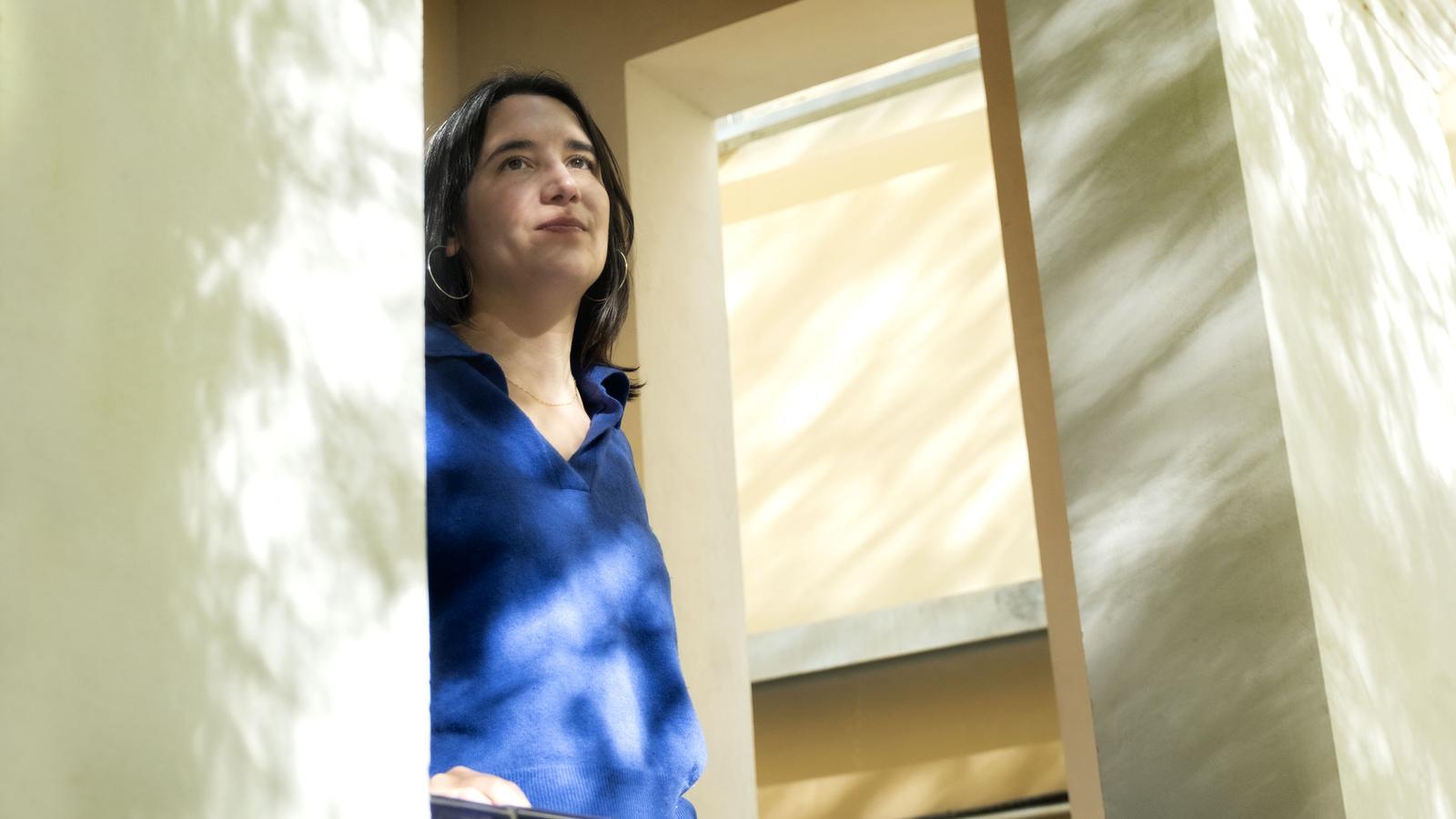

-
CAT -
CAST
- Maria RoviraBlackie Books176 pages / 19.90 euros
The book we are reviewing here was to be titled There has to be a better way to do this, that the author, comedian Maria Rovira (Barcelona, 1990), he says it's a mantra that accompanies him. But that title fell in favor of Garland, which according to the dictionary of the Institute of Catalan Studies is a chain of flowers, of braided foliage, that is hung as an ornament; and whoever says flowers, says banners or whatever. It is based on this idea of a string of memories and thoughts that we must read this book, which bears the subtitle "Words, losses and other celebrations".
In her work as a monologist and collaborator on humor programs under the artistic name of Oye Sherman, Rovira has a serious demeanor and doesn't engage in permanent hilarity, but rather doses out jokes and witty remarks. We don't find here, therefore, laughter on every page, but rather a humorous substratum that springs forth in small brushstrokes and is aided by the blessed footnotes, where we find complementary information of the style: “How Japanese the word sounds notary, right?” or “What a crybaby”.
Master this braid of autobiographical content, that is, the account of your existence viewed with the corresponding humorous distance: "I went to therapy with the secret illusion and hope of improving, of becoming someone else, someone who deserved the love and consideration of others and oneself, the egg and the hen. And when you go, they tell you: 'No, no, you have to love yourself as you are: as you are'. What a scam. Give me my money back".
Thus, we know that as a child she did not learn to do a handstand or to tell the time correctly. We witness family scenes, we accompany her to the beautician and to the class ofaqua aerobics, with the imagination within Marina Sáez's graphic novel. We share with her the death of our father and the concerns typical of our thirties, which she portrays halfway between Dante's famous phrase –in the middle of the journey– and another from a movie aboutAgnès Varda, on a character says: “We have already shat half of our shit”. Garland serves to connect better with a generation that is perhaps a bit stigmatized, but which is still our hope for the future.
Love the words
As a child, the author wanted to be a writer and, as a good millennial, she was made to read a story in primary school that wouldn't need to be read and that she quotes here. Although Private Life by Sagarra also appears, the excellent memoirs of Patti Smith, the Fierce Attachments by Vivian Gornick, and even J.D. Salinger. Those stories read when she was a child, although dispensable, instilled in her the desire to tell stories and the love for words, which is one of her characteristic traits.
Her linguistic interests are often present in the text, appearing recurrently throughout and forming her personal signature. We find, among others, synonyms for nyanyo or the etymology of the word alopecia. At the end, an appendix offers us the words she likes and others that catch her attention, either because they seem incorrect but are not, or because they could exist but do not. I loved the chapter on "intrusive thoughts" and I can highlight some brilliant sentences that made me laugh heartily: "Whether your life seems better or worse to you can depend exclusively on a few endorphins you've managed to get from swimming"; "A wounded male ego is one of the most flammable materials that exist"; "I like babies crying on the bus in the morning, because then there's someone who isn't pretending to be okay".
