The Greta association (Group for the Recovery and Study of Architectural Tradition) was founded in 2011 in Girona with a clear mission: to reclaim anonymous architecture. The kind that doesn't fill books of great monuments but has shaped the DNA of our towns and landscapes. The entity brings together professionals from architecture, history, and geology who work to protect heritage through urban planning and technical research.The entity, led by architect Olga Muñoz and geologist Marta Puiguriguer, has launched a series of talks, walks, and routes to present the book. The next event will be this Saturday, June 6, at 10 am, with a guided tour of Mas Marés in Roses, including a wine tasting. On July 17, at 7 pm, it will be presented at the Anchovy and Salt Museum in L'Escala. And on August 29, at 6:30 pm, in La Selva de Mar, a route through farmhouses in the valley will take place. The series will conclude in Cadaqués on October 3 and 4 with a presentation and sound art session at Sala Maifrèn, and the following day with a route starting at 9:30 am to discover the ruins of Mas Rabassers de Dalt. Registrations are limited.
This is how life was in Cap de Creus: the farmhouses that knew how to coexist with the tramuntana
A book documents how humans transformed the landscape before tourism and proposes learning from their capacity for resilience and adaptation

-
CAT -
CAST
GironaAmidst the tourist monoculture of Cadaqués, Teresa Madrid and Pau López row against the current, with their sights set on the resilience of the ancestors who inhabited Cap de Creus. Almost a decade ago, they began managing different olive groves to make oil and to manage a flock of guirra sheep, from the area, to preserve soil fertility and clear the dry stone walls that they work manually. From Mas de la Senyora, they reclaim two of the fundamental pillars of Cadaqués' historical identity: agriculture and livestock farming. But also understood as a way of caring for the soil, building landscape, and creating community and culture beyond tourism and environmental protection.
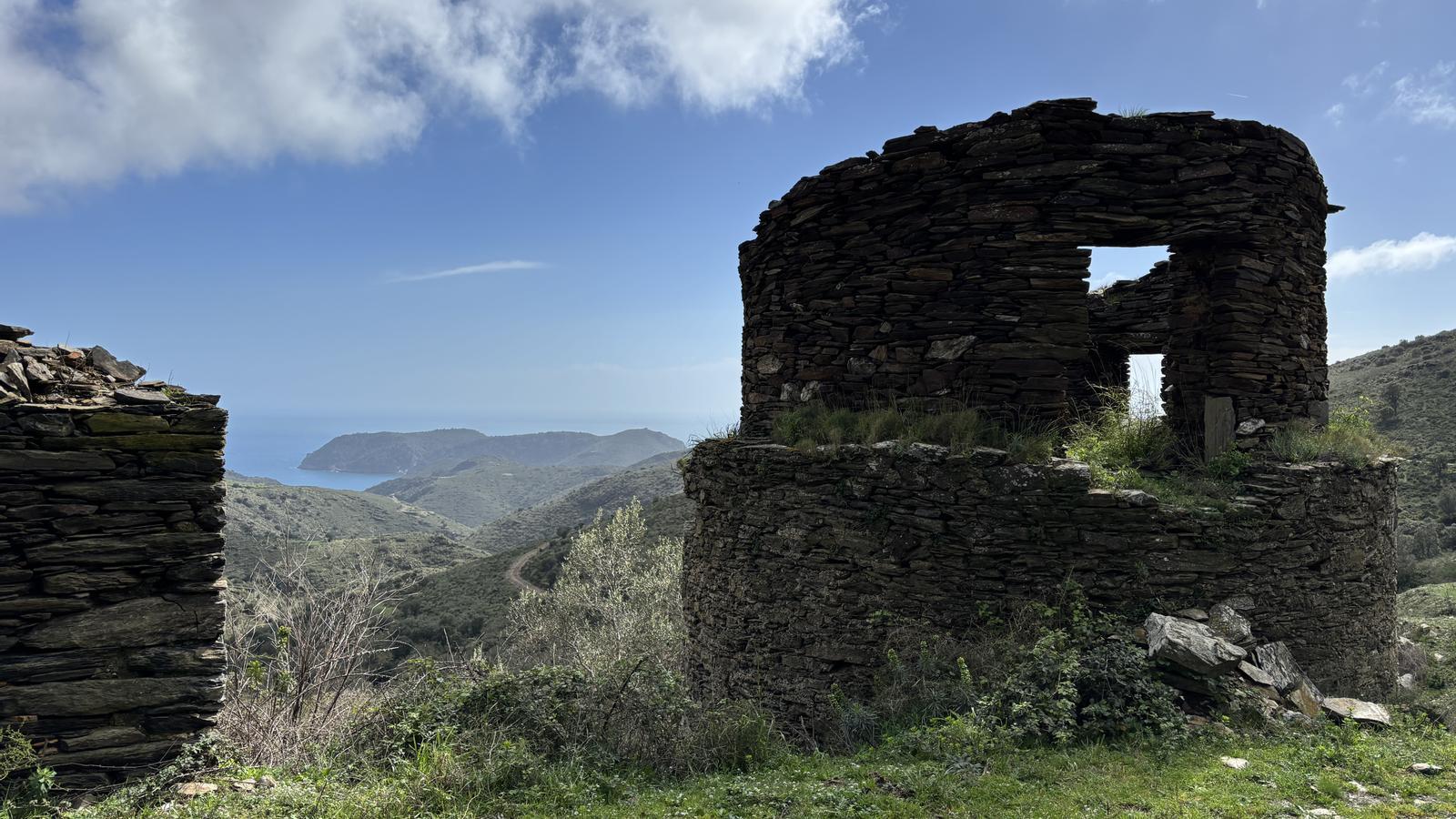
Cap de Creus. Learning from traditional architectureCap de Creus. Learning from Traditional Architecture, published by the Greta association, which sees the light after four years of intensive fieldwork to document about forty farmhouse ruins before they disappear due to both degradation and oblivion.

Walking through the Cap de Creus Natural Park, we have come to believe that it is a territory where nature expresses itself without filters. But it is the opposite. "Often, when we talk about traditional architecture, we say it is the built landscape; in the case of Cap de Creus, this definition is literal, even the mountains are built," the authors, architect Olga Muñoz and geologist Marta Puiguriguer, state in the book. The extensive fieldwork reveals a way of building completely adapted to a very hostile environment, where the farmhouses became a unique case of resilience and adaptation that, for the authors, can serve as an example for future challenges in the management of the natural park beyond tourism and environmentalist purposes.
Radical adaptation to the environment
In Cap de Creus, farmhouses were built in a very different way from the rest of Empordà. Without any luxury, they represented a unique exercise in radical adaptation to a harsh environment where there was almost no land to cultivate. This makes traditional architecture complex and at the same time rich, because the basic materials for construction were also very limited. Both the lime to make the mortars that joined the stone and the clay to make bricks were scarce resources, and ingenuity had to be used to optimize them. In the few kilns preserved, pieces of different bricks were used to build them, while the few limestone veins in the massif are exploited.
Regarding the way the farmhouse was built, it should be taken into account that it was primarily designed to house livestock, which in many cases was the means of subsistence. Only a third of the built surface was for the family, who usually lived on a first floor of about 100 square meters, accessed by an external staircase, very different from the typical Catalan farmhouse – there were also no attics, which meant they had almost nothing to store–. Below, there was part of the animals. To shelter from the tramuntana, the farmhouses do not offer a north-facing facade, but an edge: a rotation of the floor plan allows to "cut" the wind and divert its pressure. To further ensure that the most valuable livestock were protected, the floor was semi-buried on the north side, and either there were no openings, or at most a small triangular one was made.

It is in these lower rooms below the farmhouse that we find one of the most "interesting elements" architecturally. It consists of vaults and arches that in some way make us think of ancient Romanesque hermitages. "The same construction system of two or three arches is repeated in fifteen different places and it does not seem to be self-construction," explains Muñoz. On the family floor, the roof was made with short wooden beams, a maximum of four meters long with cane instead of laths, which indicates that there was also little access to wood. The rest of the farmhouse was made entirely of stone to shelter the livestock, with different corrals and another difference compared to Empordà farmhouses: there are almost no haylofts. For the authors, it is a sign of the little cultivable land available for grain and that the flocks were of sheep and goats and there were almost no cows.
An exceptional hydraulic infrastructure
But the most titanic work of the massif is not found in the walls of the farmhouses, but in the kilometers of stone walls. It is estimated that in Cap de Creus there are between 7,000 and 27,000 linear kilometers of dry stone walls. Longer than the Great Wall of China and, in the most optimistic version, half the diameter of the Earth. They are not only the crossbeams of the terraces, but also an exceptional hydraulic infrastructure, a device to retain the little fertile land and control and maintain the water. "We find very few wells because the water in Cap de Creus is at a great depth," explains Puiguriguer. So most of the farmhouses were located in areas that, when it rained, could capture water. But at the same time, torrential rain could pose a big problem for the crops. To deal with this, "a hidden, also buried infrastructure" was created, of which, says Muñoz, we only know "the tip of the iceberg" and which was built from "collective work".
The authors of the book point out that their intention is not to take a snapshot of the past or an invitation to nostalgia, but to take the diagnosis as a reference for the management of the Natural Park administration, taking into account cultural heritage. During the beginning of the presentation cycle, the public was surprised to discover an "unprecedented" Cap de Creus far from mass tourism and that is gradually fading away. For Roger Biosca, president of the Greta Association, it was "urgent" to document and analyze the farmhouses to "raise general public awareness and with the hope of being able to influence the saving or recovery of some of them". In this regard, Martí Ferrer, coordinator of the entity, explains that the book summarizes Greta's will very well: "Through the study and dissemination of past knowledge, to recover architectural tradition as a tool for the rehabilitation and construction of the present".
The answer to this challenge is already provided by examples of living resilience such as Mas de la Senyora, in Cadaqués, or Mas Marés, in Roses, where the winemaker Anna Espelt advocates for mosaic management. This model – pastures, vineyards, and olive trees – has proven capable of stopping large forest fires. "In a world where firefighters, naturalists, and farmers have often had little rapport, it is essential to identify and listen to people capable of looking with curiosity, on an equal footing and without dogmas, because together we have already seen that we are capable of doing a lot with little budget. Separated, on the other hand, the territory is managed without those who work it," concludes Espelt in the book's epilogue.
