David B.: "There are too many people who think their life is exciting and that it's good enough for a book"
Illustrator, publishes 'Mr. Owl and the Land of the Dead'
-
CAT -
CAST
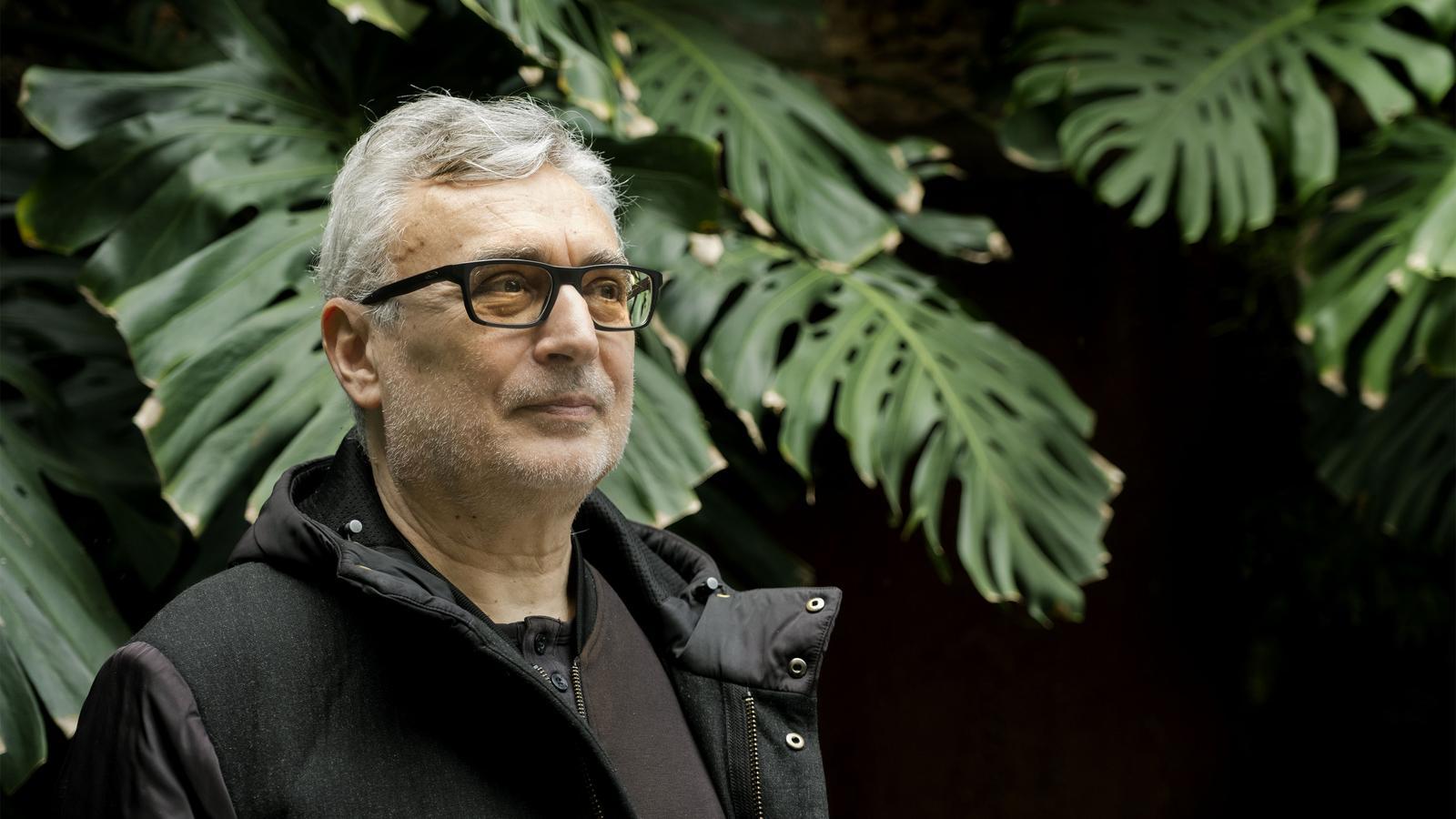
BarcelonaL'ascension du haut mal (1996-2003; Epileptic in the Spanish edition), one of the greatest non-fiction comics in history, turned the Frenchman Pierre-François Beauchard (Nimes, 1959), known as David B., into one of the essential names of the Nouvelle BD, the movement that completely revamped French comics during the 90s. But he is not the author of a single work but a creator with a boundless imagination, almost overwhelming, as he once again demonstrates in El señor Búho y el País de los Muertos (Salamandra), the exuberant poem about life and death that he has drawn in panels of prodigious black and white.
In the introduction, he mentions a poem by René Daumal, Il suffit d'un mot
. I have read it and it is very curious how the verses resonate with El señor Búho, almost as if he had adapted it.
— When I made the first version of this story, a short story of a few pages, what I did was a graphic transposition without adding almost anything. But I liked how it turned out and I developed the part about the hereafter. I have introduced René Daumal's images in the middle of my story, and I also follow Daumal's poem construction and his approach to the figure of death.
He started working on Mr. Owl in the early 90s and finished the comic in 2025. What made him take so long?
— Life. There is a mix of personal and professional things. I have often had to work for other publishers to make a living. And when I did the original short story, my partner at the time told me: "Listen, if you're talking about me! I'm the protagonist." Consciously, but unconsciously, I was doing it. So I continued with the story, but now aware that she was the character. Meanwhile, she was diagnosed with cancer, was ill for a few years, and died. And after her death, I picked up the story again, determined to finish it. In reality, working on it for so long allowed me to reflect on the story and find the most suitable construction. I never write everything at once. First I have a general idea, I know how it will end, but the events come along during the process.

The relationship I had with death when the book began must not be the same as I have now, over 60 years old.
— Yes, Marine dying so young made me aware of the impermanence of life. It wasn't like the death of my grandparents. Marine was my first death of someone my own generation, and I felt it was profoundly unfair. Someone so young, so full of life, who had never had health problems... But my brother, who suffered from epilepsy from a young age, also influences this topic. It affected my sister and me a lot, as we saw him suffer crises every day: he would collapse dead and then come back to life. Seeing him die and come back to life three times a day was also an approach to death. And it was all a mystery, because he couldn't explain what happened to him during the crises, he didn't remember anything. We were children and we imagined he was traveling to another dimension, as if it were a science fiction movie. And I think all of this comes through in my comic.
When speaking about the history of autobiographical comics, everyone mentions you, precisely thanks to Epiléptico, the comic you dedicated to your brother. But in reality, most of your works have a more fabulatory dimension and move in the realm of fantasy and dreams.
— Yes, it's curious. My life also started to shift towards the fantastic when my parents began to resort to alternative medicines and what is now called new age, because traditional medicine wasn't working. They turned to magicians, sorcerers, and people who acted as if they had powers, so our daily life was steeped in fantasy. This was my normality; for me, there is no difference between magic and reality. And this has been reflected in my work. Just as my parents became interested in esotericism, I have literarily navigated through these worlds.

So his creative world is intimately linked to the tragedies that have marked his life.
— Yes, but it's like in the comic El señor Búho: reality and fiction are two lines that converge. Both characters are real: Marine, who was my companion, and Mr. Mussol, who is partly me. And although it takes place in a fantastic world, there is also a real basis: the protagonist of the comic works in the world of the dead in a comic book store, just like Marine, and listens to the same music as her, Ella Fitzgerald. These are details I've included so that people who knew her can identify them.
Is he identified with Mr. Owl? Therefore, does he feel like a guide accompanying the reader towards the world of dreams and death?
— Yes, a little. That's what Marine used to tell me. "You give me calm and security." She was very afraid of life, and I think I helped her to be less afraid when we were together. And that's what I've tried to reflect in this story.

When he made Epiléptico, autobiographical comics were a rarity and it was difficult to find publishers to edit it.
— Yes, and that's why we created a publishing house, L’Association, to publish things that were different and that you couldn't find from other publishers. Now autobiography is very common in comics, but back then you couldn't find anyone to publish it for you. We read American autobiographical comics that had impacted us a lot and that inspired us to found the publishing house.
What do you think about the current boom in first-person comics? Has it become an editorial trend?
— Now people make a lot of autobiographical comics because it's easy. Writing a work of fiction is not necessarily easy, while your life is material you know. There are too many people who think their lives are exciting and make for a book, but that's not always the case. There are lives that are indeed exciting, that must also be acknowledged. At L’Association we receive many files with autobiographical proposals and we have to filter them, because there are things that... “You get up in the morning, open the fridge to make breakfast, oh dear, there's no butter...”.
It was recently announced that L’Association's financial situation was critical and that the publishing house was in danger of disappearing. How did they get into danger and what is the current situation?
— After the pandemic, two things happened: first, the increase in manufacturing costs due to the price of paper and ink, and second, a crisis of readers. Young people no longer read us. I see it in the audience at my book signings, the vast majority are between 40 and 70 years old. I am now 67, and they are growing old with me. I believe my audience will disappear with me and no one will read my books. Even major publishers admit there is a crisis of readers. Comic book stores have closed and many publishers and authors cannot make a living from their work.
How have they managed this crisis at the publishing house?
— As we could. When the manager retired we didn't replace him, and thus we save a salary. His work has been shared among the other three employees. We also make fewer books, only one per quarter, and we think a lot about what we publish. Before we could publish at a loss, but we can't afford it anymore. We have also changed premises and gone to a smaller one. Mr. Búho has worked well, we've already done a second print run. I am the only one of the founding authors left at L'Association, and I try to make books like this because it's the best I know how to do. At the end of the year I will publish another one and I hope it works well and allows us to make a little money.
A few months ago Art Spiegelman and Chris Ware came to Barcelona and spoke at the CCCB about the impact that the magazine Mad and the work of Robert Crumb had on them as children. Do you have any foundational image that opened your eyes to the possibilities of comics?
— The first autobiographical comics I read were by Robert Crumb, which my mother gave to my brother. He wasn't interested in them, but I was, a lot, and I kept them. But if you ask me which image impressed me the most, it would probably be one from Pif, the children's magazine published in France by the Communist Party. By the way, the character Pif had been created by an Aragonese Republican refugee, José Cabrero Arnal. They were very classic comics for children, but I also discovered a young Italian artist there, Hugo Pratt, who published the first stories of Corto Maltese. I had never seen anything like it, it was an aesthetic shock and it was much more adult. And it arrived at the right moment. I also started reading Charlie Mensuel which was clearly a comic magazine for adults, and I discovered Crepax, Moebius and Tardi, who impressed me a lot, both for the stories and the drawing.
One of the great recent controversies of French comics has been the cancellation of the Angoulême Festival. What position did L’Association take?
— We took a stand in favor of the boycott against the festival. There were some management problems, but above all it was because someone working for a festival sponsor violated a girl. When the girl reported the rape, the festival fired her, and this outraged many people who considered it unacceptable for the director to reapply to direct the festival. The boycott was followed by many independent publishers and authors in general, including those from large publishing houses. Therefore, the large ones had no one to sign at the stands, so they also decided not to go, and this sank the festival. The Angoulême City Council is planning a new direction for next year, and now we are at this point.
Norma published at the end of last year her first collaboration in La Mazmorra, the fantasy saga created by two classics from L'Association, Joann Sfar and Lewis Trondheim. And it's curious, because the story is very connected to the metaphysical universe of El señor Búho. Did Sfar and Trondheim write it thinking that you would draw it?
— Yes, they wrote it for me. They said "David will surely like drawing this skeleton and these kinds of things", and they made a story that fit me perfectly. We've known each other for many years, we worked in the same studio and they know my universe perfectly. I've lost track of Joann a bit, but I see Lewis regularly. In fact, it's thanks to him that I made the book.
