The public humiliation that ignited the fury of Joan Miró
A great exhibition at Les Abattoirs addresses how the attacks of surrealism, the Civil War and Francoism fueled the artistic radicalization of Miró

-
CAT -
CAST
- Les Abattoirs - Museum of modern and contemporary art of Toulouse. From October 3 to March 7, 2027.
André Breton exercised the role of Pope of Surrealism with great forcefulness: he did not tolerate any of the movement's members deviating from the path of aesthetic and political radicalism he had set. And when they did, he would exclude them, or subject them to public mockery, as happened to Joan Miró in 1926 with the sets and costumes for the Russian ballet show Romeo and Juliet, created by both him and Max Ernst. André Breton and Louis Aragon led a group of surrealists who burst into the premiere with whistles and shouts and handed out a pamphlet titled Protest, in which they accused Miró and Ernst of having betrayed the principles of surrealism by making commercial art. "It is not admissible for thought to be at the service of money," the authors stated, for whom that collaboration meant "domesticating dreams for the benefit of the international aristocracy."
While in Paris the intervention of the police was necessary, when the show arrived the following year at the Liceu, the reaction of the public and critics was more positive. But for Miró, the diatribe from Breton and Aragon remained deeply engraved: the following year he began his project of "assassinating painting," and the rage that the fight with Breton and Aragon caused him was present throughout his career, as argued by Carles Guerra and Lauriane Gricourt, director of Les Abattoirs, the Museum of Modern and Contemporary Art of Toulouse, in the great exhibition that can be visited from October 3 to March 7, 2027. "For Miró, it was a blow with which he understood that it is not enough to align yourself with an aesthetic, surrealism; rather, you must always take a step forward," states Carles Guerra. "Miró took it very seriously –he adds–, and the idea of assassinating painting was applied methodically." Likewise, Guerra points out that Miró appropriated those insults, turning them into a creative stimulus: "When you want to understand the reactive character, the, let's say, aggressive character of Miró's response; you think it is something that comes from him in an essentialist way from within and, however, you see that it goes through many episodes in which he has been attacked, since the year 1918, at the Dalmau Gallery, when they tore up his drawings, or the scandal of the premiere of Romeo and Juliet. To understand it, I compare it with what Judith Butler says about the feminism of the 60s and 70s, such as the ability to resignify what was initially an insult."
But in the end, Miró ended up being more radical than Aragon, because the French poet was one of the personalities who publicly asked that the mural he had made on the stained glass windows of the Architects' Association of Catalonia not be destroyed. And, on the other hand, Miró's collaboration with the La Claca company in 1976 on the anti-Franco Mori el Merma, seems more transgressive than the Romeo and Juliet of 50 years earlier. Like the pamphlet by Breton and Aragon, the exhibition is titled Joan Miró.Protest, and has an extraordinary budget thanks to the support of institutions and companies, among which are the Toulouse City Council, Toulouse Métropole, and the French state, through the Prefecture of the Occitanie Region.
Rethinking painting on stage
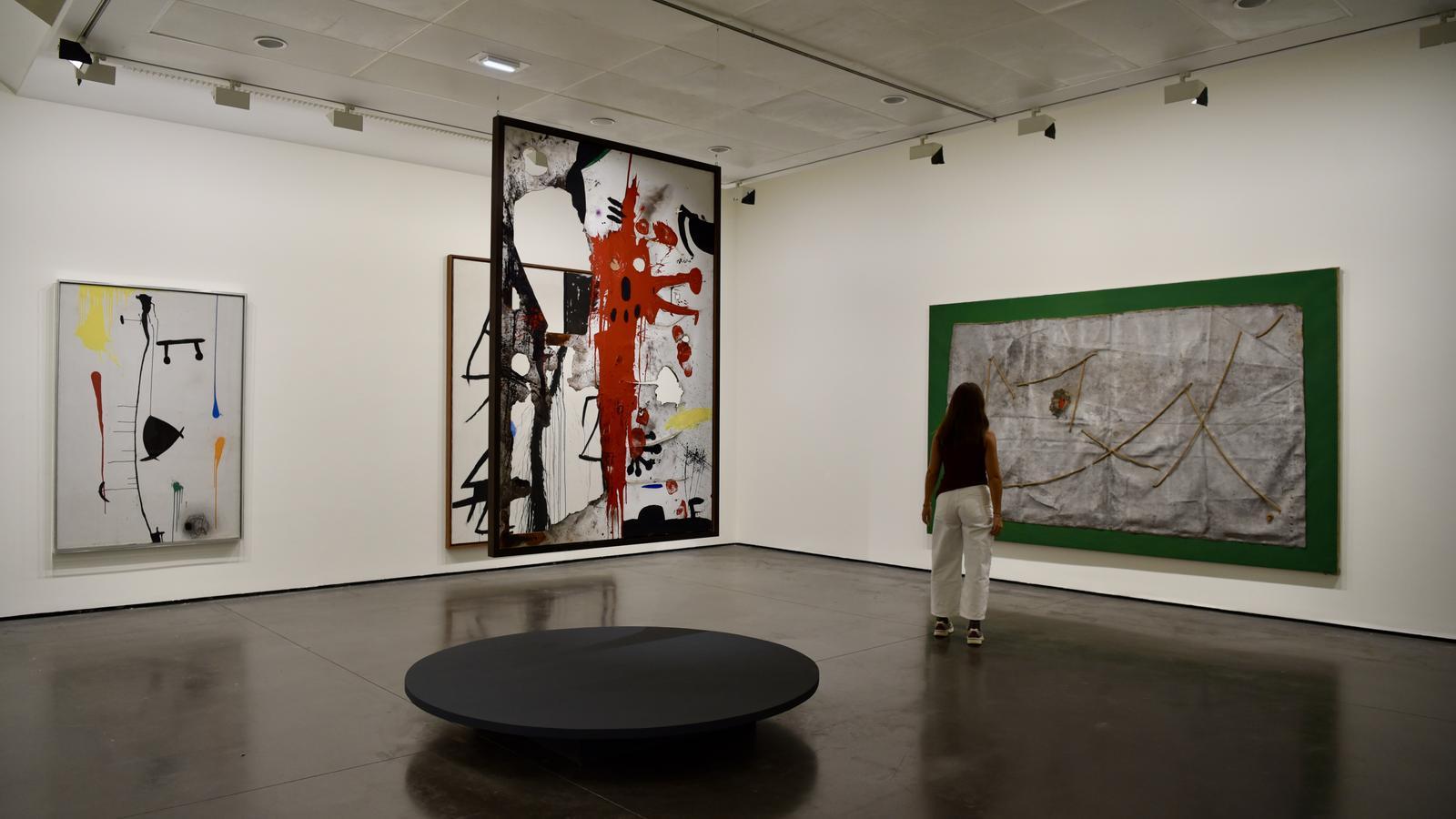
Joan Miró.Protest includes nearly 200 works, among which are about fifty unique academic female nudes, owned by the Reina Sofia Museum; and thirty of the prints from the Barcelona series, evocative of the artist's painful inner exile. The first room is the most heterogeneous: there are documents related to Romeo and Juliet, and those from another collaboration with the Ballets Russes, Jeux d'enfants, in which Miró introduced object-paintings. "The theater space is also a true space to rethink painting," says Guerra. Regarding the paintings, Guerra reviews the different strategies with which Miró begins to transgress the limits of painting, such as painting without previously preparing the canvas, on industrial materials like Masonite; and making object-paintings. From there, the tour is articulated in work blocks, among which are the nudes he made at the La Grande Chaumière Academy in Paris in 1937, which reflect how Miró breaks with naturalism by distorting the proportions of the limbs, and, at the same time, maintains contact with reality. "He had just made the Catalan Peasant in Revolt at the Spanish Republic Pavilion at the 1937 International Exposition, and I interpret this moment as one of a dilemma between continuing with abstraction or reinforcing figuration," explains the curator. "What does the year 1937 represent? It is the year they see the ears of the wolf of fascism –Guerra also says–. That year, Walter Benjamin gave a lecture in Paris in which he spoke of the author as producer, and asked what could be done against fascism, and what was the style with which they could oppose it. Benjamin did not choose either surrealism or Dadaism, but rather said that an author must allow others to also be authors, to have a voice." And, more specifically, Guerra points out that The Reaper and Guernica may have traits of socialist realism, but that both Miró and Picasso saw that that line led to "an academicism that paralyzes freedom.
The journey continues with Miró's anti-Franco sentiment, through the Black and Red Series (1938), made in Paris in the midst of the Civil War, and Barcelona (1939-1944). Precisely, Pere Portabella interspersed images of these engravings with archival footage of the Civil War in the film Aidez l'Espagne (1969), which was released on the occasion of the Miró retrospective organized by the Architects' Association of Catalonia, Miró otro, which was a response to the official retrospective at La Capella, the inauguration of which Miró did not attend so as not to be used politically. "With that film, Portabella points out that Miró was the missing link that connected them to before the Civil War". Curiously, Portabella did not find the Civil War images in the State but rather at the Toulouse cinematheque.
Abstraction does not mean evasion
As he proposed with Tàpies, Guerra points out that Miró's apparently abstract paintings from the 70s are, in reality, history paintings, in the sense that they reflect the overwhelming conditions of Francoism, as would be the case of La danse des coquelicots (1973). "This does not mean that Miró ignores historical reality. The facts do not force painting to subject itself to narrative and figuration, but rather there is an ostensive relationship between them, and it is the spectator who decides whether the work is political". In the final section, Miró's iconoclastic fury comes to light again in one of the famous burnt paintings, the one that is owned by the Joan Miró Foundation. These paintings, as can be seen in a film by Francesc Català-Roca, were made by Miró with the help of Josep Royo, with whom he had begun to work a few years earlier, an essential figure in the Mironian tapestries.
The last two areas of the exhibition are dedicated to Mori el Merma, and other works that are linked to it, because the figure of Ubu appears in the production by La Claca to refer to Franco, and Miró made the illustrations for Ubu Roi (1966), Ubu a les Balears (1971), evocative of the savage construction in Mallorca, and La infància d'Ubu (1975). On the other hand, Guerra recalls another attack that Miró suffered following Mori el Merma: when it could be seen at the Teatre Principal in Palma, someone scribbled out Miró's name on a poster and wrote underneath the word "xuetó", that is, a diminutive of the word "xueta", the historical term used to refer disparagingly to the descendants of converted Jews. Miró was one of the traditional surnames of the xuetes.
