The girl who lost her parents in the Tutsi genocide, and did not want to talk about it
The photograph by Alfredo Jaar, among the outstanding works in 'Unfocused', the new exhibition at CaixaForum
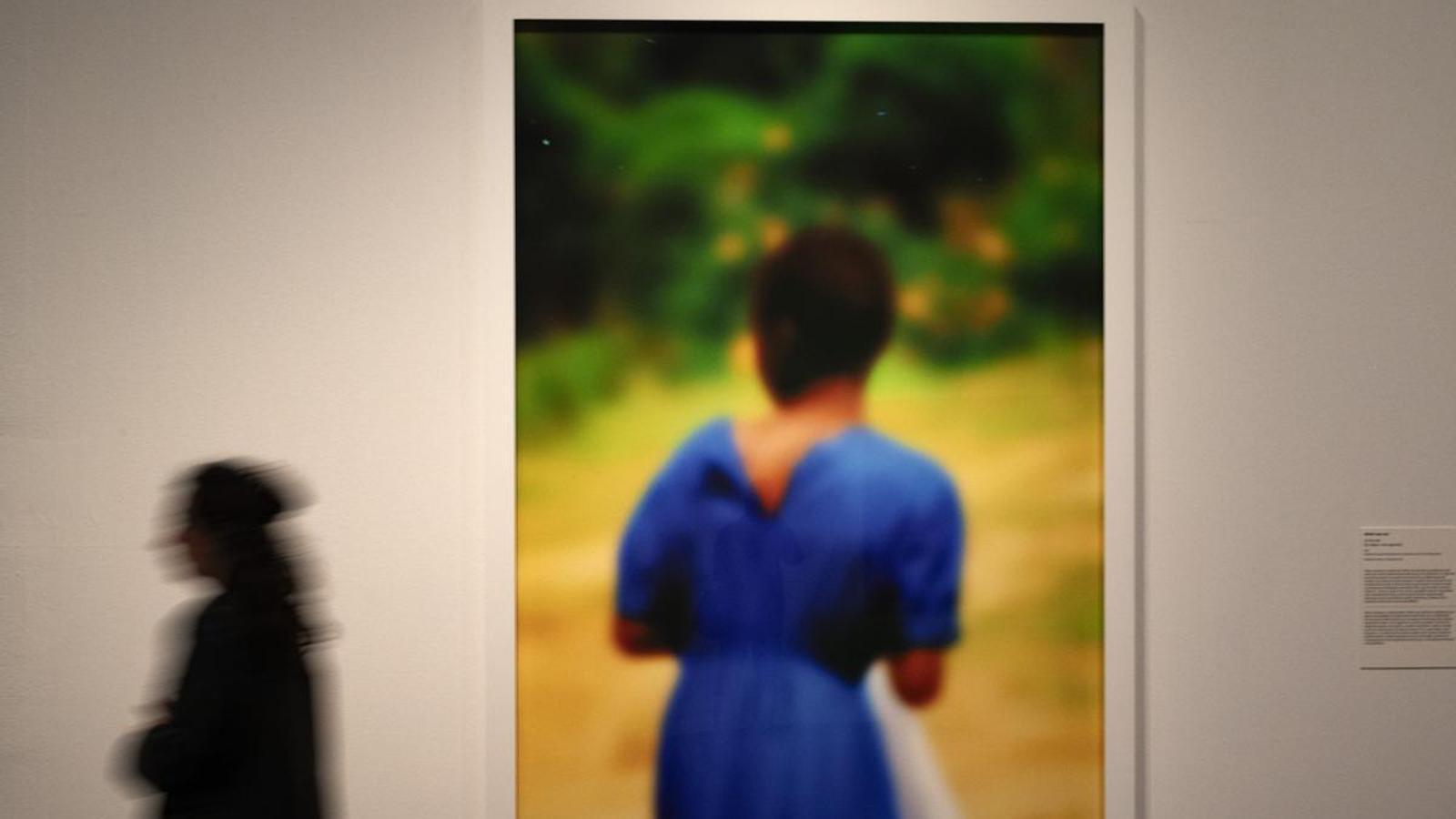

- CaixaForum Barcelona. From May 21 to September 27.
The Rwanda Project occupies a prominent place in the trajectory of the Chilean artist Alfredo Jaar. He took more than 3,500 photographs during the three weeks he spent there in 1994 documenting the genocide suffered by the Tutsis. The objective was to denounce the passivity of the international community in the face of the massacre. But when he returned to New York, he realized that the images were too harsh and too journalistic in nature; so he began to work on different artistic projects to show them. One of these images, titled Six Seconds, can now be seen at the new temporary exhibition at CaixaForum in Barcelona, titled Out of Focus. Another Vision of Art.
Indeed, the woman in Jaar's photograph is out of focus, but it's about turning the situation around and not seeing the indefinite and imprecise as flaws or signs of unfinished work, but as a new creative horizon and an intellectual stimulus. Of Six Seconds, Jaar recalls the following: "This girl witnessed the murder of her father and mother with machetes. I had arranged an appointment for her to tell me her story. But when she arrived, she changed her mind [...]. When she turned and left, I grabbed the camera and shot without focusing at all; that's why she appears blurry." At that point, the image became something else. "It represents my inability to explain this woman's experience, or Rwanda's experience; my impossibility," says Jaar.
"World War II marked a turning point in the use of blurriness as a distancing from a reality that is too harsh," states Emilia Philippot, head of the scientific and collections department at the Rodin Museum in Paris and co-curator of the exhibition with the director of the Musée de l'Orangerie, Claire Bernardi. "We don't want to guide visitors, but rather to make them ask questions in front of each of the works," Bernardi adds.
The exhibition is the result of the alliance between the "la Caixa" Foundation and the Musée de l'Orangerie, and is one of the first dedicated to blur beyond photography: in painting, sculpture, and video. It includes 77 works by 58 artists, among whom are great names such as Claude Monet, Alberto Giacometti, Mark Rothko, Thomas Ruff, Nan Goldin, Christian Boltanski, Hans Haacke, Julia Margaret Cameron, Bill Viola, and Pipilotti Rist. After being shown at the Musée de l'Orangerie itself and at CaixaForum Madrid, in Barcelona the exhibition incorporates an unfinished painting by Turner, The Port of Brest: Quay and Castle, owned by the Tate; the back nude I.G., by Gerhard Richter; and the engraving by Odilon Redon The hazy outline of a human form, in the background of which is a disturbing presence that seems to threaten the protagonist woman.
"The starting idea is that as visitors walk through the rooms, they first have a sensation, even physical, of bewilderment at the works. We want them to focus, to try to understand what they are looking at. We ask them to dedicate time to it, to let themselves be guided first by perception before thought," points out Bernardi. Another of the most well-known works in the exhibition, Jpeg ny01, by Thomas Ruff, is also a reaction to a tragedy: it is a blurred image of the Twin Towers during the 9/11 attacks, with which Ruff wants to question the objectivity of photography and highlight the brain's ability to create images with less information.
From the collective to the intimate
The route begins with the Condensation Cube, by Hans Haacke, which changes depending on the number of people in the room. From here, the curators propose a series of areas ranging from the most particular, as is the case of the vertigo in Character contemplating informalism, by Perejaume, to the collective. Another feature of the exhibition is the dialogue between works from different eras. Thus, near The pond of water lilies, pink harmony,, by Monet, are the drawings by Clémence Mauger, made from grapevines seen through a microscope. "The emergence of the scientific image allowed humanity to reposition itself and rethink its place, while also becoming aware that part of this perception escapes us," says Philippot.
After the central part, dedicated to the relationship with collective history, where the works by Jaar and Ruff are located, the exhibition continues with an area related to "personal memory, identity, indeterminacy with respect to categories such as gender and belonging," adds Philippot. This is the case of a small self-portrait by the writer and photographer Hervé Guibert. He took it when he already knew he was seropositive and it is evocative of the fragility of the body and the proximity of death. And to conclude, there is an epilogue on the uncertainty of the future, which highlights a still life of flowers by the photographer Nan Goldin made during the first days of the covid pandemic confinement. "It is about calling for elevation, inspiration, spirituality, to find our place in this turbulent world of today," says Philippot.
