The fight to recover the grandfather of the Valley of the Fallen becomes a spectacle
Teatre Nu stages a story of memory during Francoism uncovered by historian Queralt Solé and ARA journalist Sílvia Marimon

-
CAT -
CAST
BarcelonaIn 2008, the literature professor from Capellades Joan Pinyol discovered that his grandfather was not buried in the cemetery of Lleida, where his family had brought flowers for 40 years, but in the Valley of the Fallen. The truth came to light thanks to an article in the magazine Sàpiens written by ARA journalist Sílvia Marimon, in which historian Queralt Solé detailed the names of the thousands of dead that Franco removed from Catalan cemeteries (in most cases without the families' permission or knowledge) to fill the crypts of his mausoleum. That discovery marked a turning point in Joan Pinyol's life: from then on, he began a struggle that has not yet ended to recover his grandfather's body and bury him next to his grandmother, in Capellades.
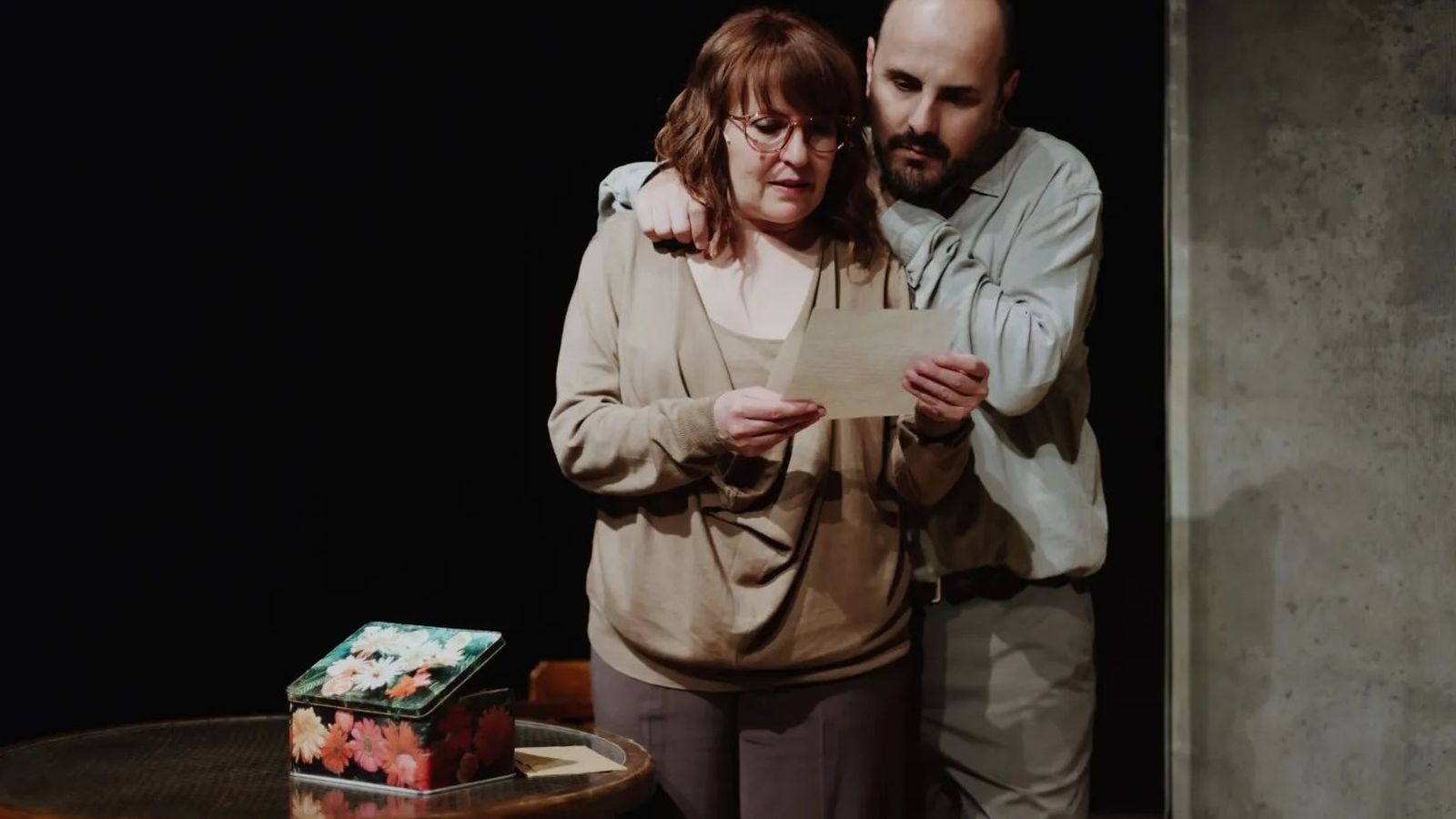
His story moved the company Teatre Nu, based in Sant Martí de Tous, which decided to turn it into a show. Inspired by the book Grandfather, I will take you out of here (Saldonar), they have premiered a play of the same name that can be seen at Sala Atrium until July 5 as part of the Grec festival. It will then have a run in November and will go on tour in Catalonia next year. The show stars Àurea Márquez and Miquel Malirach and features about fifteen characters: from Pinyol himself and his grandfather to the journalists who have dedicated reports and documentaries to them, as well as the various family members of the protagonists. "It's a very interesting and human story, which talks about us, about memory and forgetfulness," claims the director and playwright of the production, Víctor Borràs.
Preventing the past from falling into oblivion
On stage, Márquez and Malirach reflect on how Joan Pinyol learned about the events and, subsequently, all the bureaucratic and administrative hurdles he encountered when trying to obtain his grandfather's body. "Joan has made a life engine out of it. He's been fighting for 18 years and nothing has changed," laments Borràs. The playwright defends the importance of bringing historical memory shows to the theatre to prevent the collective past from falling into oblivion. "The generation that lived through the Civil War is disappearing and young people see the dictatorship as very distant. The bridges are breaking, we have the duty to keep talking about it because in this country memory has been poorly handled," highlights Borràs.
The company, creator of shows like The Irishman's Bones (2023) and The Woman on the Third Floor (2021), often seeks to stage productions that are close to them in territorial terms. Due to proximity, they knew Pinyol's story –"He is a professor at a high school in Igualada where many students from Sant Martí de Tous attend," says Borràs– and this also encouraged them to turn it into a show. "The story is very powerful in itself, but we also like to create shows that happen here, in our home, and can tour everywhere. We want our artistic work to be defined by where we are," emphasizes the director. In addition to their own creations, the company manages the Casa del Teatre Nu, which since 2015 has hosted a stable performing arts program in Sant Martí de Tous.
