The discovery at the Hôtel-Dieu that can solve the enigma of the origins of Paris
The remains of a wall of Gallic Lutetia have appeared on the Île de la Cité
-
CAT -
CAST
BarcelonaUntil a few days ago, the only trace of Gallic Lutetia was the accounts of Julius Caesar in his work The Gallic Wars. The Roman general explains there that in 53 BC he convened a general assembly of the peoples of Gaul in the Lutetia of the Parisii. At that time, Rome was facing Vercingetorix, the young Gaul who had convinced his fellow countrymen to burn their own cities and crops to leave the Roman troops without food or supplies. The negotiations must not have gone very well, because just a year later, in 52 BC, Caesar's lieutenant, Titus Labienus, confronted the Parisii in Lutetia, and the latter set fire to their own fortification to prevent it from falling into Roman hands. Since then, there has been much debate about where in Paris the famous Gallic town was located.
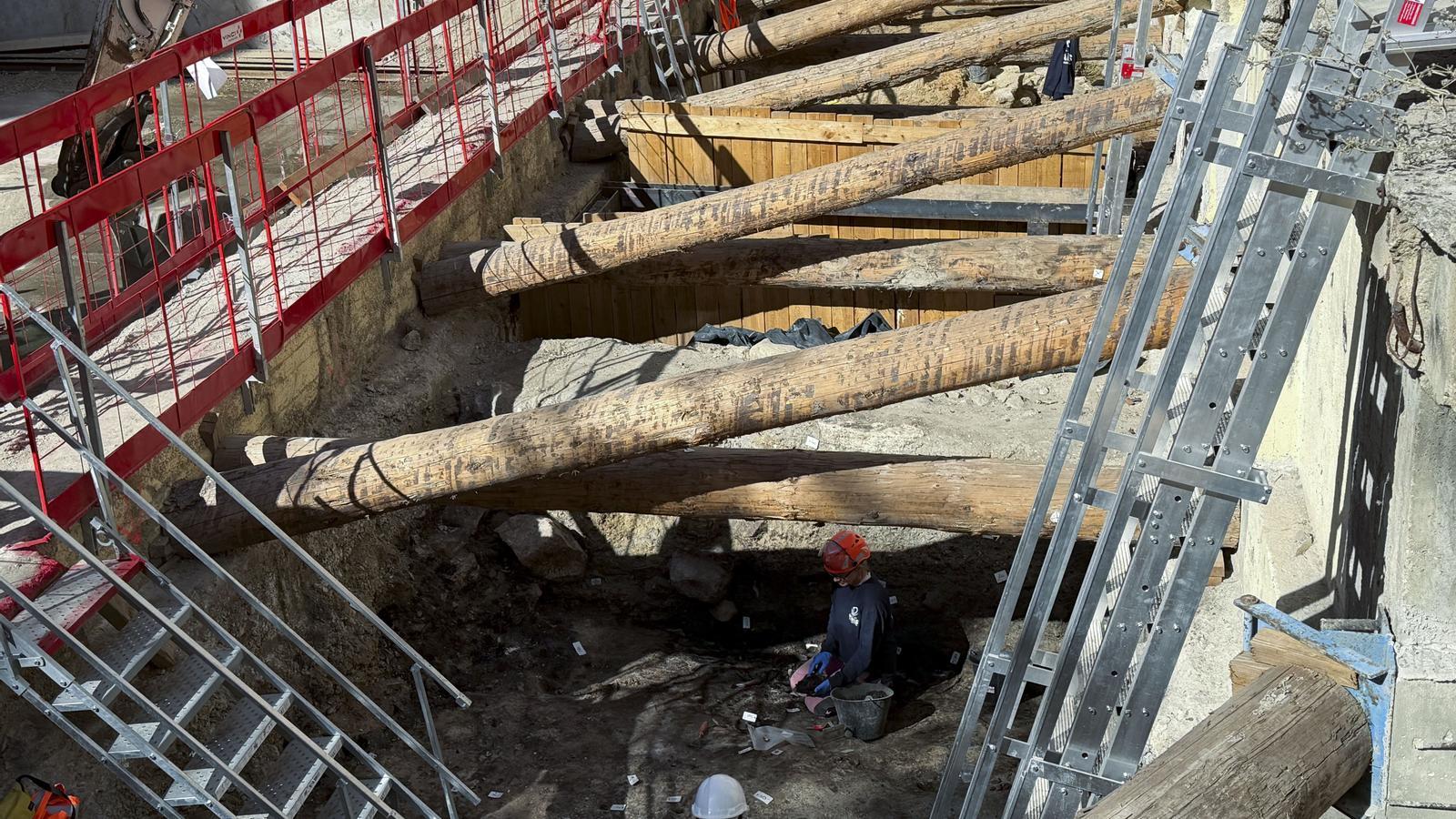
The discovery under the courtyard of the Hôtel-Dieu hospital, next to Notre-Dame Cathedral, on the Île de la Cité, of an imposing stone and wood wall about twenty meters long—with construction techniques typical of Gallic fortifications—could provide answers to some of the questions about the city's history. Not only are there the remains of the wall, which could be the defensive rampart, since a platform of sand and gravel has been found behind it, but also the traces of a violent fire. Carbonized seeds and the remains of a wooden building engulfed by flames have been located there. Another piece of evidence confirming its presence is a Gallic spearhead.
"The hypothesis of the Île de la Cité was based on Caesar's description, which located Lutetia on an island in the Seine, and on the continuity of the city in Roman times. However, until now we only had indirect and later evidence, such as the Pillar of the Boatmen," explains Dominique Garcia, president of the French National Institute for Preventive Archaeological Research (INRAP). This Gallo-Roman monument was discovered in 1711 under the choir of Notre-Dame Cathedral and was erected by the guild of the nautae (the boatmen of the Seine). It is important because the first inscription mentioning the community of the Parisii was found there, but it dates from the time of Emperor Tiberius, decades after the Roman conquest. Therefore, it proved that the Île de la Cité was a Roman religious and commercial hub, but it left the big question unanswered: where was the Gallic fortification that fought against Julius Caesar?
It is precisely here that the importance of the new finding lies: the wall of the Hôtel-Dieu is not Roman, but Gaulish, and constitutes the first particularly solid material evidence in favor of the location of the Gaulish city of Lutetia on the Cité. The absence of Gaulish remains had led some researchers to propose other locations, especially Nanterre, about thirty kilometers from the Île de la Cité. "It was not, therefore, a matter of denying the existence of Lutetia, perfectly documented by Caesar, but of debating its exact location. The discovery of the Hôtel-Dieu provides today an archaeological argument of great importance in favor of the Île de la Cité," says Garcia.
The first results of the carbon-14 analyses on the wooden elements give a dating range between 200 and 10 BC. Therefore, it would fit with the chronology of the events recounted by Julius Caesar. Furthermore, the Roman general provides a description of the fortification that recalls the Île de la Cité: an island connected by bridges in a meander of the Seine.
This discovery allows, above all, to move from a Lutetia known through texts to a Lutetia that will now be able to be studied materially. "The wall, the traces of fire, the charred seeds, the burned building and the archaeological furniture will allow us to reconstruct the organization and functioning of the oppidum. They can also provide us with information about the construction techniques, economic activities, and the environment of the Parisii. The traces of destruction are especially interesting, as they could be related to the events of the year 52 BC narrated by Caesar," defends Garcia.
The conservation
The material conservation and dismantling of the wall are particularly complex due to its fragile state. The stone blocks, exposed to fire, as well as the wooden elements—largely charred—make its removal and preservation very difficult. "The restructuring project of the Hôtel-Dieu does not plan to keep it in situ. Therefore, it will be dismantled with great care, after having exhaustively documented each of its components from an archaeological and scientific point of view. Photogrammetry and a 3D reconstruction will allow for an extremely precise image of the structure to be preserved. A mold will also be made that will allow a section of the wall to be reconstructed, incorporating some original stones, which in the future can be presented to the public in a Paris museum," explains Garcia, who also clarifies that one must remain cautious, but that the discovery could be a turning point in the knowledge of the past of the current French capital.
"The discovery considerably changes the way we will observe the subsoil of the Île de la Cité from now on. The presence of a wall implies, in effect, the existence of a broader organization, of which we still only know a part. Complementary excavations will be able to search for associated structures, habitat levels, or other elements linked to the oppidum. It will be necessary to explore, especially, the relationship between the fortification, the ancient banks of the Seine, and the spaces occupied within the enclosure. The challenge now is to understand not only where Lutetia was, but also how the city of the Parisii was structured," asserts Garcia.

