A Roman forum, revolutionary hypotheses, and a heated debate
The presentation in El Born of the discovery of Roman forum remains stirs up controversy among an audience with many archaeologists

-
CAT -
CAST
BarcelonaNumerous studies, investigations, and excavations have allowed us to learn increasingly more about the history of Barcino, the Roman colony founded by Emperor Augustus in the 1st century. We can learn about their diet, how they cultivated oysters, how they bid farewell to the dead and which gods they worshipped, how they planned their streets, and how they built them. Research also demonstrates that nothing is immutable and that everything is open to debate. And debate took place this Tuesday during archaeologist Jordi Amorós's lecture on... the biggest archaeological find in the last thirty years in BarcelonaA monumental pavement from the Barcelona forum. A hundred people, many of them archaeologists and historians, filled the El Born auditorium, and more than fifty people followed the event via live stream.
Antiga hipòtesi
Nova hipòtesi
MURALLA
DECUMANUS MAXIMUS
Bisbe
plaça Sant
Felip Neri
CATEDRAL
Regomir
Dagueria
GENERA-
LITAT
Paradís
Llibreteria
CARDO MAXIMUS
plaça Sant
Jaume
Ferran
Jaume I
Hotel Barcino
Hèrcules
AJUNTAMENT
plaça Sant
Miquel
Ciutat
Antiga hipòtesi
Nova hipòtesi
MURALLA
DECUMANUS MAXIMUS
Bisbe
plaça Sant
Felip Neri
Regomir
CATEDRAL
GENERALITAT
Paradís
Llibreteria
CARDO MAXIMUS
Hotel Barcino
plaça Sant
Jaume
Ferran
Jaume I
AJUNTAMENT
Hèrcules
Ciutat
plaça Sant
Miquel
Antiga hipòtesi
Nova hipòtesi
MURALLA
DECUMANUS MAXIMUS
Bisbe
plaça Sant
Felip Neri
Regomir
CATEDRAL
GENERALITAT
Paradís
Llibreteria
CARDO MAXIMUS
plaça Sant
Jaume
Ferran
Jaume I
Hotel Barcino
AJUNTAMENT
Hèrcules
plaça Sant
Miquel
Ciutat
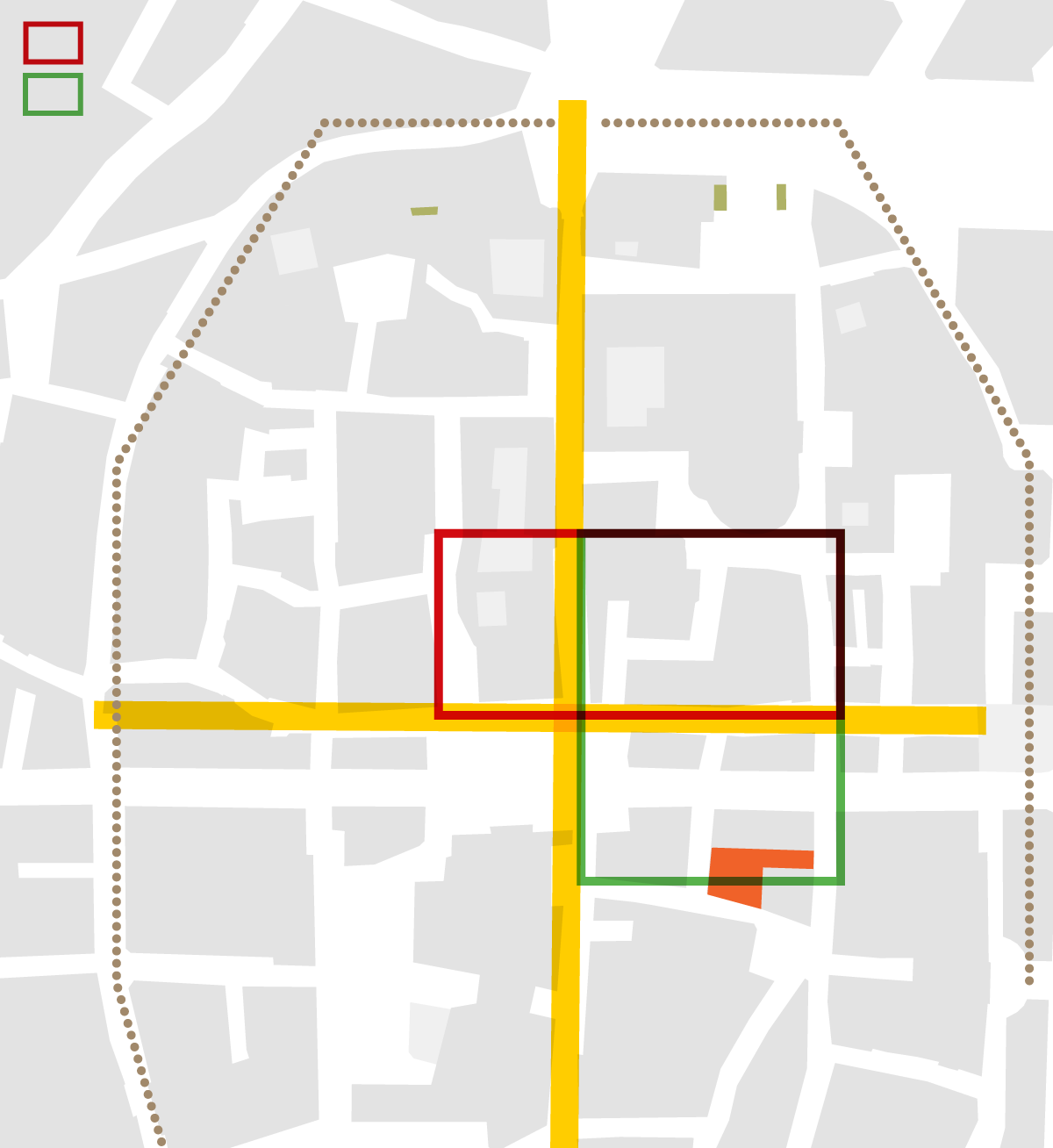
The Montjuïc stone paving was revealed during the expansion works of the Gran Hotel Barcinoat number 3 Hercules Street in Barcelona. These remains, which will be preserved and displayed in a museum space within the hotel, provided new evidence that necessitates a reinterpretation of the location and orientation of the forum, a central element of Roman civic life and the intersection of the two main axes of the urban layout. These two axes were the thistle, in a north-south direction, and the decumanus, in an east-west direction. Until now it had been assumed that the forum was aligned with the thistleAnd that's how it has been explained until now at the Barcelona History Museum. New archaeological documentation, however, indicates that it was aligned parallel to the decumanusThis implies a 90° shift in the urban planning interpretation of the colony's center.
According to this new interpretation, the forum was perpendicular—not parallel—to the sea. This is not the first time the forum's position has been questioned. As early as 1595, Jeroni Pujades drew the columns of the Temple of Augustus following an axis similar to that defended by the new hypothesis, and in 1954, Agustí Duran i Sanpere pointed to the same orientation after finding monumental remains. In 2008, following the same line of thought as Pujades and Duran i Sanpere, Héctor Orengo and Ada Cortés argued for a reorientation of the Temple of Augustus in Barcino. According to their research, the temple did not face Plaça Sant Jaume, but rather the cathedral, which implied a 90° shift. Orengo and Cortés published their research in the journal Oxford Journal of Archaeology In 2014, they presented their findings and explained them that same year at the Barcelona History Museum (MUHBA). They questioned the horizontal orientation, arguing it was based on flawed studies conducted by Antoni Celles in 1835 and later defended by Josep Puig i Cadafalch. The difference between their hypothesis and the more recent one lies in the temple's orientation: Orengo argued it faced the mountains, while the new hypothesis places it facing the sea.
A Century of Research
That debate didn't change the museum displays or history books. The new archaeological find might. This was the argument made by the Barcelona Archaeology Service when journalists were able to see the remains of the forum for the first time on February 24th. "Both the Catalan government and the Barcelona City Council maintain that the forum is perpendicular to the sea and not parallel, as had been previously stated. This will force changes to the museum displays and history books," said Xavier Maese of the Barcelona Archaeology Service at the time. There was anticipation and a wide range of opinions at Tuesday's conference. Amorós began by paying tribute to his colleagues who had excavated: "Many have worked for decades, there are many theories and hypotheses, and each one has contributed their grain of sand," he affirmed, because it's not easy to connect the dots in a 21st-century city to glimpse what it was like in the past. The archaeologist then gave a detailed explanation of all the excavation work. The most controversial aspect has been the interpretation of the find. "The paving corresponds to an uncovered public square from the founding period of the colony, at the end of the 1st century BC. There is nothing underneath," said Amorós, who has been greatly frustrated by the lack of time to explain everything he wanted. Among other things, he cited a century of different hypotheses and theories, with names like Duran and Sanpere, Antoni Celles, Francesca Pallerés, Isabel Rodà, and Orengo and Cortés, among others. Amorós described Orengo and Cortés's theory as "revolutionary," a theory that was refuted in several articles by the archaeologist Isabel Rodà. As a result of the controversy, the Barcelona City Council's Plan Barcino commissioned Reinald González in 2018 to conduct a study of the different possibilities for the temple and the Roman forum, a study that remains unpublished. "We reached the same conclusion as González, but with different methods. González used bibliographic research and documentation, while we used archaeological research," Amorós said. However, changing the forum's orientation and contradicting Celles has stirred up a lot of controversy. "It's a shame that a thorough scientific debate didn't take place before disseminating a hypothesis. What we're doing today is precisely what should have been done before presenting it to the media or creating a museum display. Personally, I don't see it clearly: it needs to be discussed calmly and reflected upon," Rodá said. "The discovered pavement is impressive, but it's not conclusive proof: no associated ancient pottery has been documented, and the stratigraphy appears to be dismantled. With the current data, there's no clear need to change the forum's orientation. We must bear in mind that Barcelona has two hills and a complex topography that influenced ancient urban planning." "Roman cities had more than one public space of this type," he added. Amorós replied that all the excavations in the surrounding area had been thoroughly studied. Rodà also lamented that not all the findings related to Sant Just i Pastor, such as the archaeological remains of monumental Roman structures from the 1st century AD, had been taken into account. Regardless of whether the forum should be rotated or not, the new interpretations also change the history of urban planning in Barcino. The talk in El Born demonstrated, among many other things, that the Roman past stirs up strong passions, that debate is always welcome and greatly enriches research, and that there's nothing wrong with starting with new topics. As Cortés said, there are still many questions to answer. "We shouldn't be afraid either, and there are no dogmas," added Eduard Riu-Barrera. With everything that has been said, there's even more desire to imagine what Barcelona would have been like in the time of Augustus.
