'Poem of Catalonia': J.V. Foix's sea
-
CAT -
CAST
I propose a summer literary plan: swimming in our Mediterranean with the verses and poetic prose of J.V. Foix. The poet from Sarrià and Port de la Selva thought that, faced with the immensity of the sea, humans are insignificant beings, like pigeon droppings: "The sea pigeon", he used to say. More than 70% of the Earth is made up of oceans. An idea that came to him from afar. As Fòcius (that's how he signed some texts in the newspaper La Publicitat, the best newspaper of the 30s), playfully, in an article of March 1, 1932, he quotes himself: "Our sosie J.V. Foix in his book Gertrudis said in a poem that the Earth should be called the Sea and that men were larvae of fish rejected along the shores. The world for him is «a spherical fish tank thrown into space for the amusement of angels»".
In the book Mira la mar, Marcel·la! (PAM), Montse Ginesta and Lluís Quintana Trias have made a selection of poems and poetic prose by this avant-garde classic with medieval echoes. Montse Ginesta has also done the illustrations. The "sly" sea at night, the sea bursting with light under the scorching sun, the calm sea and the furious sea, he salivates over them all. The real becomes unreal, vice versa. He puts words and imagination to the enigmas of the salty waters and the archaic geology of Cap de Creus, to each pebble, each outcrop, each silence or gust of wind, "eternal nakedness, sky and sea".
At the sight of his seascapes, Foix exalts himself, becomes passionate, gets excited. And he doesn't stop writing: "I get up in the morning / and write what cannot be said". The nouns and verbs and adjectives, like waves, carry him out to sea, to the rocks: "Give yourself completely to the sea, and do the crawl / While a flight of gulls covers the sun". Verses spring and blossom from his hand from the "evening sobs" of the calm waters, from the "disappointment of slimy nets" of the fishing boats, from the daily mysteries that assault him in every corner. From everything he makes a memory, a magical presence, a tale.
He says: "From afar everyone shouts: the sea!, the sea!; but when in front of it, it stays silent for hours and hours". He contemplated and scrutinized its dark and dazzling nature for years. He started going to the Port in 1924, he spent his summers in a fisherman's hut that he bought at the end of the 40s and he walked along the coves with the dinghy El freu de la Medella. A freu is a narrow and shallow passage between an island –often called a meda or medella, if it's small– and the coast.
On September 10, 1922, in Sa Tuna, near Begur, with a group of friends, including the painter Josep Obiols, they receive Carles Riba and go out to sea on "an evening of eternity": "We rowed, now one, now the other, through immortal darkness, we all remained silent watching the phosphorescent sparkle that springs from the water with each stroke of the oar and the trail of light left by the rudder, so clear that it illuminates the bottom of the waters with dawn lights". Riba, from time to time, "as if praying, recalled classical verses". "But I realized that each of us intensely lived our own solitude. I felt a shiver similar to the one I felt as a teenager when I first read verses by En Maragall or the freshest and most earthy verses I know by En Sagarra".
Another day he evokes the painter Joan Miró, with whom he had shared the avant-garde adventure. A Miró who seeks God and to whom a friend of the group replies: "God, strong and eternal, beginning and end of all, geometer of the absolute, omnipresent, I would find him at all hours and in all countries, facing the sea, sitting, patient and merciful, with the old and the retired, on the 'what if' bench". If it weren't for my feet swelling... You understand, right?
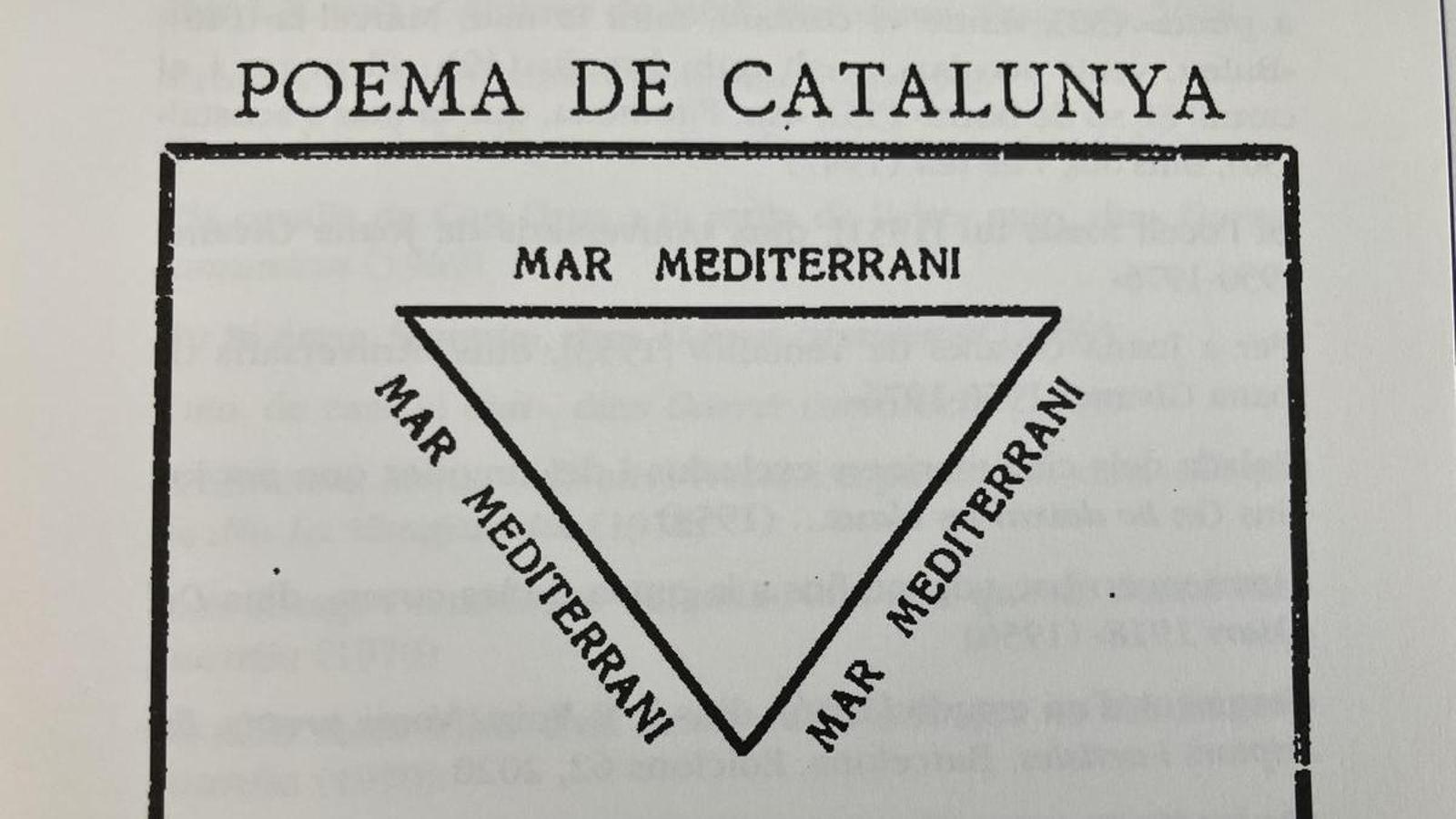
The collection made by Montse Ginesta and Lluís Quintana Trias ends with the Poema de Catalunya, a well-known calligram published in 1920, when Foix professed a radical Catalanism. He drew Catalonia as a triangle-island surrounded by the three sides of the Mediterranean Sea. The ideal country, dreamed of, with the eternal sea as the beginning and end of all things.
