'Memoirs of Hadrian': A virtuous Lluís Homar on an unnecessary television set
Marguerite Yourcenar's text returns to Barcelona with a staging by Beatriz Jaén at the Teatre Romea
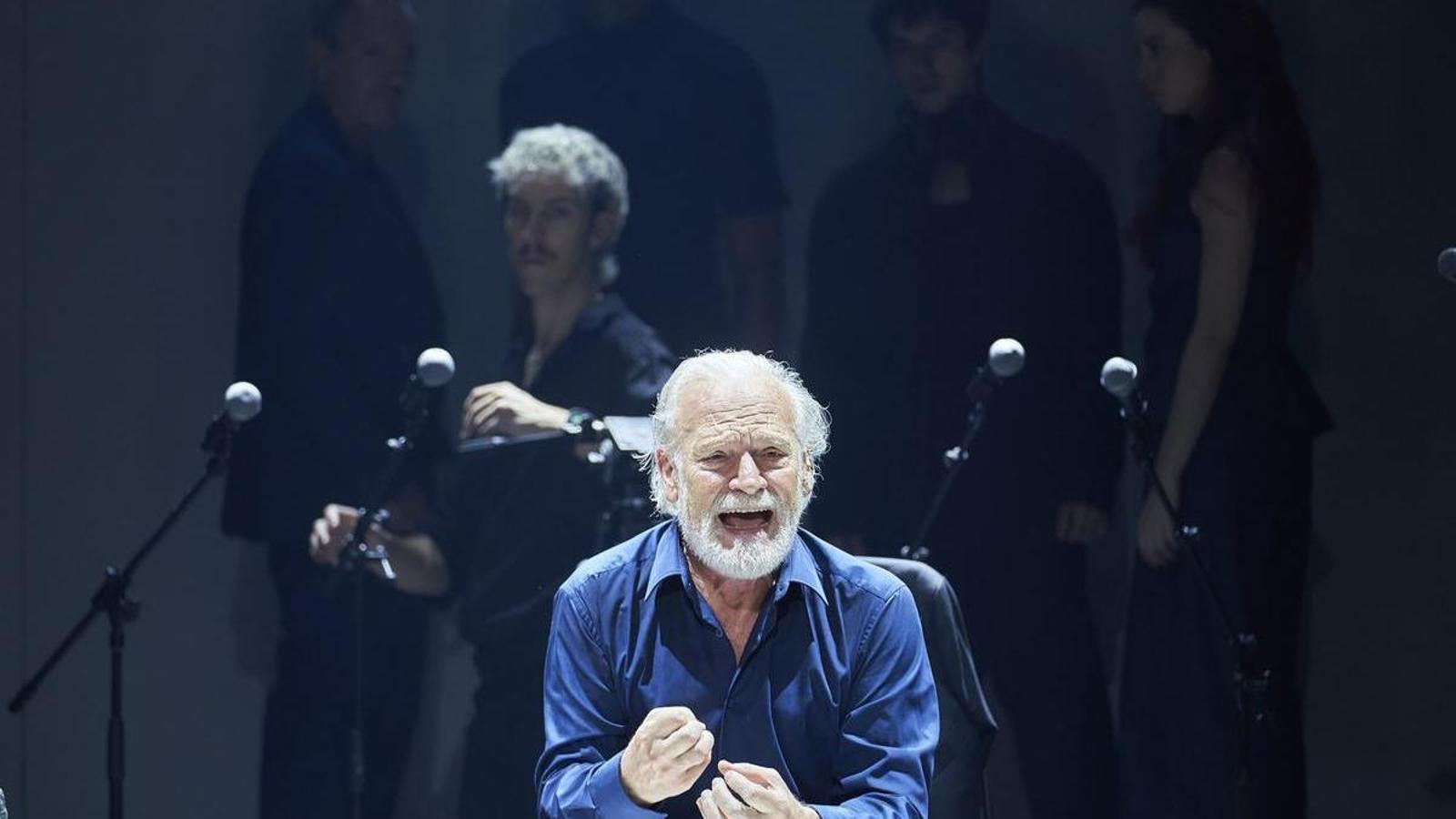
- Translation: Julio CortázarDirector: Beatriz JaénPerformers: Lluís Homar, Álvar Nahuel, Clara Mingueza, Marc Domingo, Xavi Casan, Ricard BoyleTeatro Romea. Until May 10
The historical novel or false biography of the Roman emperor Hadrian is the best-known and most-read book by the Belgian writer Marguerite Yourcenar. The novel was adapted for the stage by the Italian director Maurizio Scaparro in 1989 and a few years later it was seen in the Castilian version by Julio Cortázar, also directed by Scaparro, at the Teatre Grec in Barcelona. Now the show returns to the stage with a dramatization by Brenda Escobedo and with the fantastic starring role of Lluís Homar, for whom the part is a perfect fit. Hadrian/Yourcenar's reflections on politics, wars, beauty, and death compose a human fresco that the virtuous Lluís Homar conveys, combining delicacy with depth, confidence with tender melancholy.
It is thanks to his stage presence, his clear diction, and his ability to imbue words with meaning that the performance is powerful, despite Beatriz Jaén's staging, which, in the name of contemporaneity, places the monologue in a television studio. Hadrian appears surrounded by a silent group of makeup artists, costume designers, stylists, sound technicians, and camera operators who are constantly moving with actions that add nothing to the story and harm the continuity of the narrative. Whether because the director does not trust the word enough or out of a need to emphasize her contribution, this visual play of movements and projected images becomes unnecessary as well as annoying. Much ado for the intimate monologue of a human being awaiting death.
The issue becomes even more apparent when the story addresses the emperor's romantic relationship with his young lover Antinous and his tragic fate. The group disappears. The tension focuses and the space becomes a metaphor for the vibrant relationship between the feeling expressed in words and that expressed by the movement of a dancer (Álvar Nahuel) who is worth the entire performance.
