"Listen to this rattle!": the story of a shot mother takes the stage
The TNC premieres an immersive show inspired by the real case of Catalina Muñoz
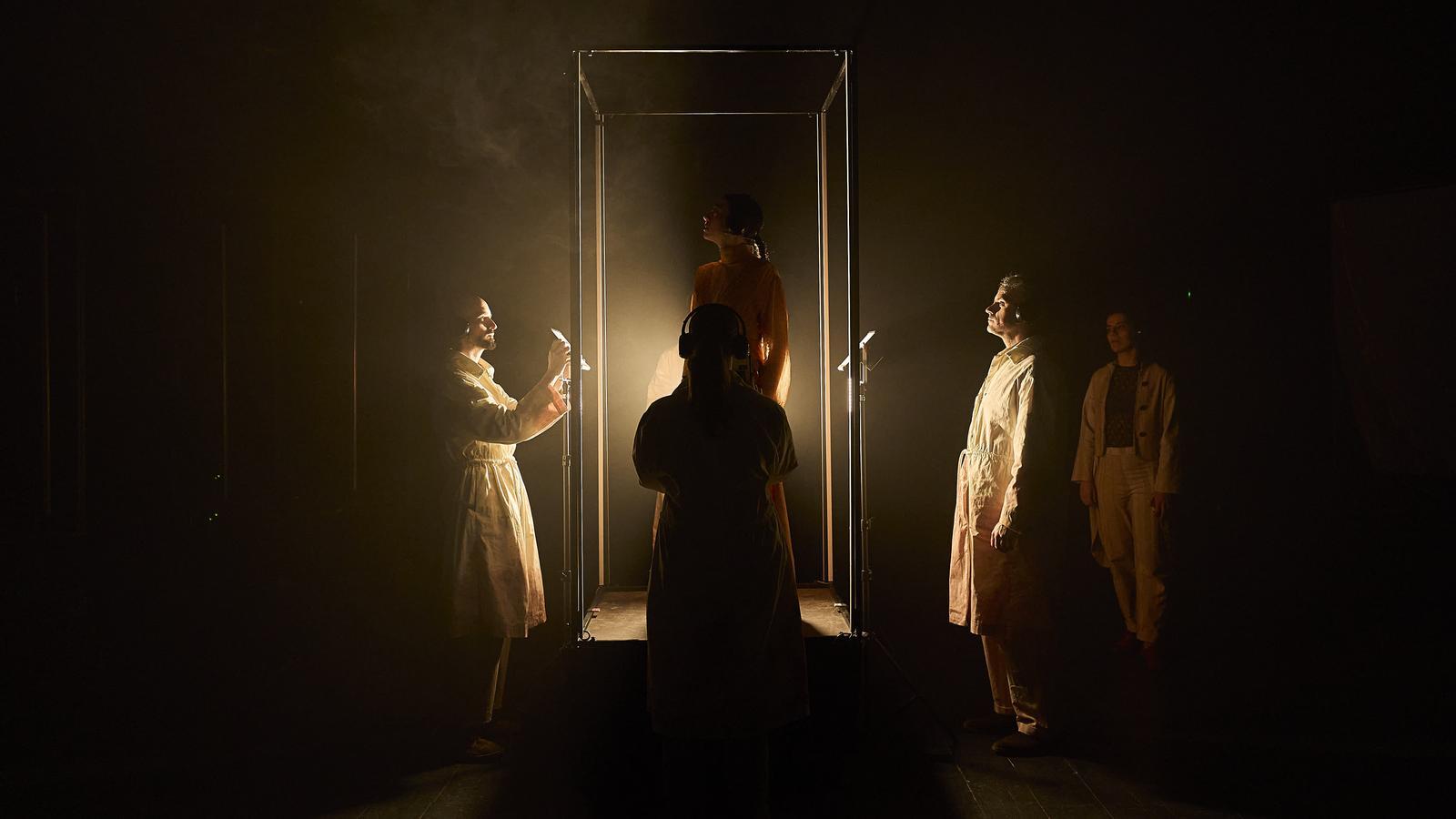
Barcelona"With headphones, music, and everything else, it touched me deeply," says a student from IES Terra Roja in Santa Coloma de Gramenet after the performance ofEl sonall, which can be seen until April 26 at the Teatre Nacional de Catalunya. This immersive show, with live music (some paragraphs from a doctoral thesis are even read to the rhythm of rap), recounts the investigation of a real case: that of Catalina Muñoz. Mother of four, she was 37 years old when the Francoists executed her at the beginning of the Civil War. Some neighbors had accused her of making proclamations in favor of the Republic, and her husband had fled after confronting Falangists. When she was murdered, she was carrying the rattle of her youngest son, Martín, who was nine months old at the time. When archaeologists exhumed her grave, in La Carcavilla Park (Palencia), they found the small toy along with some buttons and the soles of her rubber shoes.
Catalina was buried on September 22, 1936, nearly 90 years ago. Almost a century has passed, but the story has moved the students of Institut Terra Roja, many of whom have grandparents born outside of Europe. "It's a bit different from what I'm used to seeing, but because of how the actors got into their roles, the music, and everything, it really resonated with me. I didn't know much about the subject, but now when they explain it in class, I'll have a much better idea of what happened. It's good to remember what happened and all that was suffered; it's a lesson to be learned," explains Aia.
There are no seats in the room, and the audience walks around with headphones, but that's where the voices and sounds reach in this show by Projecte Ingenu, directed by Marc Chornet with dramaturgy by Alba Collada. There is also no stage, but rather four large blocks covered by a translucent screen. The actors go up and down and walk among the audience. There is not only music, but also dance; the stage space is modified, and everything happens in 360 degrees around the spectator. The rattle can also be heard, but not seen: "Listen to the rattle!" the actors say at different moments.
Connecting with younger generations
The work reflects on historical memory from a contemporary perspective, focusing not only on the past, but also on the way it is transmitted or buried. "Catalina was not a very active political militant, she was not a soldier, she was a mother. Her case allows us to show the horror of the war from something very intimate," says Collada, who is 28 years old and wanted to avoid a traditional historical reconstruction. "Many works have been done on the Civil War and we didn't want to do a typical historicist work. I wanted to connect this story with my generation," he states. In the process of building the work, Collada spoke with many teenagers and was surprised because some knew many details. In the end, it seemed more honest to delve into his own history and his great-grandfather, Baudilio Collado, who lived through the war, but whom he never knew. "It was a way to connect with my own oblivion," he says.
In the opinion of the Ingenuo team, the use of various languages, such as music or movement, creates a direct and more accessible experience. "We wanted to achieve an emotional impact to explain how the wounds of war remain and are transmitted to subsequent generations –explains Collada–. With all these resources, we want to give a voice to a skeleton and a body to a ghost. We can reach people aged 16 but also 65, and it's like slamming your fist on the table."
"There is something inherent in the work that tries to go directly to the essence of the person, beyond what their age may be. It has been a very artisanal process and we have all contributed something of our own. If you have lived through a war, it affects you directly, but if not, if you live in a society like ours, where the far-right and oppressive mentalities have returned, you can feel challenged," says Pol Blancafort, one of the performers, along with Toni Guillemat Álvarez, Gerard Marsal Norte, Neus Pàmies Juárez, Anna Pérez Moya, Mireia Sala Aresté, and Xavier Torra Xuriguera.
The theater also does not ignore that some doubted whether the rattle was real and even accused the archaeologists of having placed it there intentionally. It had to be proven that it was made of cellulose, not plastic, and that it was from that era. Catalina's husband was released from prison after 25 years, but he never spoke of the war or his wife. Martín, in the summer of 2019, recovered the colorful rattle that his mother had taken to the grave. He died in 2023 and was able to be buried with his mother. Now the rattle is kept by one of Catalina's granddaughters.
