Gavina.mp3: "I like it when something is put in front of me without moral judgment."
Musician

-
CAT -
CAST
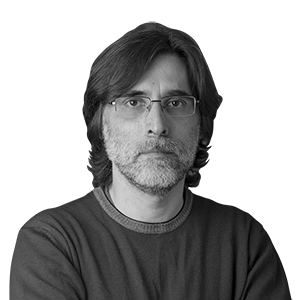
BarcelonaMax Codinach (Barcelona, 1999) is a musician and poet of truly exceptional singularity, with very clear ideas about his role in the face of the voraciousness of the music industry. At the helm of Gavina.mp3, he creates pop music using urban music tools and a poetic arsenal that blends surrealism and everyday life. After an album that established him as a breakout artist, Many bones, many stars (2024), closed 2025 with the excellent Always and by instinct, one of the best albums of last year according to the ARALike a kind of Manel for Generation Z, and with a commitment to aesthetics similar to Albert Serra's, Gavina.mp3 is one of the most exciting musical projects in the country, featuring extraordinary songs like City and Balconies, horses.
Do you have the live stream where you wanted it?
— Where I want it now, yes, but I suppose it's going to change quite a bit. The first format, without drums, was starting to feel too small for me, and it frustrated me. I even found it hard to go on stage with the old format because I could see it wasn't what I wanted to do. Since the concert at La Nau on January 28th, we've been mixing the six-piece musicians with the electronic elements. In our minds, the fun is in blending them, even though there's good value in both.
This good teak makes you want to increase the cachet, right?
— Everything we can. At first, there were just four of us at concerts, including the manager, no one else. And at La Nau, there were maybe twenty people working to make everything run smoothly: sound, lights, selling t-shirts, and so on. backlinersLast year we already had ideas that were impossible to realize with our salaries and what we wanted to allocate to the album. Now it seems to be becoming possible, and we're enjoying it much more.
Is music your main source of income, or not yet?
— It's starting to be, yes. I try to always have other things going on so I'm not dependent on just one thing. But yes, it's the first time it's been my main source of income, not my only one, but almost.
Always and by instinct What is one of those concept albums that doesn't seem like one?
— As we were finishing it, I realized it was a concept album, although I didn't have a word to define that concept. Gavina's lyrics are highly valued, both positively and negatively, as is the message, but I don't feel there's a clear message, but rather something abstract that builds up over time, and depending on how it resonates with you, you interpret it in one way or another.
It uses words and rhymes that, more than a story, convey a mood that is neither happy nor sad.
— Exactly. A lot of people told me it was very sad, and I can totally agree that it's not exactly cheerful music, or not only cheerful, but it doesn't strike me as intentionally sad either. I've found that some Gaviota songs were cheerful and quite optimistic, and at other times I've thought they were the complete opposite, and that depending on how you listen to them, they could make you a little depressed. I think that's why, because Gaviota's lyrics never take prisoners, in the sense that they are what they are, and you deal with them in your own way.
If you'd like, we can give an example: CityIt sounds like a melancholic song about a landscape that no longer exists, but at the same time, there's quite a bit of humor. The character isn't comfortable in the city, but he's getting by; it's not a tragedy.
— The thing is, the relationship with a city isn't one-sided, static, or something that can't be defined in just a few words. Like a relationship with a person, there are so many layers that depending on the moment, one or another comes out. In a song, you try to create a mosaic of all of them, and then what's left? Well, a song that might be quite pop, because of the melodies and the structure, but it doesn't give me the feeling that you finish it and say, "Ah, look, yes, that's what I wanted to say, there you go." In other words, you don't say anything, or at the beginning it says one thing and then the opposite.
Yes, you have verses that can resonate with the listener.
— The idea is that out of every twenty verses you choose one or two, keep them, and build your story with them. That's what I like and what has influenced me, not only in music, but also in literature, film... I like being presented with something without moral constraints, and deciding how I want to relate to it.
This allows you to sing verses like "I made a swastika in the center of Barcelona just to argue" in Winter is coming, the version of the song Gaetano, from the Italian Calcutta ("And what happened was a swastika in the center of Bologna / ma was only for litigation").
— This would surely be one of the highest examples of putting something on the table without moralizing. The original song says this literally, and I can't say if I would have written it exactly like this. But I do know the political ideology of the person who wrote it, and it makes no apology for Nazism. We could have changed that part, just as I changed some other parts of the lyrics, but it seemed to me that it made a lot of sense to keep it, because if I liked that song, it was partly because of that line. What the song says is that there's someone so desperate that he has to vandalize a swastika graffiti so that his girlfriend gets angry and tells him she doesn't even want to see it. I find this incredible. People wrote to me saying it was inappropriate, but I think most people are intelligent enough to understand it. Even from there, there could be a debate that I personally find very interesting, but that I don't care about artistically. That's why we did it this way. And that's why, at the same concert where we sing this song, we have political stances that most groups who don't talk about swastikas don't have. They could have changed the translation for this excellent lyricist and then remained silent in other situations. Or they could have done what we do: not get stuck on the moral high ground, but artistically create what we find interesting, and then take a stand where we need to, whenever we find it fun or necessary. Usually, for us, it's more fun than necessary, but sometimes it is necessary too.
Do you have to have fun first?
— For us, artistic creation should above all be fun and have very few limits. Then, obviously, you build a discourse, a persona, an aesthetic, whatever, more or less defined. We don't make songs that are political pamphlets, but I suppose there are many people who listen to us who can perfectly intuit what positions we take on certain things.
Robert Smith, of The Cure, doesn't have overtly political songs. However, few artists are more politically engaged than he is when it comes to challenging the music industry and rising ticket prices.
— Yes, I saw the interview with Robert Smith, and I thought it was great. Everything has a price, and taking a stand always has a price. Now, usually, what really ends up having a price is what you take out of the songs themselves. I mean, making politically charged songs might have a price, which is that you won't get booked to sing at a Vox rally, but beyond that, people will listen to you and know who you are; and there will always be festivals with your political leanings. For me, taking a political stand has to do with turning down gigs because the political line didn't align with us at all. Without making a big fuss, because it's the first time we've said it, we've turned down quite a bit of money to avoid playing at Brunch Electronik, for example, because it's owned by the pro-Israeli fund KKR. This is what ends up having a price, and this is what everyone decides. Just like when we've played in venues, we've tried to keep the price reasonable. Beyond that, going through life making political pamphlets and telling people what they should and shouldn't do is so far-fetched that it's not even a possibility. Our artistic role models have a political stance, and most don't make it explicit in their songs. However, I think there is a political position in Gaviota's lyrics, because if I'm talking about universal, generational, or contextual feelings, like frustration, there's a political reading, but not in the sense of a PSC or CUP anthem, but rather another kind of political stance, which is more solid than simply writing a political song.
And what do you think of the artists who They see music as a mission, like Rosalía or Taylor Swift, and therefore, is it worth doing certain things to complete this mission?
— We also turned down many offers from the music industry because we knew that entering it, despite the privileges, meant entering a cycle that leads you to compete with other projects; to collaborate, not in an artistic sense, but in a marketing sense; to be practically obligated to play in X venues and talk to X type of people. All of this was something that was killing me. When it was done the concert for Palestine at the Palau Sant JordiI thought that if I were the Palestinian band that played there, I would have been angry because they brought Rosalía. I think I would have disliked it for many reasons. First, because it seemed more like a Rosalía concert than an event for Palestine. And then, because of everything that had happened beforeClearly, Rosalía had to take a stand because the cost was getting too high, and I think it's perfectly fine that the cost was too high and that she ended up taking a stand. But this "now that you've come to your senses, you'll be the superstar of the concert" award... I understand the idea is for the cause to reach a lot of people, and I understand that inviting Rosalía helps reach a lot of people. But what really reached a lot of people was Rosalía singing, not the event for Palestine itself.
Yes, and that's how the media headlined it.
— I don't tend to think that having 20,000 Instagram followers comes with a huge responsibility for everything you do. If you get drunk and wake up in the street in the middle of the night, it's not the end of the world, because you're a person and you can get drunk one day and wake up in the street. But I do believe there are many things you have control over, and you'll probably give up a lot, but you're also gaining a lot. That's why the safest step in this regard is the one we've taken: staying out of all this and only talking to people we know won't cause us any problems of this kind.
Your adolescence was heavily influenced by hip-hop, wasn't it? I'm surprised by your melodic ease coming from a world where melody isn't the main focus. I don't know if it has to do with other things you were listening to back then.
— I suppose it has to do with a series of musical influences I started developing in my late teens. And it also has to do with the people I make music with. It's true that on the first album, I did the melodic composition myself, but I was already running out of ideas. On this second album, although I've generally done the melodic composition myself as well, the way I composed has been different. In many cases, I've composed directly with musicians or producers, and that really shakes things up.
Are you influenced by bands from the eighties like The Smiths?
— Yes, we do listen to The Smiths in the car for fun. Or we listen to Oasis, also because of my hair combs, because sometimes people tell me I look like Liam Gallagher since last year I was wearing a parka.
The Smiths are another one of those groups that convey a mood even if you don't understand the lyrics.
— Even now, the first thing I remember when I hear a song in English isn't the lyrics. What resonates with me most is the feeling it evokes. I don't know why, but there's something very unconscious in me that creates spaces, landscapes, or sensations without actually arriving at a specific message. I think it has a lot to do with the fact that often, when I listen to music or watch movies, it's never the message that stays with me, but the aesthetic. A few months ago I started watching the series Twin PeaksDavid Lynch's, may he rest in peace. As soon as I saw the introduction, I thought: I'll watch the whole thing, this series, for sure. Now I'm watching the third season, which I'm finding incredibly boring, but I can't stop watching it. I suppose I've ended up giving aesthetics an importance I didn't realize I had at first, and as a consumer, it's something I value a lot. I listen to Russian music, which I obviously don't understand, but I listen to it because there's something there that's created while I'm listening that interests me.
At first I thought you were using the vocoder to contribute to the character's legend, to hide the voice, but I've finally come to the conclusion that no, you've found a rather unique aesthetic and the vocoder is part of it.
— Another artist I came across through Marc [Fernández; producer] is Bon IverI knew him, but not that well. And especially to prepare for this second live show, we watched a lot of live performances, including one by Bon Iver in a tiny venue with the audience around him, where he started alone using a vocoder. We had already done some tracks with a vocoder, and we saw that it was quite effective for newcomers as well. It also has to do with the fact that, when I started making music, the thing I was least skilled at was singing directly, and adding a lot of elements gave the voice another dimension. The vocoder is very much about taking elements and creating an aesthetic. I don't know anyone in Catalonia who uses it. And yes, I think it's a tool we'll continue to use.
Gavina.mp3 was the opening act for Guillem Gisbert. How did that opportunity come about?
— It didn't make much sense. I mean, they told us when we'd never even played a gig. Well, yes, we had launched our first album at Heliogàbal. Anyway, they needed an opening act who would charge four euros and have some connection to Guillem Gisbert. And, yes, it was quite amazing because, even though we'd already played several shows when we opened for them, it was all unimaginable. It was one of the first times we'd had such a huge crowd. Obviously, most of them weren't there specifically for us, but there were a lot of people singing along. And I got to meet Guillem, who's an incredible character.
Do you have an obsession with finding the right word, like Guillem Gisbert? I know for a fact that he can spend days or months before he feels the song is on the right track...
— No, no. The writing process we should have is very different. For me, the lettering is also very important, but writing is never a battle. I'm in no hurry, nor do I need to fight with the letters. I understand that Guillem struggles so much because he's very good at it. But for me, the more I struggle, the worse it turns out, because it starts to become artificial. I mean, I've never asked anyone what word they think would sound best, I've never looked for synonyms, I've never thought about what the best word is to define a feeling. It all comes from deep within, and I don't question whether I say what I want to say, because I don't want to say anything; there's nothing to say.
Even so, you come up with very powerful verses, like "to be so happy and so dead inside," or words like the horses of Balconies and horsesYou think: why are there horses?
— There's this whole element of surrealism or Catalan magical realism. I think it's a good thing that we're making music that, in some ways, resembles pop, because my writing style has nothing to do with pop. And since I never think about what I want to say, sometimes you read the lyrics without the music and you think: this can't possibly be a pop song, because it says nothing, everything is cut off, it jumps from one thing to another. But precisely this gives me incredible freedom, and I was very surprised that people could learn these lyrics. They're not like Oh, DoloresIt's a story you hear once and remember forever. This way of doing things works really well for me, and I think it's a good thing we do pop because any other genre would be unlistenable with these lyrics. But luckily, the mix of everything, and also the fact that I didn't come from a musical background and therefore the melodies I created at the beginning weren't very musically complex, helped those lyrics come across. I mean, I was saying very strange things, but with a very simple melody, and on top of that, the music we used didn't really have much to do with the lyrics. I think that whole mosaic appealed to people.
How do you feel when you see people singing these lyrics?
— The other day at La Nau was the first time I didn't sing along to at least part of a song. Normally, I wear headphones and I don't hear what's going on outside. But that day I took one out because it's something you have to experience from within. It's something that's generated there, like an atmosphere. It had happened before when we'd done concerts and some people had sung along, or when you could really feel the energy of the crowd singing, but what happened that day had never happened to me before, not singing at all. There were songs I sang because people had paid and because, obviously, I had to sing them, but I could have chosen not to. And the next day you think: that's quite something. heavyBecause they learned and sang along loudly to lyrics I wrote. There are many steps that are natural for me and for them, but when you watch them, you think: amazing. It's an incredible source of pride that the people sang, and that the musicians performed perfectly.
And how are you handling the festivals?
— The most impressive festival we've done is Cruïlla, where we played on the main stage and it was pretty incredible. Since Gracie Abrams was playing after us, there were huge crowds. Most of them weren't there for Gaviota; I'd say they didn't even know what Gaviota was. Plus, the audience was mostly Gracie Abrams fans, which is a very different kind of music. So there was quite a sense of disorientation. heavyBut hey, cool. That's also part of the job, connecting with people in the moment, regardless of whether they know the lyrics or not. We've had our fill of going to places where maybe 10% of the people knew us and the rest had no idea. And we'll keep doing that this year because as you grow, more people know you, but you also end up in bigger venues where there are more people who don't know you.
I don't want to finish without asking you about the geography of the album, because it includes Europe, Vallcarca, Copèrnic Street in Barcelona...
— Vallcarca is where I currently live and where I've lived for fifteen years. It's where my mother lives. Copernicus is the street where the high school I went to is located. And well, Europe is my home. City He talks about Berlin, not Barcelona, and when I say "how many corners of Europe without a sea," I'm laughing; they have plenty of clubs, but they lack a sea. I try to talk about places to establish a kind of connection with the real world. For example, in They say about you You have lyrics you don't quite understand, and the moment you feel "Copernicus," you can more or less make sense of it. With Vallcarca The same thing: it ended up being the title, but the fact of saying that I take the motorbike and go to Vallcarca, which is what I have done every day after working, after studying, grounded it a little and put a counterweight to it in the song.
