Francisco de Zurbarán, a painter in a state of grace at the National Gallery in London
The first major exhibition of the artist in the United Kingdom includes forty of his best works

-
CAT -
CAST
LondonIn the first room of the Sainsbury Wing of London's National Gallery, a crucified Christ is agonizing. It is Crucifixion (1627), the first documented commission by Francisco de Zurbarán (1598-1644). It is an intimate and, at the same time, striking image: the drama is above all conveyed by the impenetrable black background that surrounds the figure of Christ, depicted with a care and delicacy that humanize him. This painting caused a sensation when it was presented in Seville, at the Dominican convent of San Pablo el Real: two years later, the Seville City Council invited the artist to establish himself in the city without having to pass the painters' guild examination. Now, this monumental painting opens the major exhibition that London's National Gallery is dedicating to Francisco de Zurbarán, the first in the United Kingdom, from May 2nd to August 23rd.

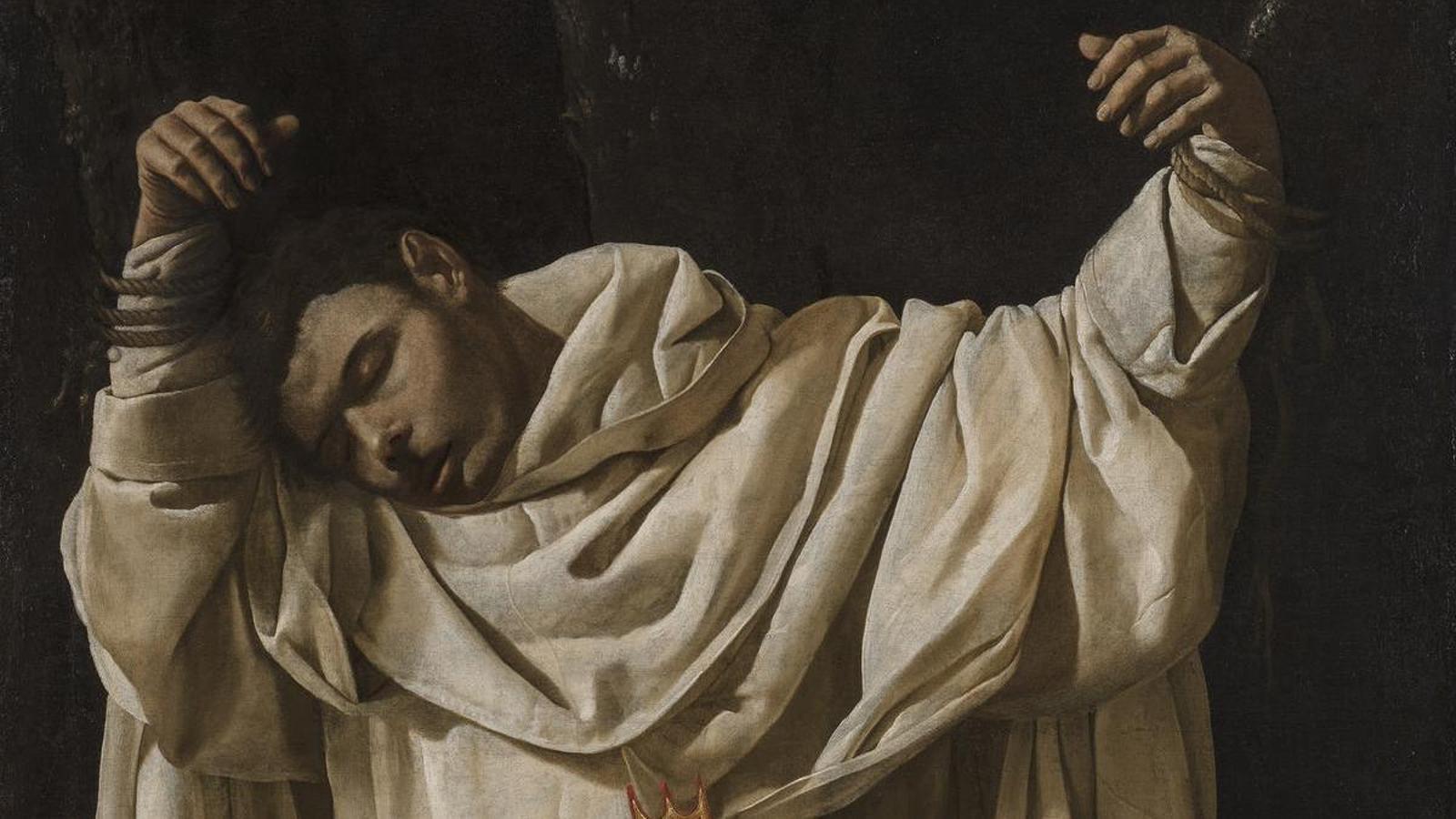
The exhibition, simply titled Zurbarán, includes 38 of Zurbarán's finest paintings and four still lifes by his son, Juan de Zurbarán. “The 1627 image of Christ is very stark. Zurbarán is not an artist who dedicates much time to setting, landscape, or context. He is interested in the power of painting,” states Francesca Whitlum-Cooper, curator of the exhibition along with Daniel Sobrino Ralston. “In the early 18th century, Antonio Palomino, art historian and the first art chronicler in Seville, wrote that people went to see this work and that, because the sacristy was very dimly lit, they thought it was a sculpture —explains Whitlum-Cooper—. Zurbarán works on a flat surface, but the figures seem to emerge from the canvas.” Because of this, and his use of chiaroscuro, several experts point to Caravaggio's influence on Zurbarán. Another of the most striking paintings in the first section is one of Saint Seraphim, tied to the limit of his strength.
For the director of the National Gallery, Gabriele Finaldi, the hallmark of Zurbarán's art is that he achieves “an intense realism united with profound spirituality”. He adds that “these two things may seem contradictory, but Zurbarán manages to unite the truest and the most mystical”. “We have tried to present a very pure Zurbarán for the public who does not know him, and also all the variety and originality of his vision”, summarizes Finaldi. Six of the exhibited works, including the famous Agnus Dei, come from the Prado Museum. There is also a colossal head that may have been part of a theatrical set: the Prado has it labeled as “Attributed to Zurbarán”, but Finaldi and his team are convinced it is his.
The MNAC has loaned to the exhibition Still Life with Earthenware Vessels and Immaculate Conception, but the version of The Vision of Saint Francis before Pope Nicholas V on display is not from the MNAC, but from the Museum of Fine Arts of Lyon. The exhibition also includes two paintings recently attributed to him that had not been exhibited before: two small pictures featuring two earthenware jugs. Zurbarán associates symbolic elements such as a jug of water and a rose with the purity of the Virgin Mary, but, according to Finaldi, Still Life with Earthenware Vessels and the two jugs, much more common, can carry a transcendent charge. "This argument can be made for Still Life with Earthenware Vessels because in all of Zurbarán's work there is a recognition that behind appearances there is a spiritual world," says Finaldi.
Although Zurbarán is associated with Seville, he was born in the Extremaduran town of Fuente de Cantos into a well-off family. He was the sixth child, the youngest, of the textile merchant and tax collector of Basque origin Luis de Zurbarán and his wife Isabel. The success of the Crucifixion led to a constant stream of commissions. In fact, he has gone down in history as the most important painter of the religious orders in Seville in the early 17th century, and one of the most important in Spain during that century, alongside Diego Velázquez and Bartolomé Murillo. He also excelled at translating complex religious scenes and messages into accessible images, and when he had to innovate, as in the Vision of Saint Alphonsus Rodriguez, a Jesuit subject with no iconographic precedents. To showcase his talent in large format, three paintings from an altarpiece for the Carthusian Monastery of Our Lady of Defense in Jerez de la Frontera, measuring over 15 metres in height, have been reunited after more than a century: Adoration of the Magi, The Virgin of the Rosary with the Carthusians and The Circumcision. "We must imagine that they would originally have been displayed at a height of seven metres. That is why the friars' attitude is one of looking upwards, towards the Virgin Mary," says Daniel Sobrino Ralston.


Painting saints in droves
The exhibition addresses Zurbarán's factory of saints and the large workshop he had, especially for exports to Latin America, particularly to Peru. There are several portraits of saints in luxurious dresses such as Saint Elizabeth of Hungary, Saint Catherine of Alexandria and Saint Casilda. “Zurbarán completely transformed textiles by applying his talent as a painter of sacred images and his knowledge of textiles – states historian Benito Navarrete in the exhibition catalog. He was capable of painting various types of clothing in a superlative way and endowing each with the corresponding texture”.


In the final section there is an area dedicated to still lifes. One of the most spiritual is Still life with lemons, orange and a rose. Lemons were considered a symbol of Easter, the basket of oranges and the orange blossom signified virginity and fertility, and the glass of water, purity – in this case associated with the rose of divine love. Among the images of private devotion that follow, one attracts attention — being an unusual theme — a Holy Family with the Virgin breastfeeding the Child. The exhibition concludes with the section The Power of Painting, where it is suggested that the painter of Crucifixion with a Painter could be Zurbarán himself. The exhibition, sponsored by Iberdrola, ScottishPower and BBVA, will subsequently be on display at the Louvre Museum and the Art Institute of Chicago.
