Christianity and democracy, the strange couple
-
CAT -
CAST
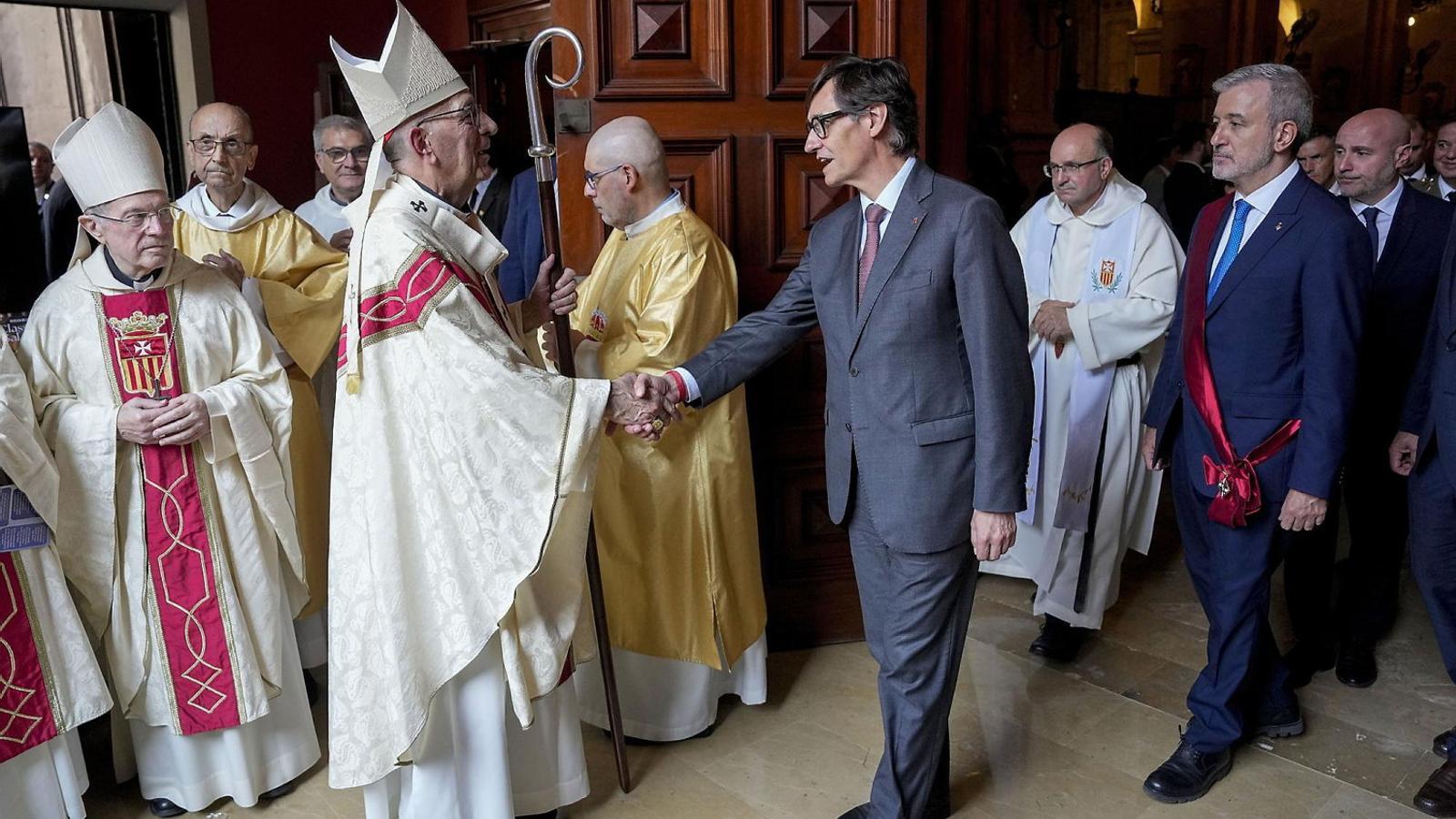
In a country that is both Catholic and priest-eater like ours, the relationship between religion and politics has historically been sinuous and critical. Polarization became very extreme during the Civil War, the echo of which continues to resonate. Vox-PP remind us of it every day. At the same time, there are surprising phenomena: we have, for example, a socialist president, Salvador Illa, who does not hide his Christian humanism in the midst of a society that is going in another direction, increasingly secularized and orphaned of meaning. And at the same time, we have an independentist far-right that banally warns about the dangers facing Christian civilization, whose values it does not practice.
Democracy urgently needs religionThe German sociologist Hartmut Rosa discusses this in the essay Democracy urgently needs religion (Fragmenta Editorial, translated by Marc Jiménez Buzzi). Certainly, the title catches the attention. A good title for a good book, which does not always happen. Rosa does not hide the reality of fundamentalisms: radical evangelicals in the United States, archaic and very harsh Islam in Afghanistan, the patriotic Orthodox Church supporting Putin in Russia, Hindu anti-Muslim nationalism in Modi's India... And we could go on, of course, also Netanyahu's criminal national Judaism in Israel. That said, the author sees religion as a two-faced god, like the Roman Janus: it can make people "receptive and transformable" and it can make them "authoritarian and fundamentalist." He leans towards the former possibility.
Faced with what it considers a "frenetic standstill" (an accelerated society that, however, no longer advances, does not progress), faced with "dynamic stabilization" (constant economic growth to maintain position, not to lose ground, even if it is environmentally unsustainable), it looks to see if the openness of religion can contribute anything interesting. Of course, it sees institutions representing religion as "undemocratic, retrograde, authoritarian," as an anachronism. So, what then?
His answer is that religious heritage contains a treasure: a listening heart. It is here that he sees an opportunity to break free from the global and individual logic that creates "a systematic relationship of aggressiveness towards the world": more energy expenditure, more multitasking, the fear of stopping, burnout, distrust of the different. An overheated lifestyle.
burnout, distrust of the different. An overheated lifestyle.
He does not deny, in any case, the technical progress achieved. Nor the path by which we have accessed it: "The market and capitalism were essential engines for creating all the opportunities and resources we have today." And yet, he believes we have reached a point of saturation, of resource depletion. That is why we are returning to the scourges of yesteryear: epidemics and wars. Today, general confusion is great, to the point that we no longer even know what to eat, how to inform ourselves, what is true and what is false. Everything is under suspicion. This creates great insecurity and dissatisfaction. "We gave up long ago on the hope of finding a good life and a successful relationship with the world," says Hartmut Rosa. Everyone is convinced that their children will live worse. We have lost the future and even the past, finally critically revisited with a colonial gaze.
All this has placed us in a deep democratic crisis. It is here that Rosa formulates his thesis: to replace despairing aggressiveness with a religious capacity for listening. "We have to stop shouting if we want democracy to work." How? He explains it with the concept of resonance, the willingness to listen, to let oneself be transformed, to become vulnerable, without seeking any concrete gain. It is the attitude he believes people have when they enter a church or temple and let themselves be penetrated by an inner silence. A similar openness to what happens before the immensity of the sea or mountains, or in the lushness of a forest.
For Hartmut Rosa, the advantage of religion is that it is based on a collectively created and shared attitude, ritualized and culturally practiced, which is why he speaks of religion and not simply spirituality. His is a view at the antipodes of theological dogmas, fanaticisms, and absolute truths. In fact, with Bruno Latour, he believes that "demanding a person to declare what they believe marks the end of religion." Then, can Rosa's free, receptive, and creative religiosity help save democracy?
