Are you looking for relatives who fought in the Civil War? A database of 37,002 militiamen is born
The archive of subsidies that the dictatorship took to Salamanca comes to light to dismantle myths about the conflict and help families find their relatives
-
CAT -
CAST
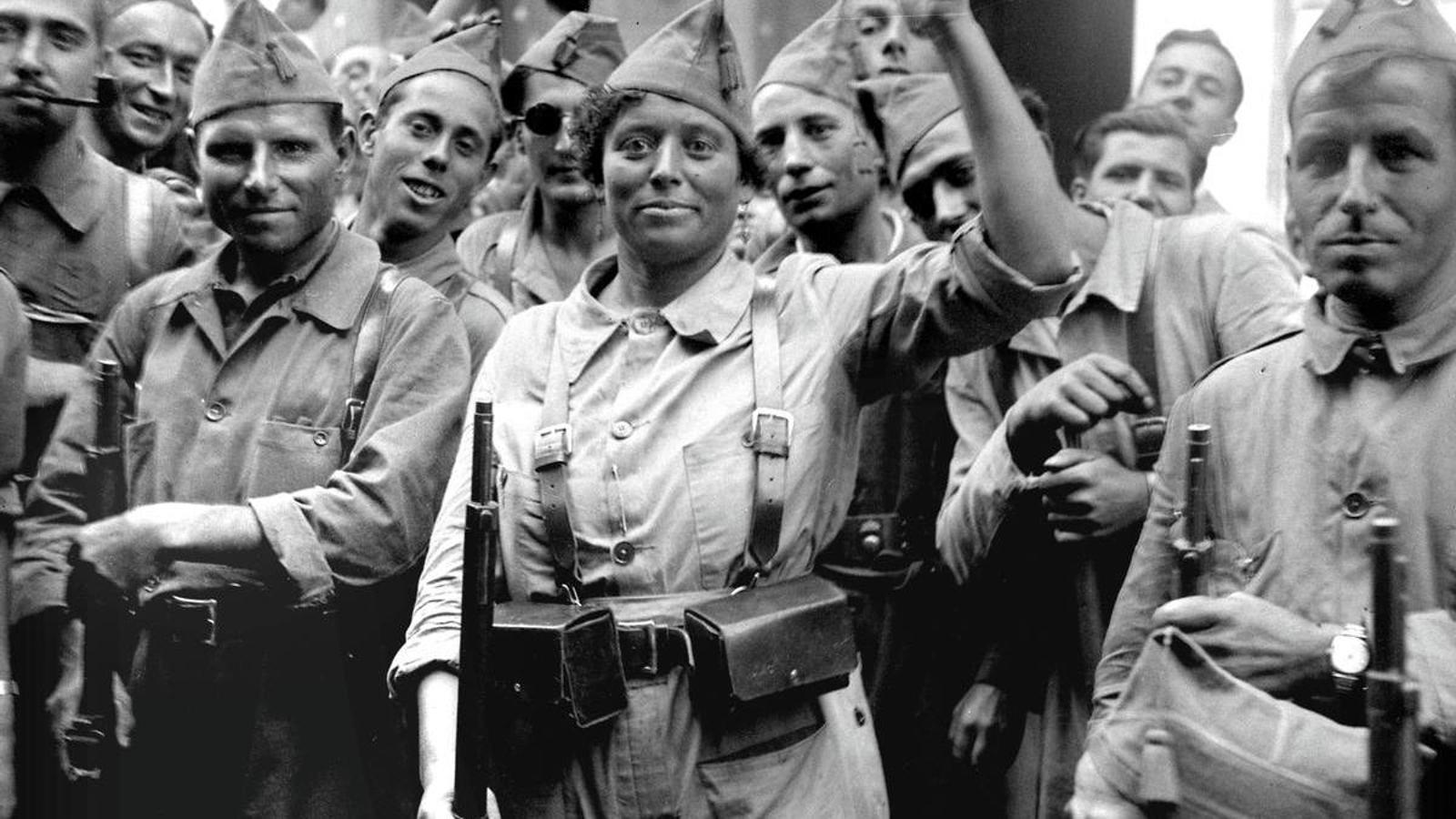
BarcelonaUpon the end of the Civil War, the Special Documentation Delegation of the Francoist apparatus confiscated tons of administrative documentation from the Generalitat and various entities with a clear repressive purpose. Among this documentation were the papers of the Generalitat's Subsidy Office, with the name, political affiliation, place of birth, and the fronts and columns where 37,002 militiamen and women had fought. Whether men or women, and regardless of their rank, they earned 10 pesetas daily. This documentation, after a long and intense mobilization of Catalan civil society, returned to Catalonia in 2006. It was the first intake, of 500 bundles, that arrived at the National Archive of Catalonia (ANC). This collection has made it possible for the Memorial Democràtic, with the collaboration of the archive, to create a public database of militiamen."With this tool, relatives and researchers will be able to find the life trajectories of their relatives," assures historian Gonzalo Berger, doctor in contemporary history from the University of Barcelona and specialist in militias. Berger has led the research that culminates eleven years of research initiated with his doctoral thesis. The human value of this tool is evident in testimonies like that of Marta Domper, who for years searched for proof of the history of her great-uncle, Joaquim Domper. "Sometimes I had even asked myself if he had really existed – she explains–. At home, my great-uncle had always been spoken of as a hero. He was from the CNT and went as a volunteer to fight against the rebels." Afterwards, he went to France to fight with the Resistance and never returned to Spain.

"My father used to say that my grandfather had been very brave. They spoke of anecdotes like when, at the Battle of the Ebro, he would leave the trench and steal food from the Francoist side. In France, the Nazis captured him, but then they released him," says Marta Domper, who had all this information because it was talked about at home, but nothing official, no papers, no documents, because Joaquim died alone in France, he never married or had children. "There were letters and papers, but they were either lost or burned. I searched a lot and found nothing until I came across Berger's thesis. He has collected the subsidy data and I found the day he went to the front, one of the first days, July 23rd, with the Durruti column," explains Marta Domper, who doesn't want her great-uncle's story to be buried under silence. "My father is losing his memory and it would break my heart if it were forgotten forever; for me it's like a debt," she adds.
From 1980 onwards, with the Transition, the return of all documentary heritage confiscated by the Francoists began to be considered. "Although the Ministry of Culture initially recognized the legitimacy of the claim, for years technical impediments were alleged to prevent its transfer. Between 1996 and 2003, the State's refusal was categorical, which triggered intense mobilization of Catalan civil society. Finally, thanks to restitution law 21/2005, in 2006 the first return of these funds to Catalonia took place, popularly known as the Salamanca papers", explains Enric Terradellas Prat, head of the Administration Funds area at the National Archive of Catalonia.
The 1,501 female militia members: "They were neither expected nor wanted"
All subsidy payment documents bear the Generalitat's coat of arms and control stamps, and include the name of the militiaman, the person who collected the aid on their behalf, the front, the population, and the payments received. "Thanks to the cross-referencing of data with the Human Cost of the Civil War census, the deaths of 1,900 of these militiamen have already been identified, in addition to documenting 500 wounded and 200 sick," explains Berger. "There were 1,501 female militiamen. It is an exceptional and massive fact. They were neither expected nor wanted, but they also decided to face the coup d'état. The majority were women with a prior political trajectory – states the historian. Many families do not know that these women had fought. Some went into exile and continued fighting, sometimes in the French Resistance, just as others returned and never spoke of it again; they had no other alternative but to accept the domestic and silent role of women that Francoism assigned them," he adds.
The military insurrection in Barcelona was considered a failure on July 20, 1936, but a significant part of Spanish territory remained under the control of the coup-plotting military, especially in Aragon, which represented a direct threat to Catalonia. To respond to this situation, President Lluís Companys signed the decree creating the Antifascist Militias of Catalonia on July 21, 1936. Composed mainly of volunteers from antifascist organizations and military personnel loyal to the Republic, these units had as their primary objective to contain the advance of the rebel troops. The Central Committee of Antifascist Militias assumed the organization, recruitment, and equipment of the combatants, and two days later, the first columns marched towards the Aragon front.
"To be able to collect the subsidy, militiamen had to have political or union backing to prove they belonged to one of the Militia Committee organizations; control was strict to prevent infiltrations by right-wing individuals. This gives us a very precise map: 39% were backed by the CNT, 25% by the PSUC, 10% by ERC, 6% by the POUM, 3% by Estat Català (recently refounded in 1936), 3% by the UGT, 2% by the FAI, and the remaining 5% by other entities such as Acció Catalana or the CADCI. This data helps us dismantle the myth that the militias were exclusively composed of libertarians," says Berger.
Although 7% of volunteers resided outside of Catalonia, Barcelona acted as a major recruitment hub. There is also a 3% of international combatants, many of them children of political and economic exiles in France. Regarding the fronts, the great threat was in Aragon, where most of the columns were deployed. There was also the expedition to the Balearic Islands, and between September and December 1936, some 6,000 Catalan combatants moved to defend Madrid. The rest were distributed in minor fronts and in the defense of the coast.
A lot of information lost
"Many sources had to be crossed. The documentary collection of Barcelona's subsidies is incomplete and military payrolls from various units had to be consulted. Furthermore, in the regional militias of about twenty municipalities, there is no direct documentary record of these subsidies; it is possible that these papers are in some corner of Ávila without being inventoried, or that they were destroyed," laments Berger, who assures that the database will be updated as new research and documentary sources that are currently dispersed or pending inventory in archives such as Ávila's are incorporated. For the historian, it is important to emphasize that all of them went to the war voluntarily: "Nobody forced them to go and fight and that makes them special, because we are talking about a war, which is the worst experience a society can go through."
"This database responds to the popular and civil resistance that was organized immediately after the failure of the military coup d'état in Barcelona on July 20, 1936. We are not explicitly commemorating the Civil War, but we do remember its 90 years because it is the most transcendent and defining episode of our recent history, with social and political consequences that reach to this day," assures the director of the Memorial Democràtic, Jordi Font. The new tool is part of a much broader project, the Memory Bank. "This initiative is, in essence, an exercise in public history: we transfer the rigorous work of academia directly to society," he adds.
"Presenting this database is celebrating the return of documentation that was taken from us to be used as a tool of repression against our population. Today, thanks to this project entirely developed by the Memorial Democràtic and shared with the ANC, we are returning this documentation to the citizens. They are testimonies – such as the diary of Pilar Duaygües i Nebot (1921-1998), of which we will publish about thirty audiovisual clips, combining it with selected images from our documentary sources to illustrate what is explained – that tell us how the war was lived and suffered from below," states Pilar Cuerva Castillo, director of the National Archive of Catalonia.

