Crisis at Royal Mail: Widows and widowers no longer have anyone to write them condolence letters
The unreliability of deliveries, with 16 million delays during Christmas alone, reaches the British Parliament
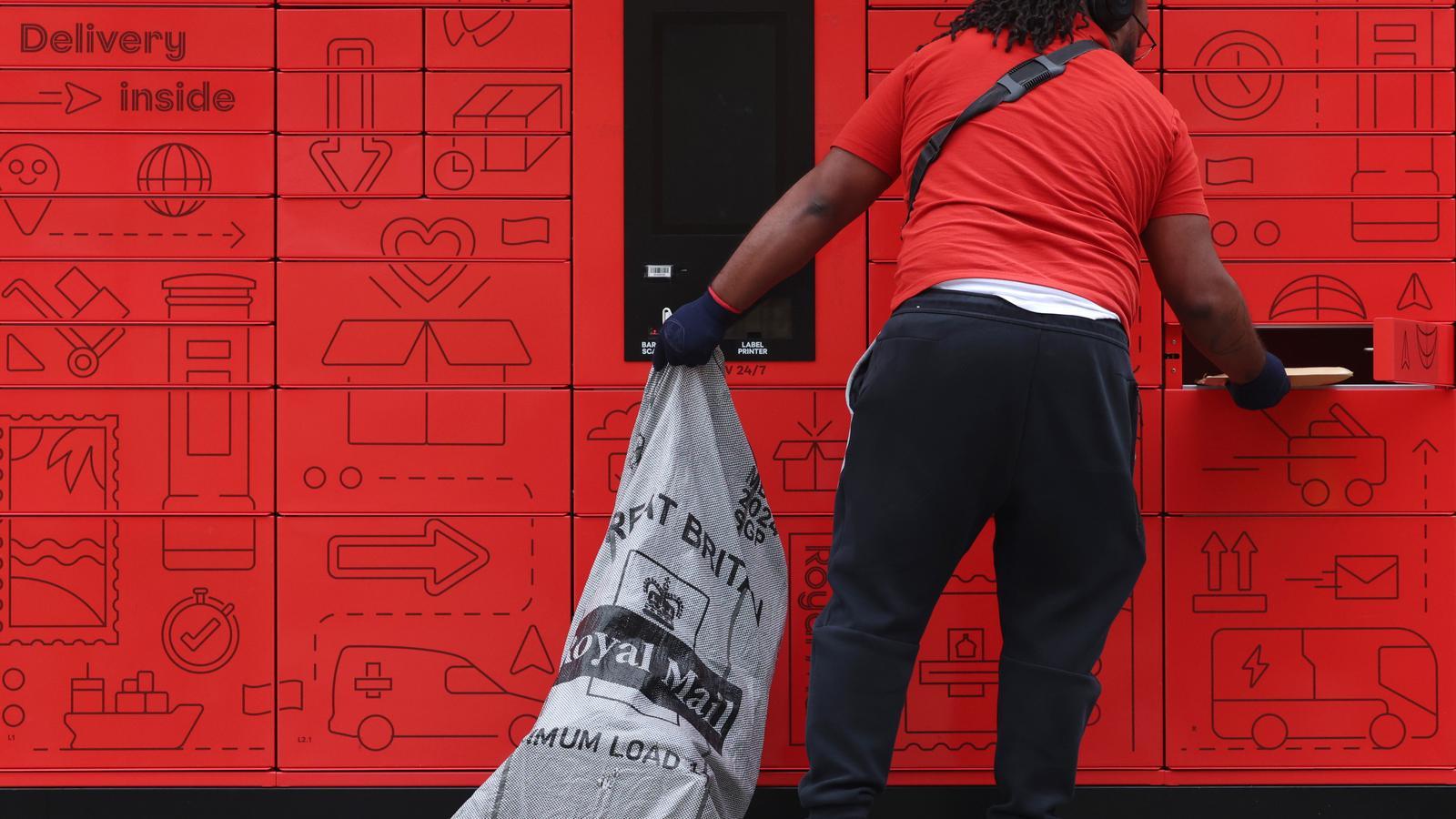

LondonSometimes, throwing a letter into a mailbox can be like throwing it into a black hole. A few days ago, Jason Bevan, an eighty-year-old pensioner living in the small town of Lidney, almost 200 kilometers west of London, lamented in the letters to the editor section of the Daily Telegraph about the unreliability of Royal Mail, the iconic British postal service. His wife, to whom he had been married for fifty-eight years, died in January and the man explained: "I received many condolence cards and was expecting more after an announcement in the local press. However, I didn't receive any mail all week."
Puzzled, he mentioned it to the local postman. And a few days later, he handed him 13 more condolence cards that, with second-class stamps, had been left in the local depot waiting to be delivered. "We can no longer rely on Royal Mail to do its job," Bevan concluded his complaint.
This is not an isolated case. The reason for the accumulation and delay in delivery is, according to service workers, increasingly common: second-class mail is held until there is a sufficient quantity of first-class letters to justify its delivery from the large regional distribution centers to the local county offices. A first-class stamp for an ordinary letter costs £1.80 (€2.07); a second-class stamp, 91 pence (€1.04).
The owner of Royal Mail, Czech billionaire Daniel Kretinsky – owner of 50% of Caprabo, among many other businesses–, stated last week, before the Parliamentary committee that has addressed the service crisis, that "if you want to send a letter [with a first-class stamp] from Brighton to the Scottish Highlands, it has to be delivered the next day for £1.80. And it's not an easy job." The distance is approximately one thousand kilometers.
A barrage of criticism
A similar service in Italy costs 5.60 euros. And in Spain, between 7 and 15, if you want to guarantee it reaches its destination in 24 hours. Despite everything, Kretinsky defended the task of Royal Mail. But it is not easy to increase the price of the service due to the purchase conditions and government regulation on mail. The second class is regulated. And, even so, it has become 74% more expensive since 2013, the time of privatization. The price of first-class stamps –unregulated– has increased by 183% since then, well above an accumulated inflation of 40%.
The fact is that since the beginning of the year, the press on the islands has been full of stories like Jason Bevan's. And there is a common narrative that this correspondent himself experienced as recently as last week. For days and days, there is no mail. And, suddenly, seven or eight letters arrive all at once.
David Pearson, a seventy-year-old retired businessman from Haworth, in West Yorkshire –home of the Brontë sisters–, explained to the Daily Mail in late February that he lost the first delivery of a traffic fine. Months later, what did arrive was the notice of legal action and bank account seizure for not having paid within the legally established deadline. He had to take urgent action.
In the days leading up to Christmas, the crisis at Royal Mail had a special impact in Derry, Northern Ireland. Holiday greeting cards and, more seriously, hospital appointments experienced serious delays. The Communication Workers Union (CWU) reported on January 7 that 40 temporary employees of the company were transferred there from England to help clear the backlog at the local depot. But they did not get ahead due to a problem, the union denounced, "of years of lack of investment and facilities unable to manage large volumes of packages". Derry was the tip of the iceberg. In total, across the country, sixteen million letters arrived at their destination late.
From Birmingham to Newcastle
And last Friday, The Sun published a list of the thirty postal districts where the crisis has had the biggest impact, located in cities like Birmingham or Newcastle. The list, which spans the four nations of the United Kingdom, was no invention of the unions. It was the admission of the company itself that, in a statement, attributed the delays to causes such as "high levels of sickness absence, lack of resources, or other local factors," such as bad weather.
Between April 2025 and January 2026, the first eight months since Kretinsky acquired full control of Royal Mail, only 74.9% of first-class mail was delivered on time, when the service's target was to reach 93%. That was the reason for his appearance in Parliament. And also that the body responsible for the reliability of postal delivery fined the company £21 million.
The calculations of their lordships suggest that the difference between targets and reality equates to approximately 126 million first-class letters that arrived late last year. And if nothing is done, with almost 10% of second-class letters also affected by delays, between 219 and 220 million letters will arrive late or very late this year.
Kretinsky had to admit to MPs that Royal Mail "is not fulfilling its promises." Despite this, he denied "any deterioration of the service" and also the accusation that the company prioritizes the delivery of packages, which are more profitable, over letters.
Royal Mail, privatized in 2013 with its stock market listing, is accumulating losses (£348 million in 2023-24, the last fiscal year for which data is available) and is seeing the volume of letters plummet. From 20 billion in 2004-05 to 6.6 billion in 2025 and a projected 5.6 billion this year. Packages are growing to 3.9 billion, but this has not yet translated into profitability. All this in a context of increasing competition from FedEx, DHL, Evri, DPD, or Amazon, which has caused the package market share to fall from 45% (2014-15) to 35% (2023-24).
Changes in labor and a reduction in staff are looming on the horizon of Royal Mail, despite the temporary limitations arising from the full control of Křetínský's EP Group. It is highly probable that the letter business will continue to decline and may eventually become residual. A service founded in 1516 by Henry VIII, initially for the exclusive use of the court, and which opened to the general public in 1635, is experiencing an uncertain moment of change in its business model.
