Anna Amigó Vilalta: "What I am singing, the harp also says"
Singing and music
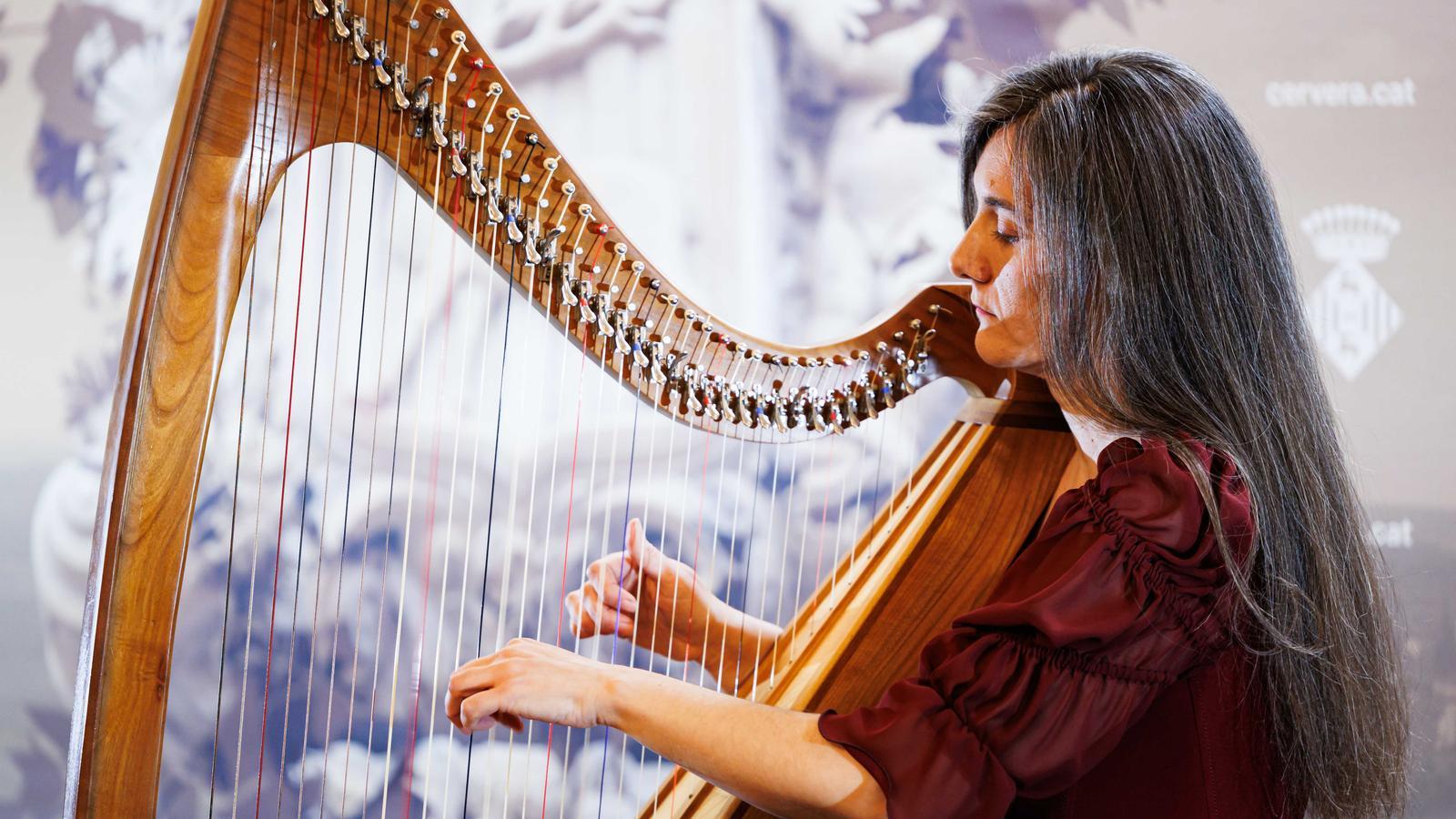

The singer and musician Anna Amigó Vilalta (l’Espluga de Francolí, 1982) will participate this Friday in the semifinals of the World Harp Competition, in the Netherlands, which brings together the best harpists in the world. Amigó is the first harpist from the State to reach the semifinal of this competition. She will attend with the Celtic harp and her work Sang de dona, which has been seen on stages in Catalonia and abroad for a year.
What is the World Harp Competition?
— It is a competition in which harpists from all over the world participate and go through different stages. I have passed two and the third, the semi-final, is when they invite you to go in person. In the first stage you send a song and a jury of three harp specialists either disqualifies or selects you. In the second, you have to make a video of the project you would play and another jury of three different people evaluates you. In the semi-final it will be a jury of seven people, very diverse.
How many semi-finalists are there?
— Fourteen, but one has fallen and we will be thirteen. During April 16 and 17, each of the semi-finalists has 45 minutes to present our project. The last one is me. The jury will choose three, who will go to the final on the 18th. In the final, it's ten minutes. It happens that on that day a very important harp festival is taking place, with artists from all over the world in various venues. The finalists open the performances and the winner is chosen. There is a fourth prize which is the public's vote and which can be a semi-finalist. Semi-finals and final can be seen online and everyone can vote.
Recently, she has been a finalist in the Enderrock awards for best emerging artist in classical and contemporary. It is a year of recognition.
— And so! I'm very happy. Being nominated was a surprise because there were many candidates. And it was with the public's vote. It means there are people who have seen you and say this is worthwhile. And they vote. It's an award to be a finalist.
We have seen him sing, play the violin. How does he get to the harp?
— I liked the harp since I was little. In Catalonia, there are only five or six places where you can learn to play, and they are in the metropolitan area of Barcelona. I am from Espluga de Francolí. I said that if I lay the harp flat, it's a piano, but my parents answered me that my sister already played it. And I had to play an instrument that I could play with my sister, and they put me on the violin, as they could have put me on a clarinet. I don't regret playing the violin. I was learning it from eight to nineteen years old.
And the harp?
— I went to Scotland and it came out again there. I was seeing it. And when I was in Belgium, I took the violin to the luthier. It was a string shop in Antwerp and it had a display case full of harps. And I told him that while he cleaned and put my violin in order, I would look at the harps. And he encouraged me to play. The next day I looked for information about a harp school and the following week I was already buying one. It was 2009. I was working and attending the Brussels Harp School. There I met Eva, who had been playing the harp since she was eighteen, and she with the harp and I with the violin formed Formiga & Cigale in 2012.
How did you learn to play the harp?
— I spent a year and a half at that school and then, self-taught. I know I want it for singing, not to be a great soloist in a philharmonic orchestra, and I've been able to set a much more accessible path for myself. I've been following along with workshops with different artists from around the world. Last year, for example, I took a Scandinavian music course with Ariadna Savall.
How is the Sang de dona project born?
— It was 2020. My father died in March and we were confined to l’Espluga. My luthier, Llibert Ribó, lent me a harp because I didn’t have mine here. In August we were still here and a town proposed I go there to play. Until then I had played a maximum of three songs at some institutional event, but never a full hour-long program. The public's reception was very good. And I saw that I could contribute something that wasn’t being done at that time. I continued arranging songs. I already had some by women, but I started looking for more specifically to have a range of different female characters.
He went to the Alcover Arts Convent to do a residency.
— I used to perform concerts and everyone would ask me if I had recorded material. You kill yourself recording an album and who buys it? And if you put it on social media, what will they pay you for the hard work behind it? The importance I give it is the live experience of the people who saw me. But I gave in and said: I'll record it. I had already played the album a lot, but I added new songs. I had integrated 75% of the album very well. Sang de dona is more than music. It's a concept. It's social. The harp is not an instrument for accompaniment, but rather what I am saying, the harp also says. It is very dramatized. These are problems of women from centuries ago that still exist.
What did recording it in a space like the Convent de les Arts bring to the album?
— It is a space that offers a lot of possibilities, because you can play on top of the stage of the old church, but there are also many chapels and depending on where you position yourself it has one sound or another. You can go to the cloister or also to a recording studio that has been recently set up. You don't bother neighbors because it's soundproofed. When you finish work, you cross the cloister, whatever the time, you do a mental cleansing, and you open another door and go up to the residence, where you have a table, a bed, a kitchen, a terrace... That's a luxury. I already knew it, because I had played there and had done another residency with Formiga & Cigale. For me it was very important to play in a place that knows me and knows me and without set hours.
How did the work go?
— It was presented on March 8, 2025. For people who hear the album, it's like coming to a concert. It's very organic. I've played in large venues, like the Convent de les Arts, in the hermitages of Montsant in the middle of nature, at the Episcopal Archive of Vic or at Parc Nou in Olot, which is immense. They are very different places. And in Olot something very interesting happened to me. I sing very wild songs, in which they rape and kill women. In La dama de Reus, she ends up getting revenge on the captain, who had raped her and killed her husband, by stabbing him. The public normally says nothing and in Olot they shouted "Come on" and applauded.
Each audience is different.
— There is no concert the same. And you can't choose one either because each audience transmits a different energy to you.
For a few years now, he has been dedicating himself one hundred percent to music. Was it complicated to take this step?
— A lot. I had always chosen to have a fifty percent job and dedicate the other half of the time to music. Covid caught me in Catalonia. First I wanted to continue my work from Belgium online and it wasn't possible. I found myself here with no job and they started offering me concerts.
And he has been able to live off music.
— Yes. I do concerts, institutional events, workshops in schools and cultural centers and libraries, where I explain the instrument.
