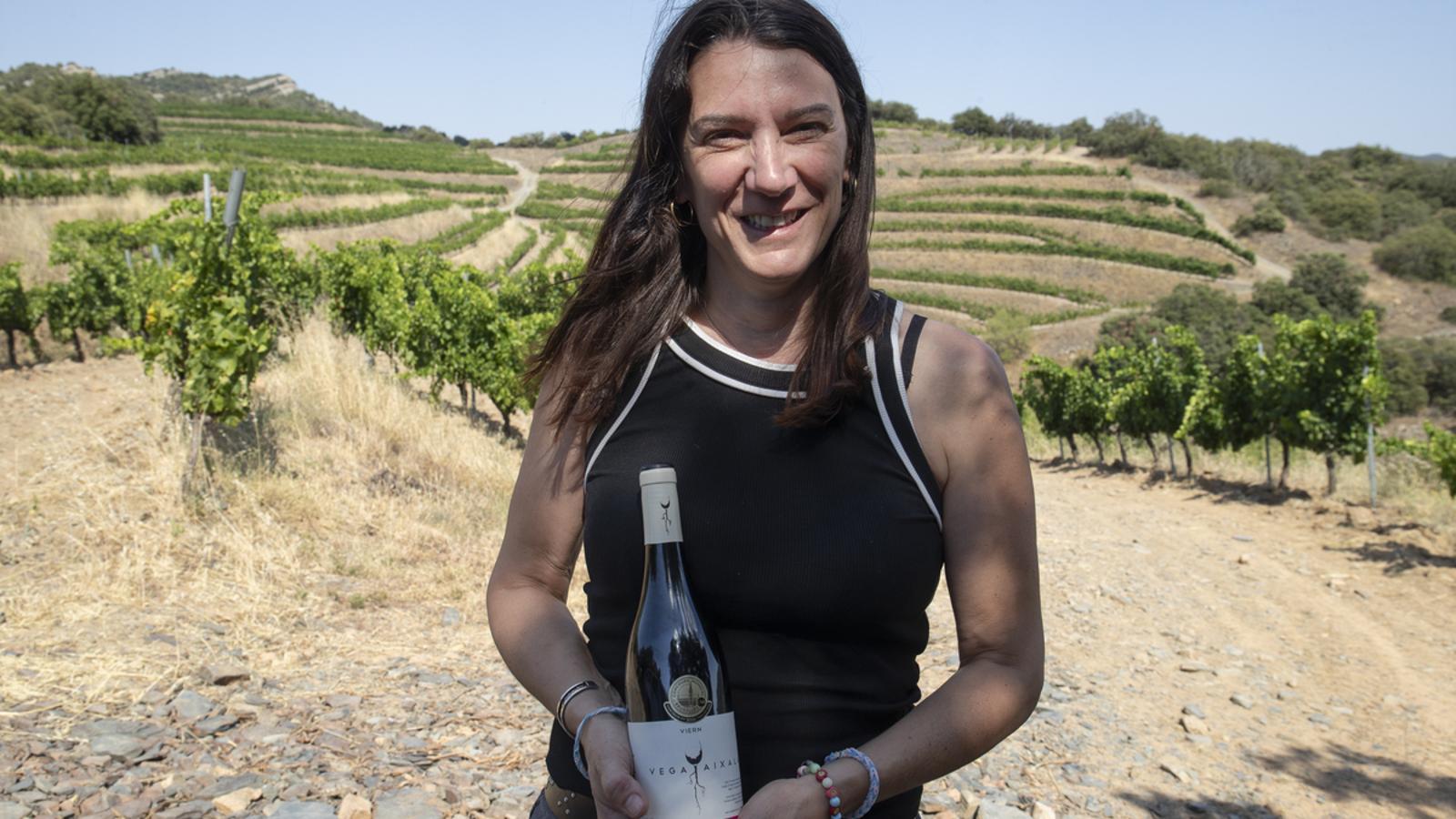
Eva Vega: "We can do something so that a lighter wine comes out, but we want to make the wine that the territory gives us"
Winegrower from Conca de Barberà

-
CAT -
CAST
Vilanova of PradesThe wine made by Eva Vega and her father, José Antonio Vega, from Vilanova de Prades (Conca de Barberà) has already received different gold medals at the Brussels World Competition, but this year their Viern 2015 has even obtained the Revelation Wine of Spain Award, which the same jury only grants to 14 wines out of the 6,700 presented. This wine, which is one of the many produced by the Vega Aixalà winery, fed by a 10.5-hectare vineyard, will go on sale in the coming days.
You haven't been dedicating yourselves to wine for long, but you already have experience in winning awards…
— Yes, we already have two Grand Gold Medals, one Gold and one Silver.
And this year, for the first time, the Revelation Wine of Spain...
— Yes, in fact, we didn't even know about this mention, but it turns out they only give it to 14 wines out of the 6,700 that are presented. So it's important.
What is Viern wine made of?
— Of Garnacha Negra, Cariñena, Cabernet Sauvignon and Syrah.
If it has so many awards, it must be very expensive.
— No! It's around 20 euros.
With this distinction, the wine will sell itself, won't it?
— No, I don't think so. It's a recognition for the winery and also for all the wines we make, not just for Viern. What makes me especially excited is that they are giving this award to a 2015 wine, because 11 years have passed and if it has been well preserved, it is very important.
What is the secret?
— The altitude helps. Making wine at 900 meters altitude gives you higher acidity, lower PH, and all of this is a natural antioxidant. It allows us to make wines for aging that you can keep for many years.
Apart from the work you do in the field, there is then a whole process in the barrel.
— We age for approximately 12 months in barrel, which is the standard for the crianza category, and we have selected barrels, of a certain quality, some new, others second or third year. We make 3,000 bottles of wine.
The jury highly valued “its complex nose of sweet spices, plums, and black tea”. Would you have described it the same way?
— This black tea thing surprised me..., but yes, ripe fruit yes, but with red notes. It has a good passage in the mouth, it is pleasant... and the wood is there, but it does not hide the essence of the wine.
Do you sell them all?
— Yes, perhaps in a year or a year and a half.
In total, how many bottles does your winery produce?
— Between 30,000 and 35,000 bottles.
And do you get the numbers?
— Yes, but we have to sell all the bottles. The market is changing now, but more or less we sell them.
How is it changing?
— Less is drunk. Apart from all the political instability, with tariffs and wars, there is also a generational factor, that younger people do not drink what we used to drink. And older people also drink less and less.
Has come to stay?
— I hope not! But all of this is here.
Wines with low alcohol content have a better market. Are you going in this direction?
— We do what the territory gives us. We do make something so that a wine can be a little lighter, but our varieties are full-bodied, with good acidity and character, and we don't want to change it, despite the trend. There are still many people looking for these wines. We also continue to bet on celebratory, winter wines, with more body. We are lucky that thanks to the acidity, they are wines that have body but are smooth. We find a good balance.
It's surprising that with so few years making wine you already have so many recognitions. Is this the formula?
— I don't know, we are new. We have been making wine for 19 years, we are first generation. But the territory gives us the altitude and the slate and the conditions here give us a top-quality product. We also take great care of the vineyard.
What does this mean?
— Be very on top of it. You can't neglect it for a moment. Making short pruning, not wanting to overproduce it, doing the treatments it needs at the optimal time, giving a little supporting water for the drought…
Without water is it impossible?
— Nowadays I think so. This year 350 liters per square meter have fallen… and last year we faced the campaign with just over 200 liters per square meter. When we started, the rainfall was 600, 500… I even remember one year with 700 liters. And all this with heat waves.
In the Conca de Barberà you are first cousins of the Priorat…
— The soil is the same, slate, and the climate, more or less, is quite similar. Perhaps ours is a bit more continental. And the other difference is the altitude, here we have the vineyards at a higher altitude.
The fact that things are going well for you has encouraged someone around here to make wine?
— There are those who help us with the harvest and buy some grapes to make their wines or who want to learn to make their own wine afterwards. When you start, you have many questions, and so we share experiences just like when we started.
How does all this start?
— My grandfather had hazelnut trees, but he also had half a hectare and made his three or four barrels to make rancid wine. But my father, who had always been interested in wine, left his job in 2003 and invested all his money in this project.
They would say he was crazy...
— Yes, he is crazy.
And what did you do before joining this madness? And when did you do it?
— I used to work in an accounting firm and I joined about 12 years ago.
What other wines do you make?
— We have up to 20 different references. Some are more classic or conventional, but we also make natural wines.
What does natural mean?
— We don't add any additives.
And what difficulties does this entail for the winegrower?
The wine is less protected and suffers a little more. Fortunately, here at altitude we have acidity, which acts as a natural preservative. But we have to keep doing tests, first making 500 liters and then growing...
Do you do a lot of experiments with wine?
— Phew, yes, a lot of things: we've tried with sparkling wines, ancestral wines, brisat wines, white from noir too…
And if it works, go ahead.
— Yes, you try with small quantities and if it is liked, next year you make more... It will have the differences of the vintage but...
Do you expect a good harvest this year?
— If we have no misfortune, yes.
What scares you the most?
— Let a surprise dana-type storm come...
