The pioneers of the pharmaceutical industry in the regions of Tarragona

-
CAT -
CAST
When speaking of the origins of the Catalan pharmaceutical industry, the narrative usually focuses almost exclusively on Barcelona. This is a logical association. Companies like Uriach, Viñas, or Esteve, along with the establishment of the first German pharmaceutical multinationals, eventually turned the Catalan capital into the main drug production center in Spain. However, this view often sidelines a little-known but highly significant phenomenon: the role played by the Tarragona region, and particularly Reus, in the early stages of this industrial activity.
During the first decades of the 20th century, the province gathered a surprisingly large number of pharmaceutical laboratories for a territory far from major industrial centers. Some of these laboratories achieved national recognition, registered dozens of commercial brands, and even manufactured specialties under license from prestigious European laboratories.
One of the first examples of pharmaceutical activity with industrial intent was that of the pharmacist Modest Nadal Riera, initially established in Tarragona. In 1902, he registered a trademark to protect the commercialization of Emulsión Nadal, a preparation based on cod liver oil enriched with other ingredients. Two years later, he expanded his catalog with Emulsión Alfa and Jarabe Nadal, the latter advertised as an award winner at the Athens Exhibition of 1903, and also registered a generic brand under his own name. His pharmacy was located at Carrer Major, 14, in Tarragona, until he moved his activity to Reus in 1926.
Another singular initiative was the manufacturing of Agua del Carmen by the Discalced Carmelites of Tarragona. Production began in 1909 at the order's convent and, from 1911, Tarragona became the production center for this preparation for the Spanish market and a large part of Hispanic America. For its elaboration, the religious had their own facilities and salaried staff, predominantly female. Marketed as a pharmaceutical specialty with digestive, antispasmodic, and sedative properties, Agua del Carmen was distributed to pharmacies throughout Spain thanks to intense advertising activity. Its production remained in Tarragona until the 1980s.
Before the Civil War, pharmaceutical laboratories also operated in Tortosa, where Climent, Gallosch, Queralt, and the Quimioteràpic de l'Ebre stood out, the latter known for the popular Tosiletas and other products under the Geve brand. In Alcover worked Tomàs Serra; in Montbrió del Camp, the Fenoll laboratory; in Mont-roig del Camp, Mont Reis; in la Riba, Calmet Carreño; and in Ulldecona, Viladot Sala.
Among all these initiatives, Reus ended up consolidating itself as the main center of the pharmaceutical industry in the regions of Tarragona. This development was not a matter of chance. Reus brought together a combination of factors difficult to find in other Catalan cities: a dynamic economy, a long commercial tradition, good communications, an entrepreneurial bourgeoisie, and a generation of pharmacists willing to take business risks. The sum of these elements turned the city into one of the main hubs of the Catalan pharmaceutical industry during the first third of the 20th century.
One of the keys to understanding the genesis of the pharmaceutical industry was the role of drugstores. The large Reus drugstores – such as Antiga Casa Coder or that of José and Melchor Bufill – distributed chemical products, pharmaceutical specialties, food supplements, and mineral waters to a large part of the territory. Long before the advent of modern pharmaceutical distributors, these companies acted as large wholesalers. Furthermore, the emergence of industrial pharmaceutical specialties completely modified traditional pharmaceutical activity. Some professionals decided to adapt to the new times and took advantage of the chemical knowledge acquired at university to create companies capable of producing medicines on a large scale.
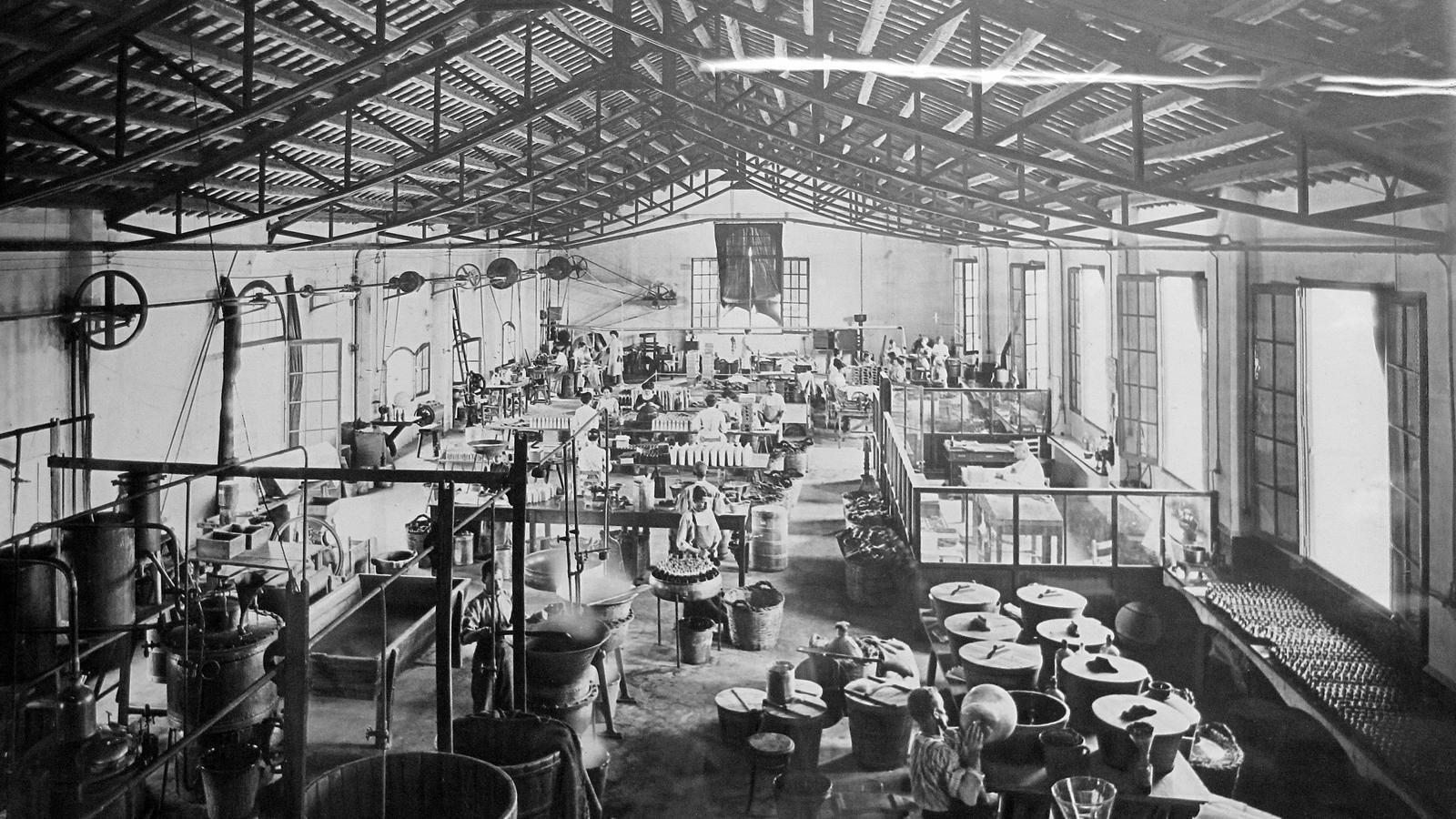
In this context appeared the figure that would mark a turning point in the history of the sector: Antoni Serra Pàmies. Son of a humble family, a pharmacist trained at the University of Barcelona and established in Reus, he transformed a pharmacy into a true industrial company. He was the sole Spanish manufacturer of Bayer's Aspirin during a decisive period, produced specialties under license from laboratories such as Bayer, Merck, Poulenc, Vial, or Wander, promoted the popular Litines Serra – the first lithinoid manufactured in Spain – and developed intense activity in the commercialization of bottled mineral waters. Furthermore, he created an important pharmaceutical distribution company, integrating manufacturing, commercial representation, and pharmaceutical distribution into a single organization. His facilities on the Castellvell road came to employ nearly 250 workers, an extraordinary figure for a Catalan pharmaceutical company of that time.
Serra Pàmies' success demonstrated that it was possible to create a competitive pharmaceutical industry from Reus. Shortly thereafter, other business initiatives emerged that consolidated this tradition. The Vallverdú family, creators of Laboratorios Klam, stands out as an example. Salvador Vallverdú Gebellí developed various pharmaceutical specialties, but it would be his son, Josep Ramon Vallverdú de Cortada, who would turn Almendrina into one of the best-known food brands in the State. Born as an almond milk elaborated in a pharmaceutical laboratory, Almendrina would eventually become a product present for generations in thousands of Spanish homes.
Another essential figure was Arturo Punyed Lloberas, promoter of a laboratory with a marked industrial vocation, who developed numerous pharmaceutical specialties and participated in projects related to mineral medicinal waters. Alongside him, we should also remember pharmacists such as Pau Ornosa, Josep Benet Soler, or Francesc Cahué, whose innovative anesthesia was distributed throughout Spain.
