Josep Gonzàlez: "At fifteen years old, my father put me at the head of the workshop"
Artisan pastry chef

-
CAT -
CAST
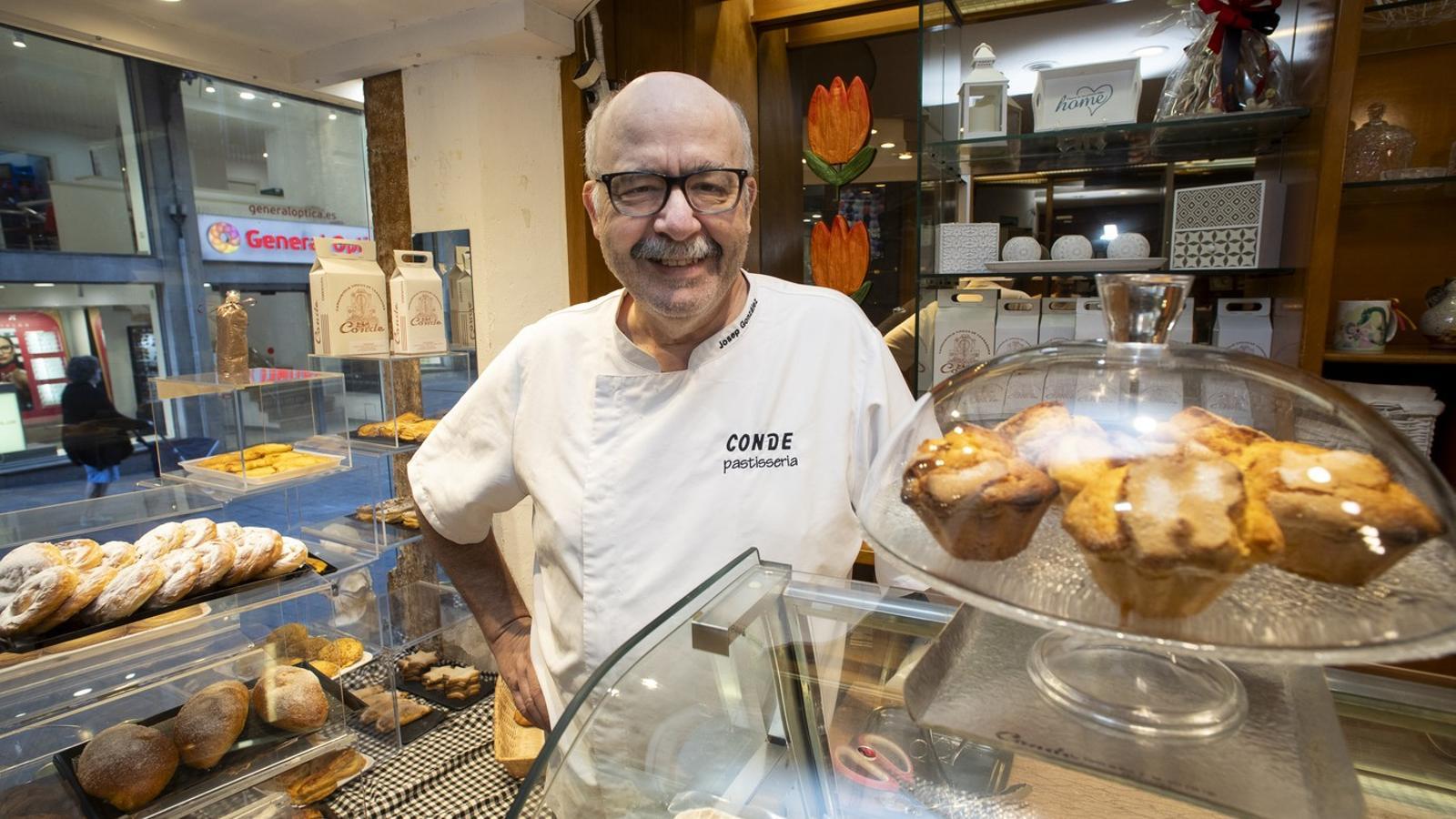
Josep Gonzàlez Catalán (Tarragona, 1962) has spent his whole life between the workshop and the counter. His father, Josep Gonzàlez Vidal, founded the Pastisseria Conde in the center of Tarragona in 1966, and in the eighties, he promoted the creation of the Guild of Artisan Pastry Chefs of the Tarragona Regions. Now the son is at the head of the historic pastry shop and the guild. He feels very much from Tarragona and has invented sweets linked to the city, such as the Sant Magí Cane, the Santa Tecla Joy, and another one for the celebration of the 200 years of the Siege of the Peninsular War. We talk to him about the trade and the situation of the sector.
All Saints' Day is approaching, one of the strong dates for pastry shops.
— Yes. As of now, bakeries are surviving thanks to the special holidays. Day-to-day business is very tight, we are getting by. Sundays are still quite strong, but it is the holidays that help us make enough revenue to keep going.
And are panellets still going up in price?
— The almond is more or less stable, but the pine nut is the one that fluctuates wildly. Nowadays, you can find pine nuts on the market for 122 euros per kilo. It is the Castilian pine nut, because there is the other type of pine nut, which is the Chinese one, which goes for under 30 or 40 euros, but the quality drops significantly, because it has no taste.
We have been finding panellets in supermarkets and large stores for days now.
— A few days ago I saw some panellets that made my stomach churn. I don't know how a bakery can do this, which is what it said.
If we look at the city of Tarragona, we see that very few artisanal pastry shops remain.
— Very few. Right now there must be about seven or eight pastry chefs, because a group of young people has joined. They have specialized, which is one of my satisfactions. The latest member to join the Guild of Artisan Pastry Chefs of Tarragona has been a bakery specialized in making gluten-free products. I think it is very important to be able to provide solutions to people who have any allergy or intolerance. And to vegans too.
In the province, how many pastry chefs are members of the guild?
— We are now 36. When my father and his colleagues founded the Guild about forty years ago, there were more than 200. There are more, but some do not register. I do not believe much in forcing people to do things, but I think in this case it would be interesting. For the sake of food, everyone who sells pastry should be a member of the guild.
Why?
— Because the Guild finds out about many things, such as products that come onto the market, and informs all its members about them. Serious contacts, contacts with the administration, which would make them do their job better. And they do not register because many of these shops that open are not professional pastry chefs. They are amateurs, who do it quite well because they like it, they are excited about it, but they are not professionals like us, who even pass it down from parents to children. Furthermore, we have been through pastry schools, where they have taught us the foundations of everything. Without the foundations, you cannot do pastry making.
In your case, were you predestined to be a pastry chef?
— I have been in this pastry shop since I was four and a half years old. At that time my father had fifteen or twenty employees, and when I arrived from school the workers themselves would prepare a piece of dough for me on the corner of the table so I could do my own things. Sometimes, if I made a well-made croissant, they would proof it and bake it for me so that when I came back I would see it. My father and the workers were a family. We loved each other very much and we all took care of one another. I grew up with that love for my pastry shop, and for pastry making in general. Now all of this has changed a lot. Finding a pastry chef is super complicated, and if you find one, they are not well prepared.
Not enough succession?
— There is not enough succession. We have a disadvantage: we work on holidays and Sundays, and all holy days. Probably, together we should find a solution to attract pastry chefs, so that the world of artisan pastry making does not get ruined. Pastry making will continue, but I do not know where the artisan one will end up. In Tarragona itself, this pastry shop is the last remaining establishment that has passed from parents to children. There is also my colleague from Trill pastry shop, whose daughter works in the shop, but if we are talking about the succession from pastry chef to pastry chef from father to son, I am the last one. You have many problems, and not only because of the lack of workers, but because the administration suffocates you with everything. Regulations here, regulations there... Personally, I spend half the morning preparing paperwork for regulations. Before, you spent more time in the workshop.
Next year you will turn 65. Do you see retirement as being close?
— My friends are all retired and they always ask me: "Josep, what about you?" Before, I used to tell them until I am 70 or 75 years old, if the body holds up. I am very happy doing my job. Now I am starting to not enjoy it, because I see all these problems. There are moments when I get excited. Right now I have two Erasmus students from Romania and, look, I am excited to be able to try to teach my Catalan pastry making to these people.
Pastry chefs wake up very early.
— When I was young, it was hard for me to see my friends going out to party while I had to go to work. But I had that culture of effort that my parents, my grandparents, taught me. At 15, my father put me in charge of the workshop.
At 15 years old?
— At 15 years old. And my father would say to me: “And now what should I do?” “Dad, do I have to tell you?” He would answer that yes, that I was learning to be a good leader. And then I would tell my father and officers who were his age what they had to do. My father already transferred this stress to me when I was very young, and I think that has been what made me fight so hard for this profession and love it so much.
Regarding the guild, what work are you currently doing?
— We encounter many hurdles placed by, so to speak, the Generalitat, which demands many things from us in order to give classes. It seems we are closing the circle a bit. We have held quite a few classes at the school we have and we have succeeded in the sense that some students have moved forward. Now we are setting up some courses with the Department of Labor of the Generalitat. Later we will go to Education. They will see that we have experience that they will be able to value.
