Four years to shoot a scene: ARA enters the exclusive studios where 'Wildwood' has been created
ARA enters the Laika studios in Portland, one of the few that are fully dedicated to this cinematographic technique, and which are now releasing 'Wildwood'
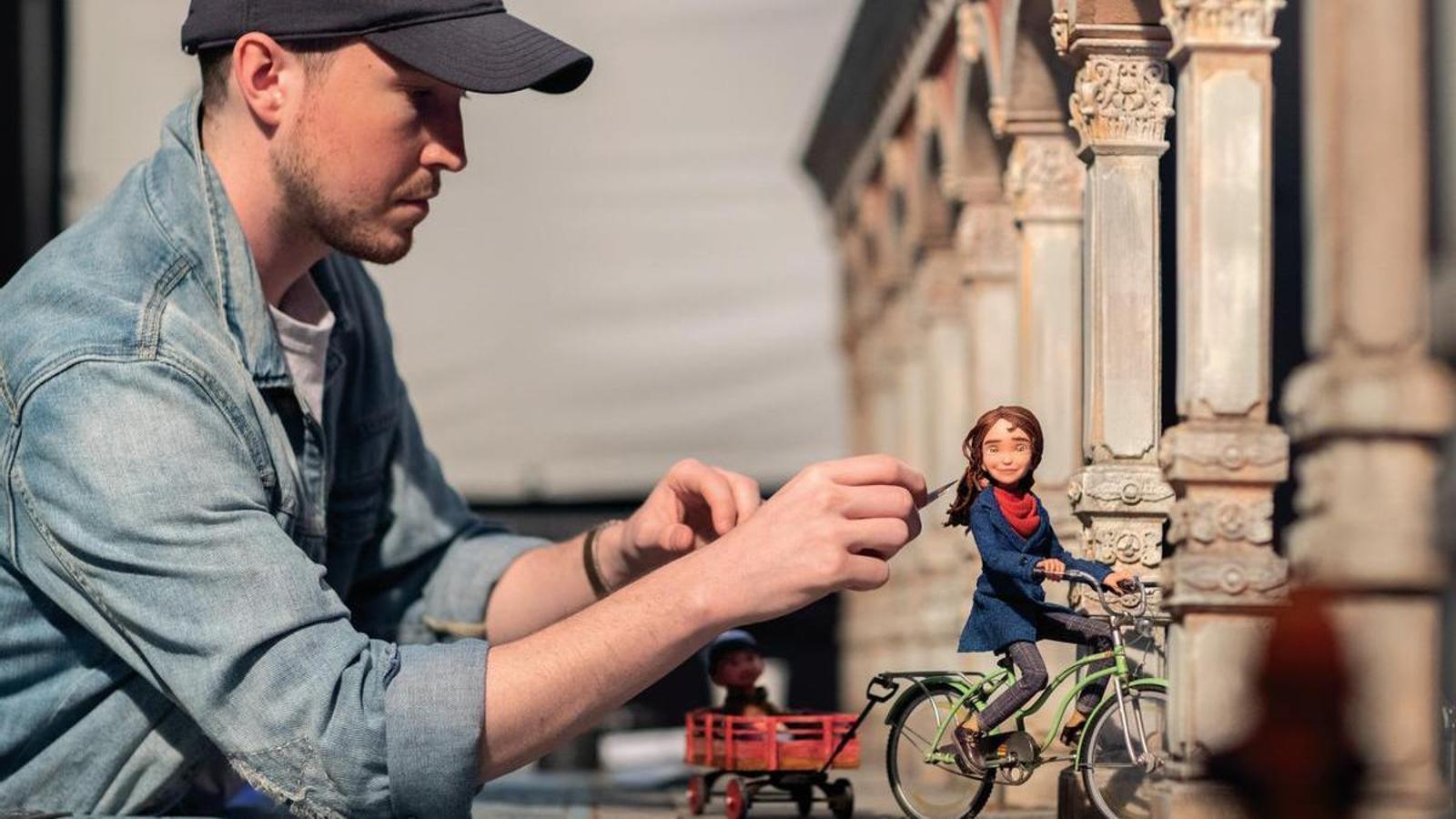
PortlandGetting lost in the labyrinthine corridors of Laika studios, located on the outskirts of Portland, the cultural and gastronomic capital of Oregon, in the United States, is like taking a walk through the history of cinema. During an exclusive visit by the newspaper ARA this summer, we were struck by a total silence. Wildwood, their latest film, the sixth and most ambitious of them all, is in the final phase of post-production and the sets are perfectly lit but without a soul in sight. All the rooms are closed off by a curtain accompanied by a rudimentary sign with the name of a color that identifies each of the spaces so that the animators do not get lost. They started with the basic colors: blue, green, black. As the locations multiplied, they ran short and had to add blue 2, green 2, and black 2. On our tour, we find much more specific ones like salmon and turquoise, which complete the more than 100 locations and 130 sets used in total. Quite a feat.
Laika is one of the few studios in the world that is fully dedicated to stop motion, the technique that brings puppets to life by capturing their image multiple times per second until creating the illusion that they are in motion. The most veteran cinephiles will remember the 1933 King Kong, which caused a real commotion among viewers not at all accustomed to special effects, however rudimentary they may seem now. Behind the giant gorilla was Willis O’Brien, considered one of the pioneers. Precisely, one of his disciples, Ray Harryhausen, perfected the technique in the 50s and 60s with films like The 7th Voyage of Sinbad and Jason and the Argonauts. In 1993, the unexpected success of The Nightmare Before Christmas, by Henry Selick, brought the animated technique back to the forefront. It is the era in which the English studio Aardman released its fun short films, culminating in its first feature film, Chicken Run, still the highest-grossing stop motion film in history today. In 2009, with Coraline, Laika joined in with one of the most powerful puppet animation teams.
Wildwood adapts Colin Meloy's 2011 novel with illustrations by Carson Ellis about a girl, Prue, who must rescue her baby brother from a magical forest after he is kidnapped by a murder of crows. A year before its publication, Travis Knight, president of Laika studios and director of the film adaptation, read the manuscript to begin creative development definitively in 2020. The pandemic slowed the project down, but without stopping it entirely. The script was finished and the actors were able to record their voices separately, which would serve as the primary guide for the animators. It also gave the creative team more time to refine the designs. “I live near one of the entrances to Forest Park, one of the least used. You have to go down a kind of ravine and pass under some trees. During the pandemic, I took many walks there, and it served as inspiration for the forest in the film,” explains Nelson Lowry, the production designer, who has worked on all the sets and is our guide at the studios.
For the team, one of the appeals of the project is that the story takes place in Portland and gives them the opportunity to pay tribute to the city where many of them live and work. There is no shortage of a replica of Voodoo Doughnut and its thirty delicious donut creations, nor Powell’s Books, the self-proclaimed world's largest independent bookstore of new and used books. But the real location that has received a deluxe treatment in the film is the Pittock Mansion. This 1914 historic building becomes a kind of giant dollhouse, nearly four meters high. It is also the largest interior set, with a surface area approaching forty square meters, because several scenes from the beginning of the film take place there. “It is so familiar to us to live here and be able to go hiking in the forest and walk through downtown Portland and the St. Johns neighborhood that it is very special to us, it is personal,” says Brad Schiff, head of animation for Wildwood, who also explains to us the miracle of bringing the puppets to life.


To understand the craftsmanship behind Laika we have to return to the history books of cinema. Each second of a film is made up of twenty-four frames. These images projected onto a white screen are what create the illusion of movement. Puppet animation follows the same philosophy but with an added difficulty. Each second requires multiple images of the figure moving minimally. Many stop motion films present less natural movement because, to save time and money, they keep the same position of the figure for two frames: instead of twenty-four different poses per second, they do twelve. Laika was one of the first studios to set out to reach the cinema standard, with a new image for each frame. They already did it with Coraline and, on top of that, in duplicate to achieve the 3D effect.
A different face for each frame
This requires manufacturing many faces to have a wide range of facial expressions. Technical evolution has been spectacular and has allowed for greater detail. For Coraline about 20,000 white plastic faces were printed that had to be painted by hand. Over the years, printing incorporated color, and for Wildwood Laika has reached 140,000. Each main character has a different face for every frame. The face is not the only thing that changes from one image to the next. The animators also move the clothes by hand, with metal wires sewn inside, and the hair that blows in the wind. The meticulous work is admirable in the scene where Prue climbs onto the back of the General, a golden eagle. The team could have done it digitally, but opted for a real puppet, with 3,794 satin polyester feathers with golden thread, laser-cut and dressed one by one. The scene only lasts a few minutes on screen and an animator spent four years filming it.
Our itinerary through the studios takes us to the workshop where the armatures that support the puppets are manufactured. They are metal structures, with machined parts and others of cast bronze, which give the animators very precise control of movement and are covered in a silicone skin. One of the innovations of Missing Link (2019), the studio's previous film, was a mechanism in the chest that simulates breathing. The contraction and expansion of this kind of rib cage is achieved just by turning a key. The effect may go unnoticed by viewers, but Laika does not want to skimp on realism. Neither in the hands. Under the skin they have a complex skeleton that is manipulated with tweezers, and they make thousands of them because they are the first thing to break.

The extreme detail and mobility of the characters represent a great challenge for the clothing. Costume designer Deb Cook, who has worked on all of Laika's films, explains that the fabrics are created specifically to scale and that the seams must align with the access points that allow for tightening the armatures. “Prue's blue coat and the knitwear for the McKeel family are embroidered because they have to make many duplicates. If they were made by hand, with needles, it would be difficult to make two identical ones. Then the pieces are hand-sewn onto the characters, and the seams must align with the entry points to tighten the armatures, without losing that credibility or integrity of what the garment is supposed to be”. Cook adds that pre-existing pieces can be used as a reference, but that all the costumes are created specifically for the film.
Practical puppets and digital puppets
Prue's journey in search of her brother and her own identity is not lacking in sentiment. But Laika brings out all the artillery in the third act in an action sequence that pits humans, birds, and coyotes in a pitched battle that is hard to believe, especially for a studio known for its artisanal approach. To expand the sets and fill the shots with people, the studio resorts to digital effects. “We had practical puppets that interacted with digital puppets. So we rehearsed with provisional elements so that the digital artists would know where a character had to be hit,” explains the head of animation. The result is almost 12 minutes and 411 shots. Knight confessed to the team that he wanted to make a Lord of the Rings in stop motion. And he has done it.
The puppets would not have a complete life without their voices. In the original version, you can hear Carey Mulligan, Mahershala Ali, and Angela Bassett. Peyton Elizabeth Lee, an actress from the Disney Channel factory, gives voice to Prue, and Jacob Tremblay, whom many remember as the boy locked in Room (2015) alongside Brie Larson, is Curtis, her loyal classmate. Knight also signed Tom Waits to play Alexandra's lieutenant coyote. "Everyone told me it would be impossible, but Tom knew our films and liked them. It was very pleasant, and I couldn't believe the moment when, while he was searching for the voice of his character, Maksim, he started to sing."
Just two months after our visit to Portland, we meet part of the team again in London, where Wildwood has just had its premiere at the BFI London Film Festival. It is the culmination of almost seven years of work since pre-production began, and the artists are grinning from ear to ear. For Knight, it is a moment of pride, and he summarizes what he expects from the audience like this. "At the end of the day, you just want people to go to the cinema and have a good time. But if they also feel something, if they feel seen, if they don't feel alone because they have experienced things like these, and if it moves them, then that is very rewarding for me."
