Unprecedented Game of Thrones in European basketball
Changes in the Euroleague pending definitive movements for the landing of the NBA on the continent
-
CAT -
CAST
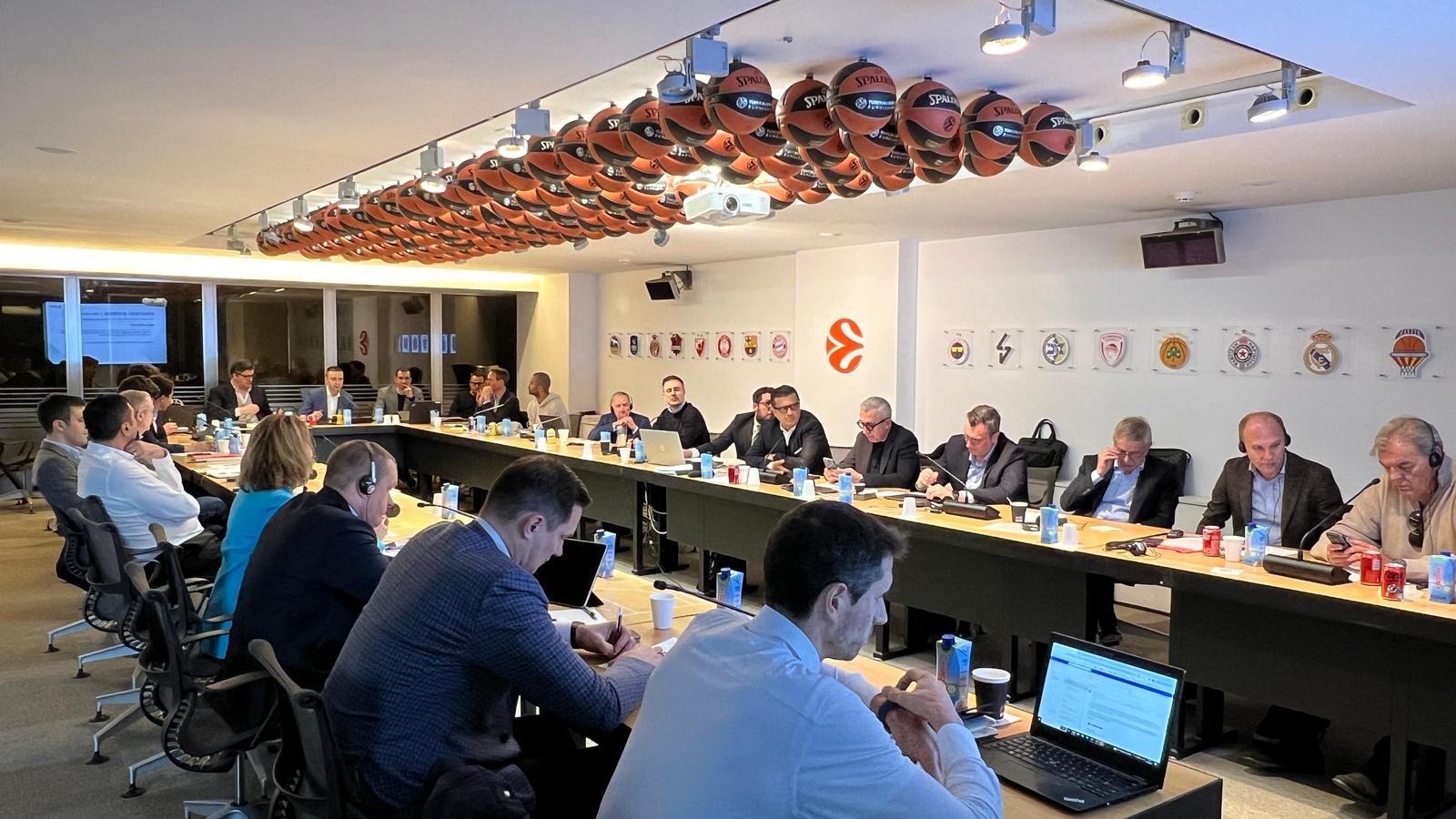
BarcelonaThe EuroLeague board meets this Friday to give all the details of the next season. To this meeting, the teams arrive in very diverse situations, whether they are committed for ten years to the continental competition, like Barça, or if they are in full negotiations. An example of this is Real Madrid. With an eye on the competition, whether in FIBA Europe competitions or in a hypothetical European league of the NBA, the white club had until June 30 to give an answer to the EuroLeague. In case of not renewing the license, it would face a loss of 30 million euros. According to ARA has been able to learn, this 10-year renewal will become effective this Friday.
Sources from the Euroleague consulted confirm a 20-team format for the 26-27 season, in which all teams from the previous season will repeat, except for Paris Basketball and AS Monaco. The Monegasque club will have to compete in the Eurocup due to the budgetary cutbacks derived from an economic crisis, while the Parisian team will have to compete to occupy one of the two wild cards in a year. One of the favorites to occupy one of the remaining spots is Besiktas, which after going through FIBA and Eurocup competitions, could move up to the top tier.
An imminent revolution
During the coming months, the Euroleague will face a profound transformation. The board already announced it on March 3rd and began to detail aspects on June 9th of this year, although this has given rise to all sorts of speculation. Among the options is a return to the 24-team format, as in the 2015-16 season, or a jump to 30 to give teams from various continental leagues the opportunity to test themselves against European giants and regain ground against the competition.
The expansion of places not only implies the access of teams currently part of the Eurocup, but also the incorporation of new cities into the Euroleague project. London, Berlin, or Rome are some of the options present for creating new franchises and expanding the continental league, a project that, formally, is expected to begin to take shape from July 1st.
The board's announcements have also introduced other innovations starting from the 2027-28 season. The main measure of the roadmap is to convert teams with ten-year licenses into permanent franchises and thus consolidate a model similar to the NBA's. With the aim of ensuring continuity and protecting against possible departures to FIBA Europe competitions, the aim is to strengthen the financial stability of the clubs.
This transformation has a key date: July 1st. According to various reports, the 13 shareholder clubs of the Euroleague will formally begin the process of becoming permanent franchises, an operation that could increase the value of the competition and the teams by around 25%, while also increasing its commercial potential. The league states it has received more than 17 expressions of interest from clubs, cities, and investor groups, which could accelerate the expansion planned for the coming years. In this context, new franchises would have to assume an entry cost of between 50 and 90 million euros, while the 13 founding clubs would access it at no additional cost.
Regarding finances, another pending move will be a capital increase of up to 1.5 billion euros, approaching the goal of achieving a valuation of 2.5 billion euros within three years. To this would be added an optional capital raising of up to 1 billion aimed at improving club infrastructure. All this stems from a valuation prepared by JB Capital, which estimated the value of the competition and the teams at 3.2 billion.
With the NBA in sight
While the EuroLeague seeks to strengthen itself with statements appealing to the good health of the competition —renewal commitments, good audience figures, and attendance records—, FIBA and, especially, the NBA are observing the situation with anticipation. In early June, Adam Silver, NBA commissioner, assured that the project for a new European competition under the NBA brand would begin to roll during the 2027-28 season. This announcement made the EuroLeague tremble, with teams like ASVEL and Madrid, until recently awaiting renewal, as possible candidates to be part of this new competition.
Silver seeks to attract EuroLeague teams
Sixteen teams, twelve permanent franchises and four extra spots: this is the format proposed by Silver, who has given until the end of June for franchises to make their proposals. “Some are existing franchises that play in Europe, and then there are groups that are joining together and want to launch teams in cities that currently do not have top-level basketball,” states the commissioner, who has identified twelve cities as targets for the new league: London, Manchester, Paris, Lyon, Rome, Milan, Madrid, Barcelona, Berlin, Munich, Athens, and Istanbul.
In order to avoid teams fleeing to other competitions, the ten-year license renewals signed during this 2026 include a penalty clause of 10 million euros in case of departure plus damages and losses. Silver assures that he is in talks with both FIBA and Euroleague, but insists that the project will move forward one way or another.
