The discreet cuts at Camp Nou
Barça postpon some non-essential finishes to gain time and adjust to the budget

-
CAT -
CAST
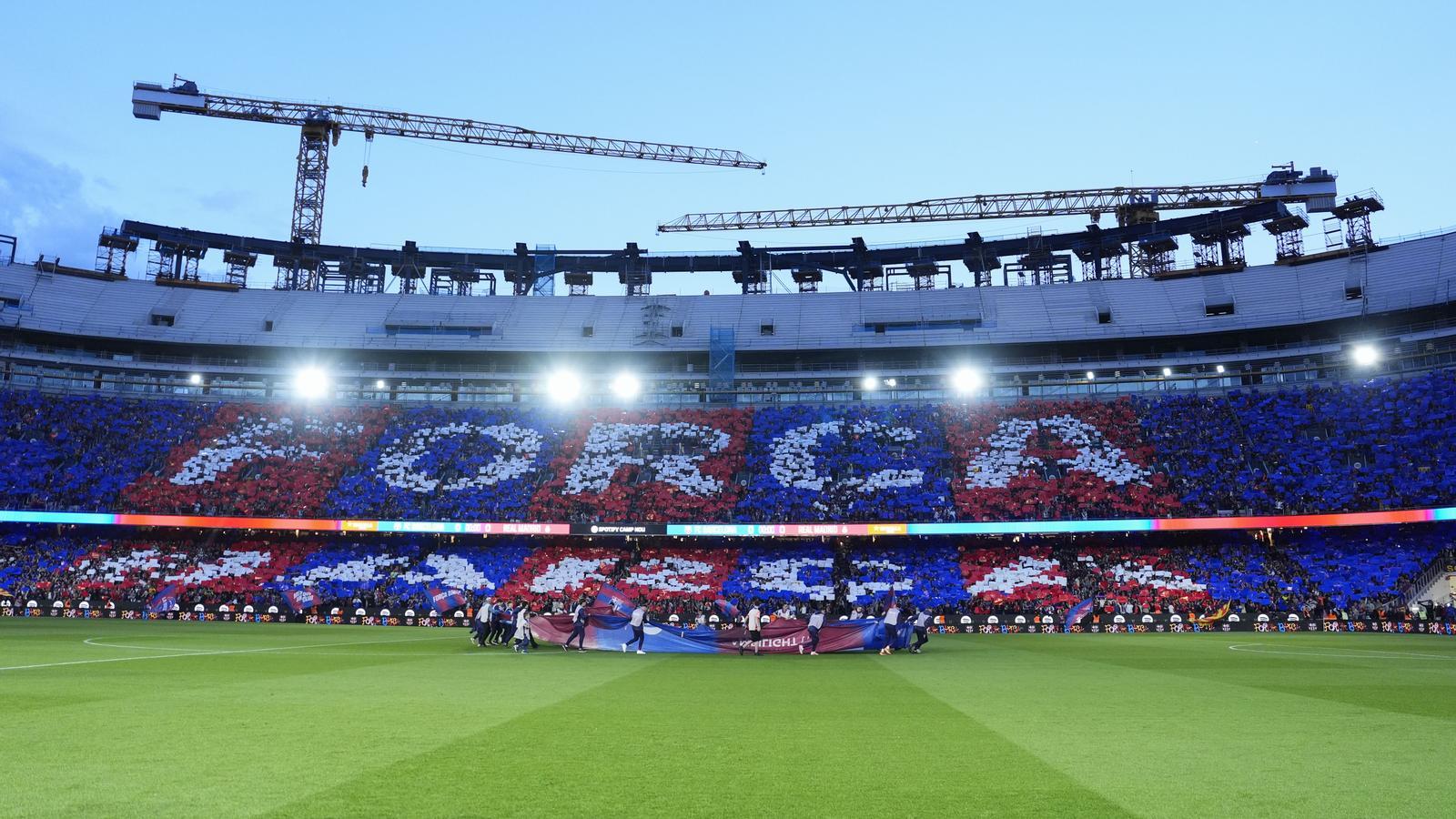
BarcelonaBarça obtained in March the permission to use all of the first and second stands without them being completely finished. A walk through the bowels of the venue is enough to see that some finishes are provisional and that there are elements, such as the catering offer, that have been set up with mobile shelving while waiting to assemble the definitive structure. It's nothing serious. It's one thing for the Camp Nou to be operational and another for all the pending work to have been done. It happens at the Santiago Bernabéu, which can fill all its seats and there are still workers inside. And the same happens in many buildings, where tenants can live there even if there's still a curtain to hang, a piece of furniture to assemble, or a room to paint.
needs to have it operational as soon as possibleneeds to have it operational as soon as possible, and therefore will focus its efforts on waterproofing and painting the area, placing the seats, enabling the services, and finishing the double ring of VIP boxes.
The initial objective was to have everything ready for the start of the 2026-27 season, but it will not be the case due to – once again – the delays that the stadium's renovation is accumulating. The new reopening date for the upper floor of the Camp Nou is the first quarter of 2027, and partially. However, with the exception of the VIP area, the rest of the spaces will also have provisional elements. Once again, functionality will be prioritized over aesthetics. "We may start 2028 with 100% capacity and the roof done, but it will take us much longer to have the stadium completely finished," says one of the sources consulted.
Several changes of plans regarding the renovation schedule
Strangled by the need to start invoicing, the club chaired by Joan Laporta prioritized the stadium's reopening over all the builders' recommendations, which proposed extending the stay at Montjuïc. Thus, it began selling tickets as soon as the City Council granted it the license. This is not what had been planned, as, as vice-president Elena Fort explained when the works began, the return would be with the first and second stands "completely finished". In the end, it was not like that. The delays in the remodeling, the conflict with the council over permits, and the multiple changes that had to be made to adapt to the safety regulations required by the Firefighters were to blame.

However, beyond the time factor, the economic factor has also played a key role. When Barça and Limak signed the contract for the renovation, a maximum guaranteed price of 990 million euros was set. Of course, at that time they did not know that the Camp Nou of 1957 had so many deficiencies and that the repairs would multiply the planned ones by five, that there would be so many limitations with working hours and that one of the steel distributors would go bankrupt and alternatives would have to be sought. Delays cause cost overruns, because salaries have to be paid for more months and because materials are becoming more expensive. The official version given by the club is that the maximum guaranteed price remains the same, but it is vox populithat the stadium will cost a few million more. A range of 200 to 300 million additional is mentioned, which the club denies, even though the treasurer Ferran Olivéexpense containment from the first moment
However, in parallel with all these setbacks, and aware that the budget could skyrocket, Limak has already been working on cost containment from the very beginning. In the renovation, there is an item in which it is very difficult to cut back, which is the structural part. A stadium like the Camp Nou is subject to very strict safety standards, and for this reason, no expense has been spared on steel and concrete. However, there are other items, such as finishes, which have some leeway. "Limak has squeezed us a lot, although he hasn't drowned us," points out one of the sources consulted, who laments the "constant" conflict between the construction company and suppliers when negotiating prices.
It turns out that the dimensions of the Camp Nou are so majestic that this negotiation process is key to the final expense. But sometimes no agreement is reached or an expense is considered dispensable in the short term. This has already happened with the paint: in some sections of the stadium, the prefabricated bricks have been covered in blue, and in others, they have been left exposed. And it will also happen in the car parks, where only a small part (350 spaces) is perfectly finished. The rest, up to the final 3,500 spaces, will only have the essential lines painted so that it can be used, and the final finishes will be left for later. This alone represents an immediate saving of half a million euros, which the club will pay - if it finally does - when it has the money to do so.
It is clear that in the short term it will not look as nice, but it is equally true that this is not a requirement to obtain the City Council's licenses, which is what really matters. For now, the official sources consulted do not clarify the doubt and limit themselves to saying that they have no record of these discreet cutbacks in the renovation project.

