The chip era arrives at the World Cup: Croatia is eliminated due to technology
The sensor carrying the ball detects a ball touch that was not seen live, in a key play of the match against Portugal

-
CAT -
CAST
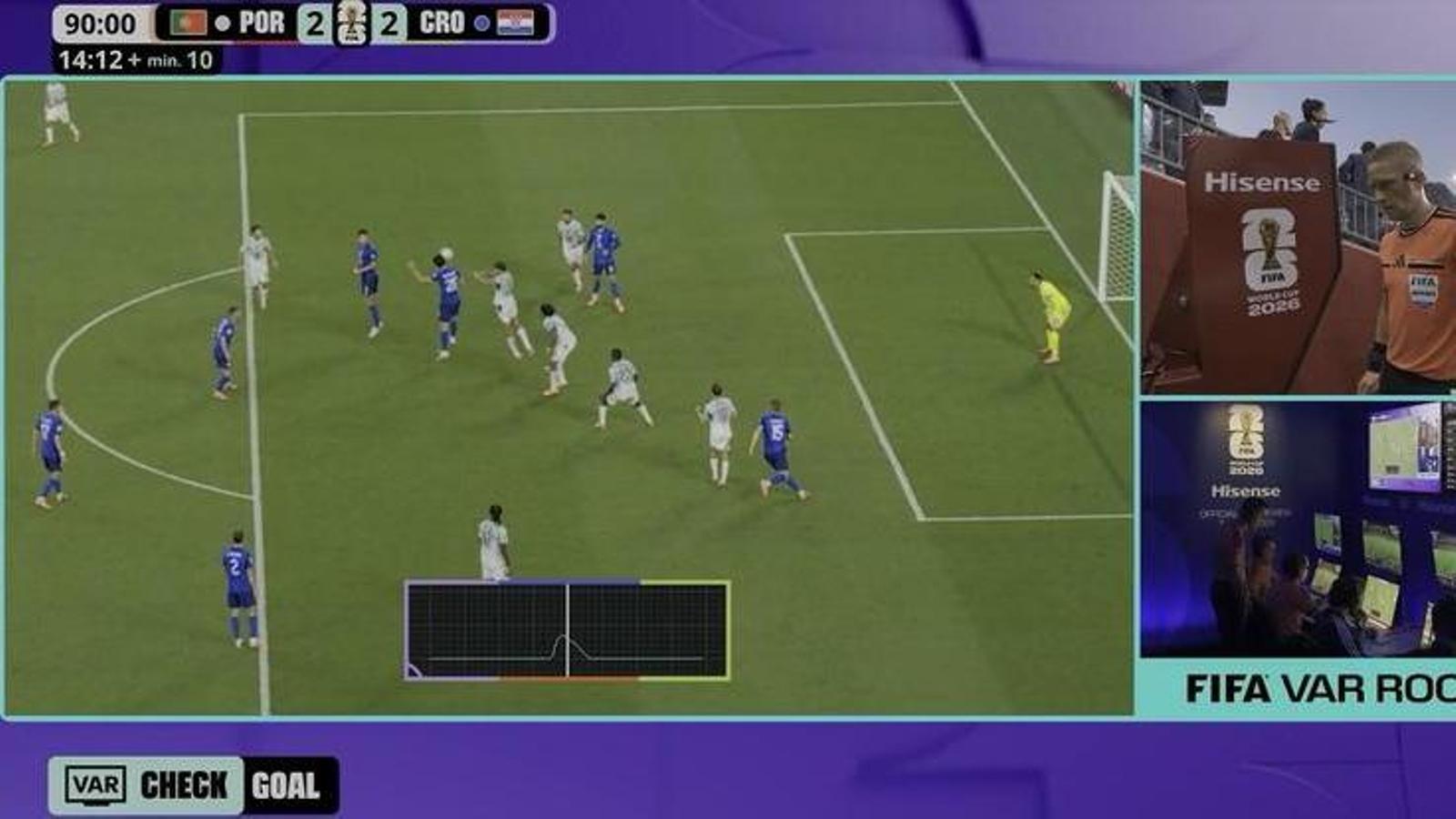
Barcelona"The referee didn't give us the goal even though he said that, in his opinion, it was legal," complained Croatian footballer Martin Baturina. It was the last minute of the Portugal-Croatia match and the Portuguese were winning 2-1. A Croatian cross came into the box and, after a rebound, defender Gvardiol scored the equalizing goal which forced extra time. The referee, Norwegian Espen Eskas, awarded the goal, but was quickly informed that there might have been an offside. "He told us that the ball's sensor said there was contact," Baturina complained. And so it was. The cross had been slightly headed by his teammate Igor Matanovic, which caused an almost invisible contact to the human eye that turned an apparently legal cross into an offside.
"There's no debate. Technology proves there was contact. It doesn't admit discussion, science helps us," said Catalan Robert Martínez, the Portuguese coach, at the end of the match. The Croats didn't see it that way. "It doesn't deflect the ball. You don't see it affecting the trajectory. You see the images and you don't see it touching it. How can you disallow a legal goal for an action where a hair touches the ball?" complained Croatian Petar Susic. Igor Matanovic, the man who had touched the ball, admitted: "Honestly, I think I felt a slight contact with my hair. I asked the referee, I wasn't sure if I had touched it. He told me there was a subtle touch on the ball and it was offside."
If the referees decided to modify their decision, it was because they received a warning. This year's World Cup ball has a motion sensor, a chip installed inside one of its four panels, which collects detailed information about every contact with the ball and sends it immediately to VAR. With this technology, it is possible to know the moment of a touch, which helps in deciding offside plays, like the goal disallowed to Josko Gvardiol.
The image shown on the TV broadcast and posted by FIFA on social media allowed for the observation of a flat line with a slight movement at the moment of contact. “The IMU sensors housed within the Trionda ball are capable of detecting any slight contact, shown to viewers in the broadcast as a heartbeat graphic,” communicated the tournament's organizing body. The system uses 16 specific cameras to track the positions of the ball and players, generally 50 times per second. In each frame, 29 data points are collected per player, which include all body parts taken into account for signaling an offside. According to FIFA, this sensor captures data 500 times per second, and records the precise movements of the ball in three dimensions, to see if there is an alteration in direction or speed, in order to clarify whether or not contact has occurred.
This is the second World Cup with a ball with a chip. In Qatar, four years ago, they already had them. The chip also played a prominent role in the Portugal-Uruguay match, when Cristiano Ronaldo celebrated a goal after a cross from his teammate Bruno Fernandes. Thanks to the chip, FIFA determined that Cristiano had not touched the ball and gave the goal to Bruno Fernandes. Now it has acted again, in this case to bring joy to Cristiano Ronaldo and the Portuguese.
