"The art of hurting without being hurt": the Barcelona Athenaeum recovers a forgotten sport 140 years later
Following the rules of a century-old treaty, students learn classical fencing
-
CAT -
CAST
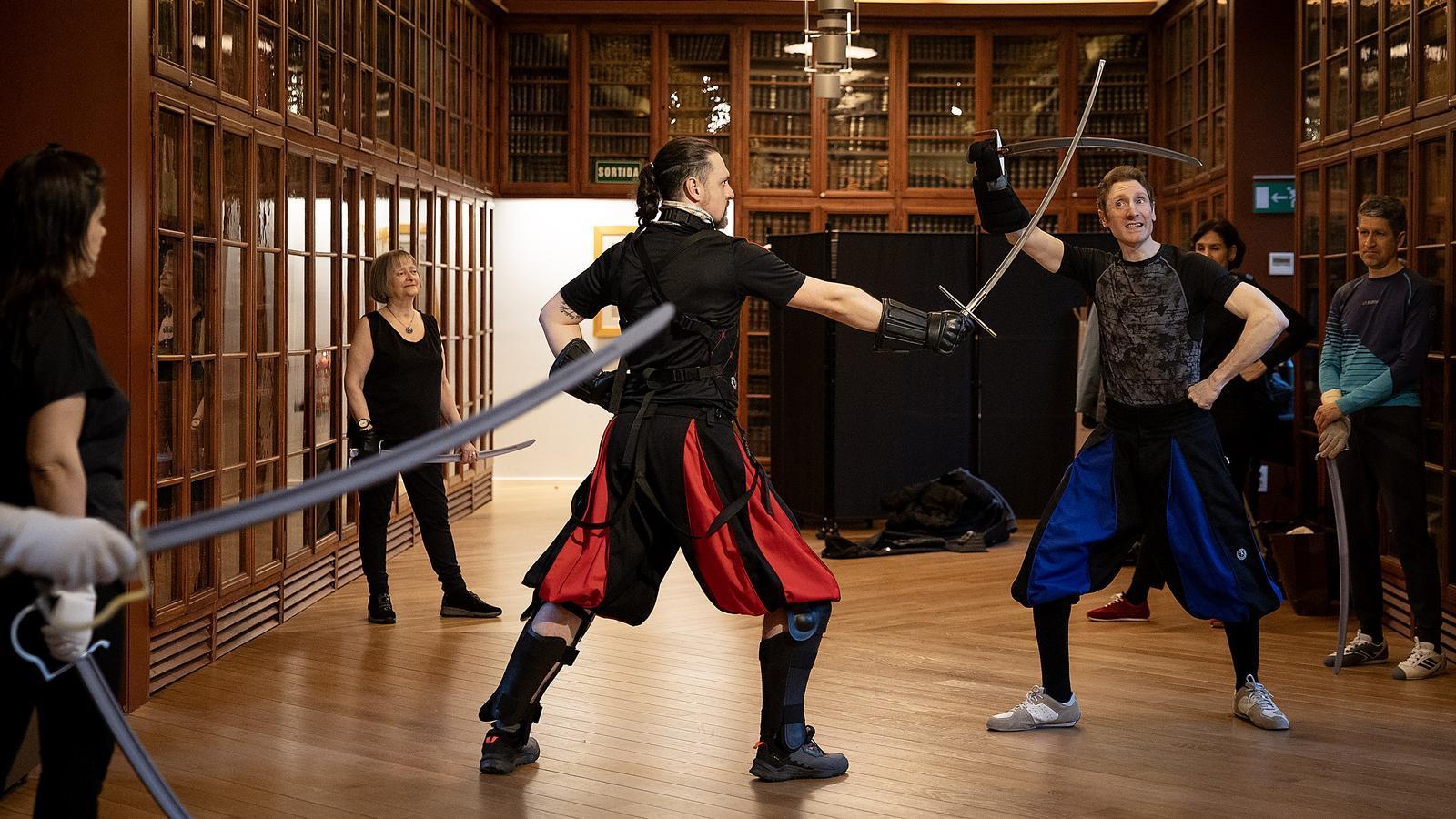
BarcelonaIt is half past six in the evening. In the garden of the Ateneu barcelonès, a group of ladies are discussing literature and two young people are talking about love problems. When Carles Tudó walks between the tables, everyone turns to look at his uniform, with breeches inspired by those of the 16th century worn by the Lansquenets, German mercenaries. Tudó is one of Europe's leading experts in classical fencing and this year he is in charge of teaching the fencing courses that the Ateneu barcelonès has revived more than 140 years after the last time the clash of sabers echoed through its halls. The sessions are held in the elegant Jacint Verdaguer hall of the Ateneu, among volumes of centuries-old books and busts of writers. "We have exhausted all places and have a waiting list," explains Tudó while preparing the swords.
"Historical fencing is the art of wounding without being wounded," reasons a man who conveys enthusiasm when he speaks of this art. He has dedicated his life to historical fencing, be it Japanese or Italian, by reading centuries-old treatises. At the Escola Hongaresa d'Esgrima in Barcelona, he teaches sport and classical fencing. He was the one to revive this discipline in an institution famous for its culture, but not so much for its sporting side. "If we have been able to organize this course, it is thanks to two people. Firstly, to Jordi Carrasco, a student of mine at the Hungarian fencing school, who is also a member of the Ateneu. And, secondly, thanks to Josep Bea Arnal, one of the great driving forces of fencing in Catalonia, who was the professor at the Ateneu 140 years ago. If it hadn't been for him, no matter how much Jordi Carrasco had proposed it, they would have said no. But we have the portrait of Master Bea, a photograph of the fencing hall, and documents proving that fencing began at the Ateneu in 1887. And it continued until the death of Master Bea. It was an opportunity to revive it. For now, the course lasts four months, but we want it to be a permanent activity," he comments.

140 years ago, fencing was at a pivotal moment, evolving from military fencing towards sport. And Bea was the great master, competing and teaching in places like the Military Casino, the Ateneo, or the famous Solé gymnasium, where so many important things happened, like the founding of Barça. Taking this course serves to recover the half-forgotten figure of that master. "At the Ateneo, we now teach a much older style than the one Master Bea taught. He taught the fencing of that era, with the saber, foil, and épée of the time. We teach a style from the 16th century, although we are also teaching some techniques that Master Josep Bea might have taught," explains Tudó.
His students arrive at the Verdaguer room and prepare. "We have a 73-year-old lady, my oldest student, and other young people on their way to 30," says Tudó, preparing the swords. "El Ateneu has bought 12 sabers from a master from Zaragoza who creates replicas of very hard nylon. Safer and more economical, but with the same weight and balance as a metal sword," explains the master, who admits that to buy classic swords, you have to contact the few masters who still make them online. Is it safe? Very. It is definitely safer than football, for example. There is no contact, the emphasis is on weapon control," he defends.
But how did he get into fencing? "Passion. There is no need to advertise, people who want to fence end up arriving naturally, as happened to me. It didn't run in the family, but I was fascinated. I started with traditional Japanese fencing, specifically with
kenjutsu, the quintessential practice of the samurai. I wanted the most authentic fencing, that's why I fell in love with this style when there weren't even clubs in Europe. A style that has been recovered in recent years with centuries-old manuals, as it had been half forgotten. The same thing had happened with European historical fencing, it had been forgotten, as sport fencing, of which I am also a professor, had become dominant, but it is a relatively young practice," he reasons.

Fencing, historically, was used to save one's skin. It wouldn't be until the late 19th century that competitions with safety elements were created to avoid injuries, as is the case now. But four or five centuries ago, it was different. "I have concentrated mainly on the 15th and 16th centuries, both on the longsword, which is held with two hands, and the sidesword, which is held with one hand. I teach this style, specifically the Bolognese tradition, as one of the best preserved fencing treatises was found there. A treatise with over 700 movements that allow us to have a lot of information," explains Tudó, who adds that at the time the Bolognese treatise was written, "in Catalonia we must have had our own, a Catalan school, but no treatise has been preserved.
At the Ateneo, students learn the movements, as if it were a choreography, to master the art of self-defense. "These are not techniques to look pretty. We are talking about movements that were designed to survive a real combat situation. The art of fencing is not so much the art of killing, but the art of not being killed. It is very easy to touch someone with a sword. What is difficult is to avoid being touched. The movements had to be perfect to avoid getting hurt, because a single blow could cut tendons, veins, or cause infections. The techniques are designed to save your skin. It's not like in the movies where movements are exaggerated; here it was about seeking short combats," says the master, who advocates that everyone can practice it. "It has always been seen as an elitist sport, but it is accessible to everyone, there's no need for a large investment nowadays," he adds.
"If you practice it... it's as if we were in the 16th century, in the full Renaissance, and you had the right to carry a sword in the street for self-defense. That's the magic, your body and your mind relive lost sensations. It's like a journey to the past," he concludes, ready to start a new session under the gaze of a bust of Jacint Verdaguer.
