"His laughter is our revenge": the son of genocide survivors turned hero in Bosnia
The young Esmir Bajraktarevic, born in the United States, has chosen to play with the land of his parents, who lost relatives in the war

-
CAT -
CAST
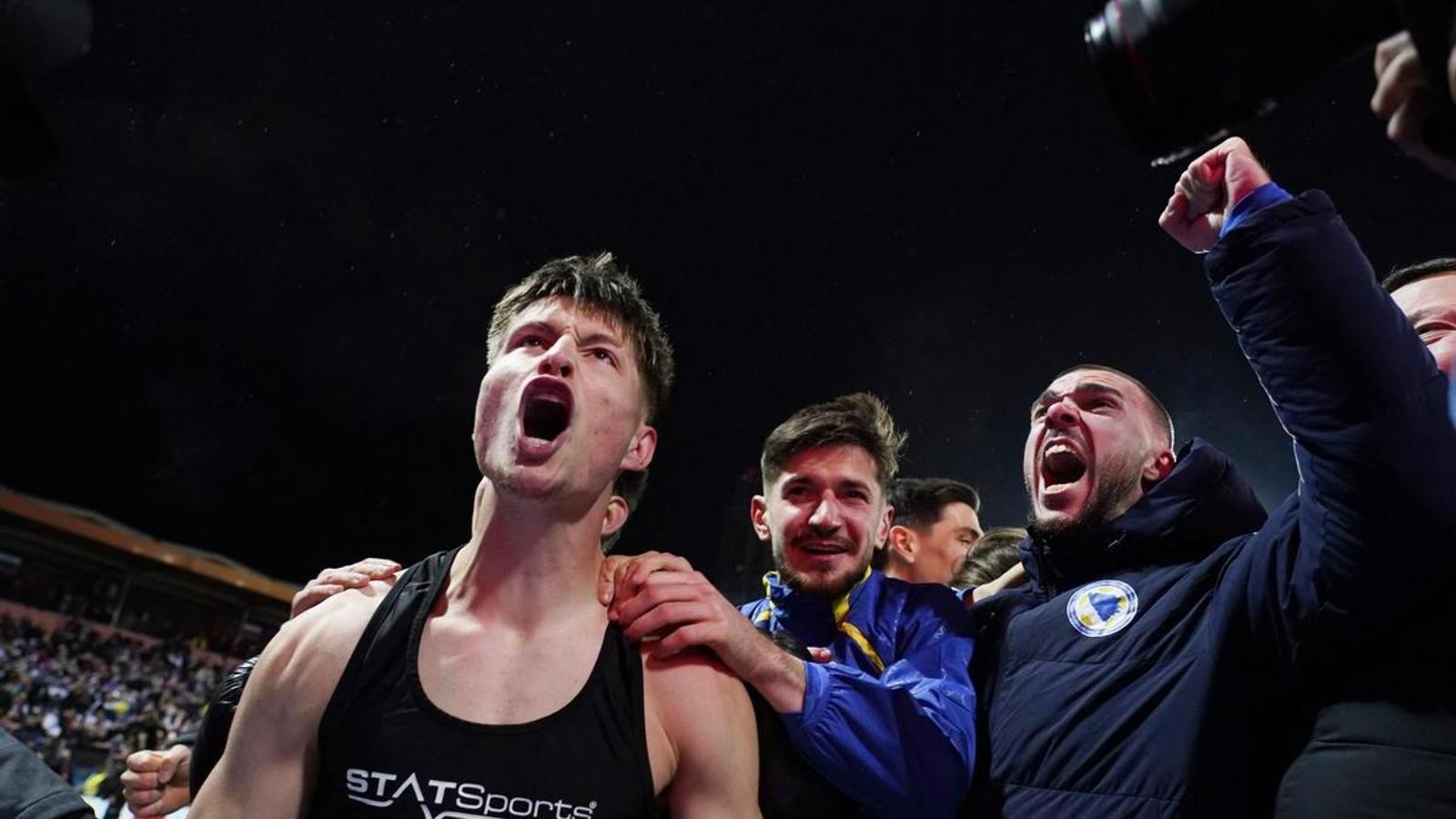
Barcelona"There was a plan so that this boy could never be born, so that my children would never be born, so that none of our children would ever be born. Their laughter is our greatest revenge", published on social media Emir Suljagic, head of the Srebrenica memorial center, the Bosnian town where more than 8,000 people were murdered by Serb paramilitaries in July 1995. He also attached a photograph of the players of the Bosnia and Herzegovina national team celebrating their qualification for the World Cup and their elimination of a giant like Italy. And in the center of the image appeared the young Esmir Bajraktarevic. A footballer, son of refugees who fled Srebrenica, the scene of one of the most recent genocides in the history of Europe.
In the stands of the small stadium in Zenica were Emir's parents. Esmir and Emina, two Muslim Bosnians who in 1995 fled as best they could from the city where they had lived, coexisting normally with their Orthodox Serbian neighbors. Children of that Yugoslavia where people who spoke different languages and prayed to different gods could coexist. But in the early 90s, hatred proved stronger, and it gave way to a series of wars that ended thousands of lives. Some of Elmir and Emina's relatives did not make it. They did, they fled by a narrow margin. They arrived in Switzerland and in 2001 they joined a program that allowed them to emigrate to the United States as refugees.
Four years later, in 2004, Esmir was born in Wisconsin. In a home where he was told he had to work hard to get ahead, that he had to be grateful to the land that welcomed him, but that he could not forget his roots. At home, they ate böreks and ćevapis, Balkan music played, and when they could return to Bosnia for vacation, they took the children, who received kisses from aunts and cousins. When Esmir started playing football, he did so with a pendant with the Bosnian coat of arms, a gift from his parents. Although he did not live through the war, it was very present. In statements to the digital media The Blazing Musket, he recalled: "My parents lost many members of their family. It's very tragic. It's something I will never forget, obviously. Srebrenica is something I will never forget. It's a part of me and who I am. I carry it in my blood. It's a very important part of me."
Bajraktarevic quickly attracted attention for his potential as a player. He didn't just train at a club, but also at home, as his father was a football fanatic. Today, at 50 years old, his father still plays whenever he can. His children were destined for football and all have played. Esmir's sister, Elma, with some success. Esmir also showed promise, but the problem was that the family didn't have much money. Football saved them, as in a team where the boy scored goals, he became friends with a boy named Liam. Upon learning the Bajraktarevic family's story, Liam's parents decided to financially help young Esmir so he could travel to try out for major football clubs. And so he secured a place at a club in Milwaukee, SC Wave, over three hours away by car.
Thanks to the support of Liam's parents, Esmir could study, play, and make the long journeys every day. Until the New England Revolution, a team from the outskirts of Boston, signed him at 16 years old. "It wasn't easy to leave. It was going far away alone. But my father told me I couldn't waste my talent." It was a success. Esmir began to progress rapidly and within a few years was already debuting in MLS, the North American professional league. And in 2024, at 19 years old, he received his first call-up to debut with the United States national team in a friendly against Slovenia.
A difficult decision
But a few months later, Esmir changed his mind: the Bosnian federation offered him a passport and to play with them. It wasn't an easy decision: "I'm from here and my language is English. My family built a new life here, so I'm very proud to be American. But my name is Esmir, and it's a Bosnian name. When people ask me where I'm from, I say I'm Bosnian. I grew up in a Bosnian family. I speak Bosnian with my parents every day. It's my blood, it's my roots. So I'm very proud to be from there," he said at the time. In the end, he decided he would play for Bosnia. And fate has rewarded him. Against Italy, he was one of the best and was tasked with taking the fourth penalty in the shootout, the decisive one. When he scored, Bosnia qualified to play in the second World Cup in its history, thanks to this young man who now plays for the Dutch PSV Eindhoven. A young man who has videos of him scoring goals in front of his house wearing a jersey with the name of Edin Dzeko, the great Bosnian player with whom he now shares a national team.
It was the triumph of a team that represents a land that has suffered a lot. A team in which mostly Muslim footballers play, but also Serbs and Croats from Bosnia. During the penalties, a member of the technical staff took a rosary and prayed as Croatian Catholics do, a player made the sign of the cross as Serbs do, and others knelt as Muslims, praying. And all together they celebrated their success by singing a song by the group Dubioza Kolktiv, a reggae and ska group that unites members from all communities with songs against racism. In a Bosnia where daily life is still a struggle, football for a few moments sent a message of hope. And in the middle of the celebration, the son of refugees from Srebrenica. The young man who will play in the World Cup in his other country, the United States. His two identities.

