Barcelona has done it again
-
CAT -
CAST
It's a few minutes past four in the afternoon. There isn't a cloud in the sky over Barcelona. The sun is beating down mercilessly. Thirty-one degrees, the mobile says. The asphalt gives off an invisible vapor that rises up your body and makes you sweat even if you're in the shade, which is particularly sought after. The classic stuffiness, intensified in the middle of the heatwave. And despite all this, dozens, hundreds, thousands of people are defying this July Saturday to come out onto the street and wait patiently behind the metal fences. There's no shortage of caps or sunscreen. Nor beach chairs, fans, or pocket fans. It's time to wait, but it seems to be a wait that is enjoyed, especially by those who have already secured a front-row spot and don't want to give it up even if they risk sunstroke.
That the Tour de France starts in Barcelona is a unique event. People are spread out along the more than nineteen kilometers of route. It's hard to find spots where no one is. When it's not a neighbor, it's a tourist. There's still a long time to see the cyclists and anything is good to entertain the crowd. The Tour Caravan helps with this: a line of vehicles in perfect condition that entertain the public by honking their horns or even giving away some souvenir. The lucky ones celebrate because at the official stalls the prices are anything but cheap, perfectly comparable to the merchandising of a sport like football. The pack of an umbrella and a cap costs fifteen euros, or fifty if a yellow hat, three bracelets and the special editions of newspapers such as L'Équipe. This is true, but you need to know French. The cyclists' bottles with the 2026 route printed on them cost 8 euros, a pair of socks costs 20, an official jersey costs 25, and the yellow leader's jersey, the star piece, costs 100. And despite all this, these mobile shops spread along the route are serving customers at a good pace.
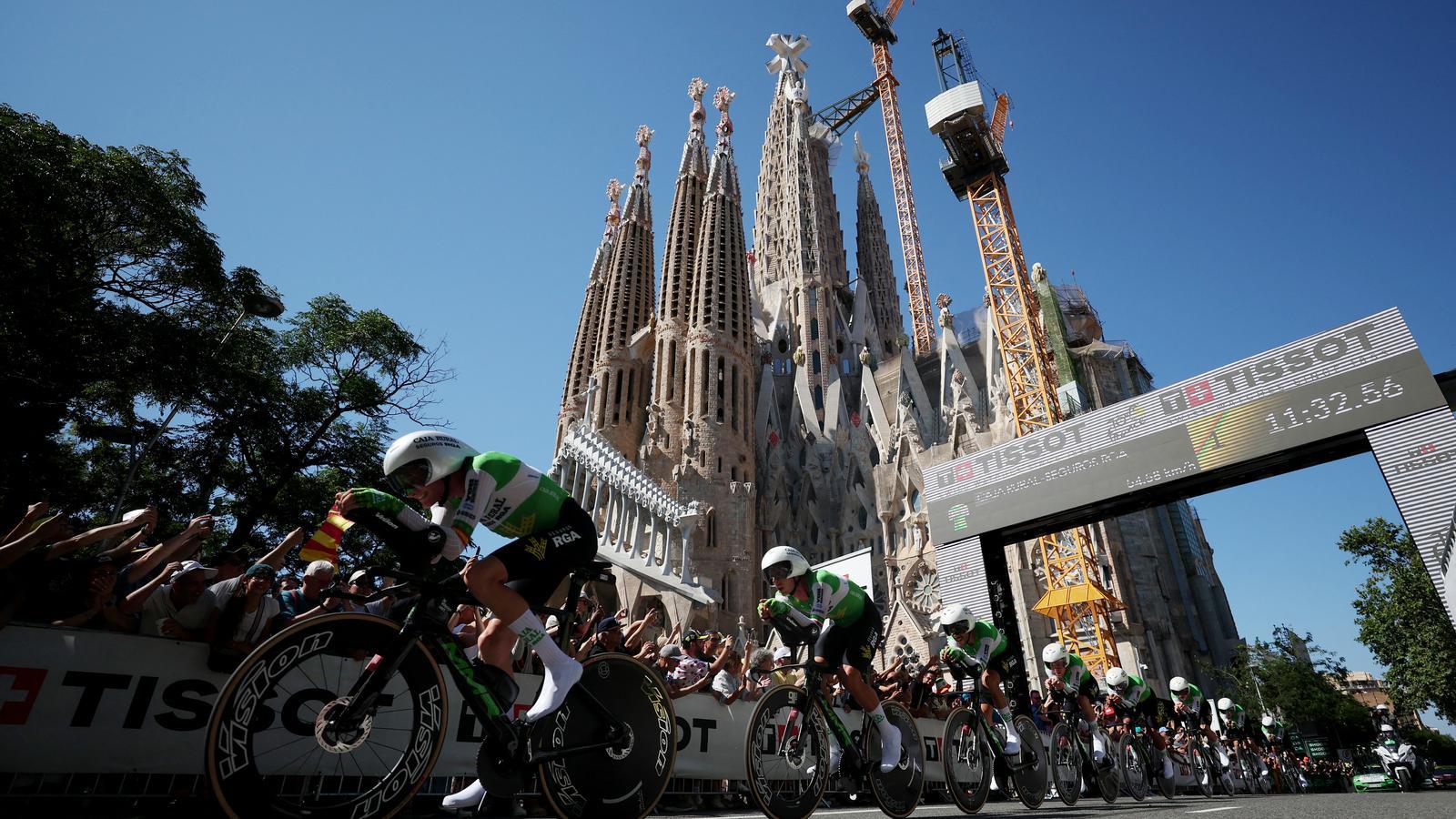
At the Sagrada Família, many curious people gather. There is doubt as to whether they are cycling fans or simple tourists who, since they are there, take the opportunity to watch the event. A win-win. They can take a selfie with the Tour participants and the great temple in the background. It is such a crowded area that a temporary bridge has had to be built for pedestrians to cross the street, which has been closed to regular traffic for hours. Getting around the city is very difficult. Many bus lines are cancelled and the metro can barely cope, even though the frequency of service is that of a weekday during rush hour.
An army of volunteers, uniformed in the event's standard yellow, help to bring order to the mobility problems. If there is no bridge, you have to ask for permission to pass. The intersection of Girona with Mallorca is one of the points where they are responsible for allowing pedestrians to cross from one sidewalk to another. But they cannot always do so, because the Tour has priority. They have no choice but to endure the grumbling, protests, and occasional insults. Great patience.

It's finally five past five. Applause and shouts of encouragement. The official start of the Tour has nothing to do with Thursday's presentation. That day was like a party where the participants gave themselves a magnificent bath of masses, walking, waving, and shaking hands with the fans on Gaudí Avenue. Today they are not in the mood for jokes. With the stopwatch running, every second counts. The cyclists are going at full speed. Vingegaard manages to complete the stage at an average of 54 kilometers per hour, including the ascent of Montjuïc. It's curious to see them race like rockets in front of the Dominiques Barcelona school, where the speed is limited by radar to 30. Who knows if the city council will receive any photos of the pack of runners in the sprint?
The afternoon advances and the heat doesn't let up, although sometimes a light breeze passes by, which is a lifesaver for those who have been standing for hours. Others have not had so much patience and have taken refuge in one of the many terraces that are making the most of August with beers and sangrias. Glasses full of ice to the brim that the thirstiest can finish in one gulp.
It's a great media spectacle. The neighbors know it, gathering at the corner of Aragó and Tarragona, looking for the cameras for their demands. There's also no shortage of flag wars. The esteladas are the majority, although few are carrying them. Cycling attire wins, especially the classic white jersey with red polka dots of the Tour. And bicycles, whether professional or for leisure. The City Council speaks of 120,000 people in the street. It has been a success. Barcelona has done it again.

