A Barça-Madrid before the storm
The historian Arnau González has investigated in a book what became of the blaugrana and white players during and after the Civil War

-
CAT -
CAST
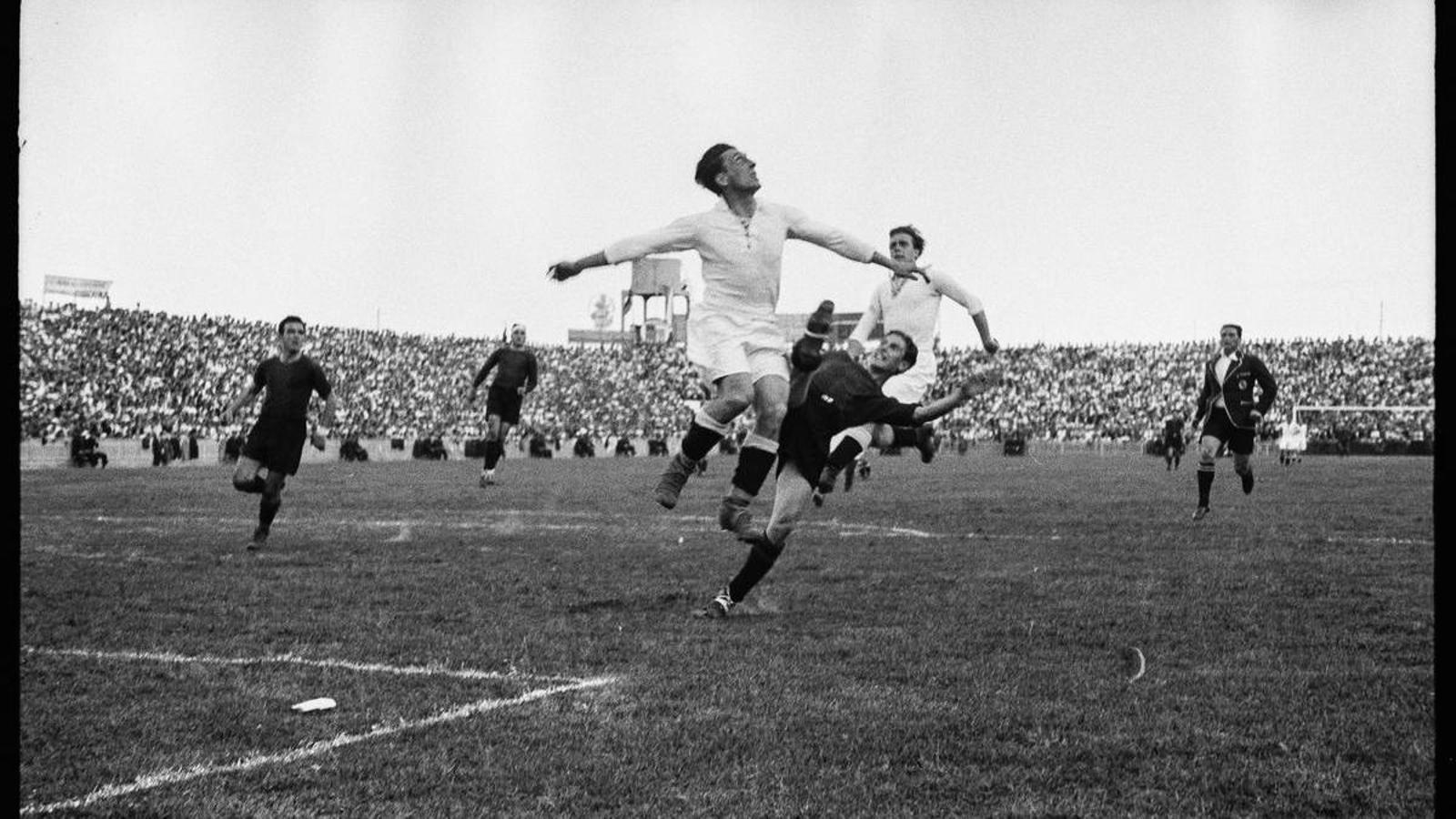
BarcelonaIn the summer of 1963, Valencia made a tour of Mexican lands. It was not an easy tour, as the Mexican state did not recognize Franco's Spain. Valencia's coach at the time was the Basque Jacinto Quincoces, a legend of Spanish football who had played for Madrid. During that tour, Quincoces met up with Luis Regueiro. Basque like him. A former Madrid player like him. But the first had sympathized with the Francoists and the second, with the Republicans, which is why he ended up exiled in Mexico. During that tour, they dined together with other former footballers who had been separated by the Civil War. They took photographs together, and those who lived in Mexico gave Quincoces an album in which a handwritten text could be read: "Noble friendship. Against cold and hot wars, atomic bombs, political agreements and all the disgust and deceit that currently roam the world in which we live... It is so strong and indestructible that neither years nor distance can crack it".The album has ended up in the hands of the Catalan historian Arnau González i Vilalta, who has published El primer clásico antes del abismo (Editorial Base). A work in which he investigates what happened to the Real Madrid and Barça players who played the final of the Copa de la República on June 21, 1936, a match played a few days before the start of the Civil War. Players like Quincoces and Regueiro. Madrid won 2-1, with Ricardo Zamora making a key save on the Barça player Escolà in the final minutes of the match. "In the photos you can see how Zamora stops the ball just over the goal line. It's an iconic image, as the photograph captures the white dust rising from the goal line. A striking image, when you think of everything that came after," says the historian. The war also took its toll on those athletes. González has spoken with the descendants of the players who played that match, and has traveled abroad several times, especially to Mexico. He has rummaged through archives and has taken the book further, to place it in its historical context. "It's a long story that will extend to a dinner in Mexico City in 1963, summarized in an album of photographs that some of the protagonists of the match gave to the Real Madrid defender Jacinto Quincoces," he explains.

"I am very grateful for the help of relatives. Perhaps this book arrives late, because in the case of Zamora, for example, there are no longer any living people who knew him. But I have traveled to different countries and I have been able to find relatives who have offered me documents and photos of great value," says González, who highlights the help of people like Josep Escolà's son, Ricard, who keeps a lot of material in Sant Pol de Mar; Josep Raich's son, Pere, in Molins de Rei; or Emilín's son, who was looked after by Amalio in Irapuato, in the state of Guanajuato. "There are others that I have discovered during my research, such as Zabalo's, protected in a large suitcase where his house was, now his daughter's, Maria Justa, in Viladecans, near Barcelona, who unearthed his dramatic journey between German prisoner camps in occupied France and Spanish ones in Morocco". At the book presentation event at the Barça Museum a few weeks ago, a representation of families of former players who were at Mestalla in 1936 was present, such as Ventolrà, Munlloch, Zabalo, Raich, Escolà and Franco, and also of Rossend Calvet, who was the team delegate.
The book also takes a historical tour of the symbolic and political weight of the two clubs, and recalls that in 1936 the white club was simply called Madrid, without the 'Real', as it was a time of republic and the team's board was politically left-wing. In fact, it dedicates a chapter to a little-known episode, when the Catalan Paco Bru, who had worked for both clubs, tried, in the midst of the Civil War, for the Catalan Football Federation to host Madrid to play competitions that could be held in Catalonia, which was in the hands of the Republicans, but not in Madrid. Barça and other Catalan clubs did not see it clearly.
The work also reflects on the origin of the rivalry and how it has evolved, to become the global classic it is today. But it is especially moving when it recounts the misfortunes of the players from that last season before the war. Civil wars divide families and communities, but many of those players, despite having opposing political ideas, never forgot each other. When Martí Ventolrà, Barça's captain in the 1936 final, died in Mexico in 1977, it was the Madrid captain in that match, Ricardo Zamora from Barcelona, who wrote an obituary from his bed after six months of not leaving his home, a year before he died himself: "Martí was a sensational boy, ten years ago I traveled with Espanyol to Mexico and had a long conversation with him. We talked about the old days: about his personal adventures and, of course, about memories…", he wrote. And it is that Zamora, who was politically conservative, was captured by communist militias at the start of the war in Madrid. In fact, foreign press even published that he had been executed, but he was still alive. On October 19, 1936, a match was played between the Catalonia team and the Valencia team at the Montjuïc stadium in Barcelona. And Ventolrà, along with the Basque player from Valencia FC, Carlos Iturraspe, asked the President of the Generalitat, Lluís Companys, to intercede for Zamora, who was imprisoned in Madrid. Zamora survived. Companys, did not. The goalkeeper went to France, and this led to him being criticized by the Francoists, who expected him to go to the zone they controlled. He did so later.
The war caused doubts, debates, and pain for the players, who held very different political ideas. Blaugrana Juli Munlloch was a left-wing Catalanist, close to ERC. He participated in the club's tour of Mexico, but decided to return home and ended up being sent to the Vall d'Aran to defend the front. Seeing that it was collapsing, he went to France to play football and finally to Mexico, where he stayed. Josep Raich was also a Catalanist, but in his case, conservative and very Catholic, which is why he was almost executed by anarchists, as he was a very Catholic Catalanist, and he went into exile in France. Defender Josep Bayo also went to France with the Republican fall, and upon returning to Spain he ended up imprisoned and sentenced to forced labor; he participated in the construction of roads such as the one in Son Morey, in Mallorca. Once released, he returned to play in the First Division, with Sabadell, a team in which Josep Argemí also played, a builder who built his own house. He was a boxer and footballer, and participated in Barça's famous tour of Mexico in 1937. A tour during which Ventolrà met a relative of the Mexican president Lázaro Cárdenas and stayed to live in Mexico, where his son would be a World Cup player... playing with Mexico. If Barça toured Mexico, many Basque players toured with the Euskadi team, such as brothers Luis and Pedro Regueiro. The book explores these two tours that turned football into a political weapon. Many of the Basques who played for Madrid were part of that Euzkadi team, as it was written then, which captivated the Soviet Union with its play. Once the Basque Country fell, many of these players stayed in Mexico: the Basque team was admitted to the Mexican league and finished second in the final standings.
Two of the players who stayed in Mexico were the Regueiro brothers. Luis returned in the 1950s to Madrid to receive a tribute from the club, even though he was not ashamed of his anti-Francoist ideas. He was able to do so because the club president, Santiago Bernabéu, guaranteed his safety. In both Barça and Madrid in 1936, footballers played who would choose different sides in the war. And others who just wanted to survive. Players who in many cases, as González's work explains, would meet again over the years, after combat and exile, to remember matches like the one in 1936.

