An extreme race to delirium: "One day I found my three-year-old son alone on the road"
The Catalan Oriol Antolí is the state record holder for Backyard Ultra, a discipline that attracts more long-distance runners every day.
-
CAT -
CAST
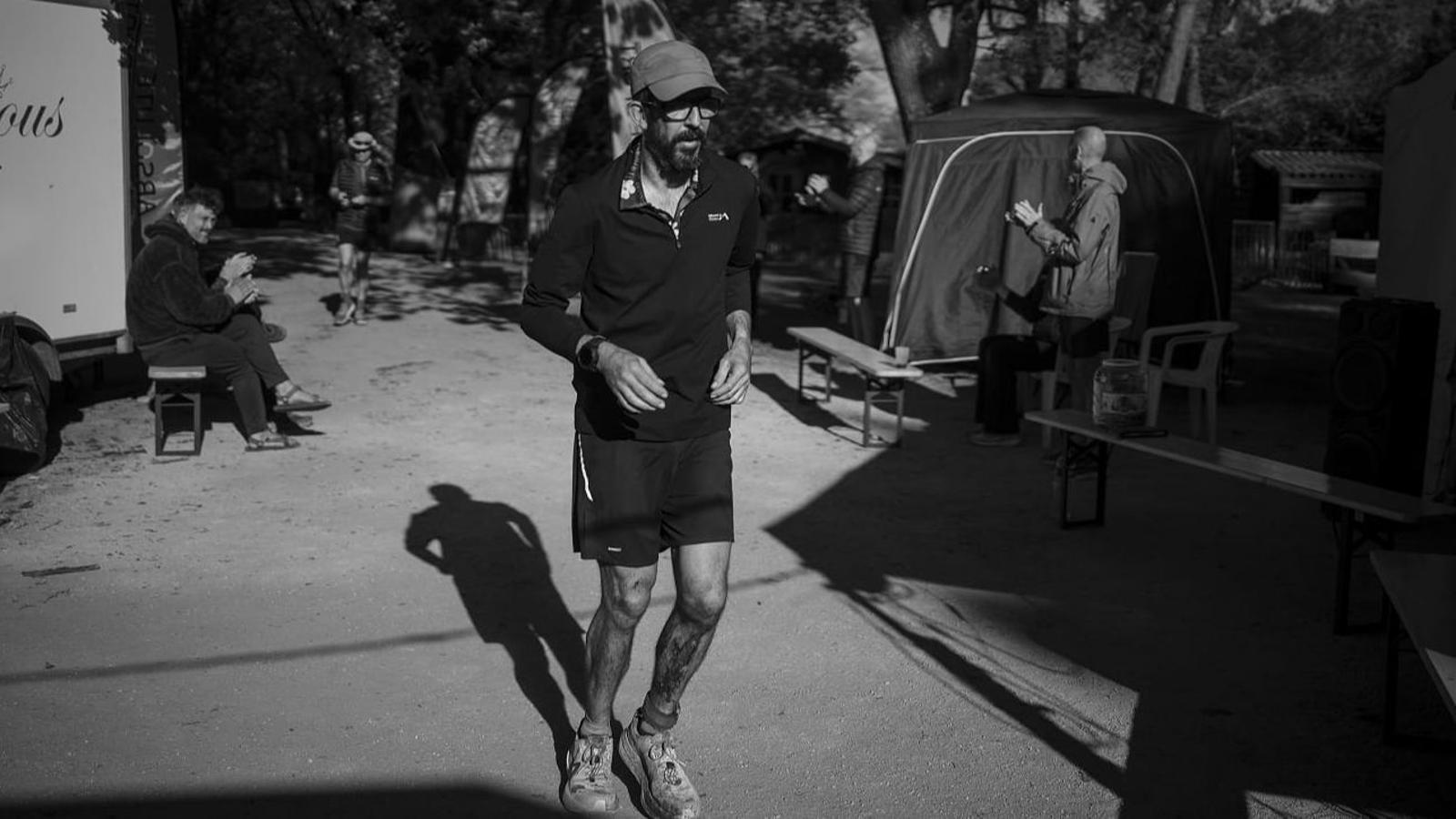
TorellóAccept that people might call them hamsters. "We always make the joke too: 'Come on, let's do the hamster'," says Oriol Antolí (Terrassa, 1983). A few days ago, he achieved the Spanish record for Backyard Ultra, a discipline that comes from America. It consists of running a 6.7-kilometer circuit with a start every hour on the hour: the minutes left between reaching the finish line and the next starting gun are used to eat, rest, and even sleep. Whoever lasts the longest wins, like in the Japanese movie Battle Royale. It's a test of endurance, not speed. The discipline is "very successful" and is becoming increasingly popular in Catalonia: the third edition of the Backyard Ultra de Terra Endins brought together 200 participants in Torelló at the beginning of May.
A few days ago, Antolí reached 113 laps, in Belgium. Almost five days, over 750 kilometers. He started running on a Saturday morning and didn't stop until the early hours of Wednesday to Thursday. The world record is 119 laps. "It's a bit of a strange thing," explains Antolí. He is an electronic engineer by profession and at the same time is the first person in the world to exceed one hundred laps in three races in a year. Last year he was seventh in the World Championship.

Antolín had always played basketball. In the summer of 2007 or 2008, he was living in Madrid for work, and one preseason day he planted the seed for the present: "I thought I'd go for a run around Retiro until I got tired. I had a Nokia with GPS and I put it in my backpack and took a euro to get home by metro afterwards. I ran 38 kilometers, that day I bought myself some running shoes and signed up for the Madrid marathon." Later he would make the leap to Matagalls-Montserrat, the Ultra Trail del Montblanc, and other ultra-endurance races. He fell in love with these challenges. In 2018, he won the Monarch's Way, a 990-kilometer race in England. It took twelve days and ten hours.
Suddenly he landed in Backyard Ultras. "I really liked it because you always have the challenge of self-improvement and because it's very social: in an ultra, you're alone 99% of the time, and, on the other hand, backyards restart every hour and you're always with people. It's a very different concept and I got hooked –he admits–. It's something very beautiful because you can go for a run, seven –which is a marathon–, fifteen –which is a hundred kilometers–, or however many you want. You're there to surpass yourself. And the most beautiful thing is that you share it with everyone: the one who finishes first can go with the one who finishes last," Antolín continues.
The physical part is key, but the mental aspect is just as relevant: "I think that whoever reaches 60, 70 laps is strong enough to do more. In the end, there comes a point where you continue out of stubbornness, dragging yourself along. It's all in your head." When a race approaches, he often trains by doing routes that pass by where he has parked the car: "To train my head and be able to overcome temptation and not give up when the urge to quit comes." His motto is to never give up: he usually drops out because he doesn't finish the lap before the next start and is eliminated.
The athlete from Vallès states that the secret lies in finding "the balance point between running too little so as not to get too tired and running a lot to have more time to rest between laps." One of his goals is to "maximize" sleep time. They take five, eight-minute naps. "On the first day you try it and you don't fall asleep, but in the end, you manage. Everyone is very surprised that you can sleep for five minutes, but when you are very tired and you haven't slept for two nights, you fall asleep instantly," he explains.
Participants who were running "with their eyes glazed over"
Sleep and fatigue often have consequences in the form of hallucinations. On the last lap of the Belgium race, I had the feeling that the plants were cheering me on. In the 2023 World Championship, a fairground attraction appeared out of nowhere. "Suddenly I also found my son alone in the middle of the road. He was three years old then. It was very impactful because it was as if I was abandoning him. You already know it's a hallucination and you try to ignore it because it can't be, but the doubt remains – assures Antolí –. I suppose the brain looks for alternatives to distract itself and it comes up with whatever it comes up with."
He has seen people "running with their eyes rolling back" and participants who were "scary" and has warned his family so that if they ever see him like this, they don't let him continue. "I'm very clear about it: health comes first," he emphasizes after calling for sanity to stop when there is danger. He also advises trying not to think too often about the number of laps so that the race doesn't become tedious. He celebrates that as it is such a young sport, he is able to live at the world elite: "It's something I had never imagined. If it had caught me when the discipline was already fifty years old, it would be much more difficult. Perhaps in twenty years, the young ones will do 113 laps."
In some Backyard Ultras, it is even forbidden to wear headphones. Antolí, in races where it is allowed, sometimes listens to music or podcasts. He says he listens a lot to El búnquer or La Renaixença. "It's a way to keep yourself awake and alert," he admits, ready to continue running on the hamster wheel.

