No fixed compensation for victims of pedophilia: this is the agreement between the Church and the State
Requests may be submitted starting April 15th and the Ombudsman will have the final say
-
CAT -
CAST
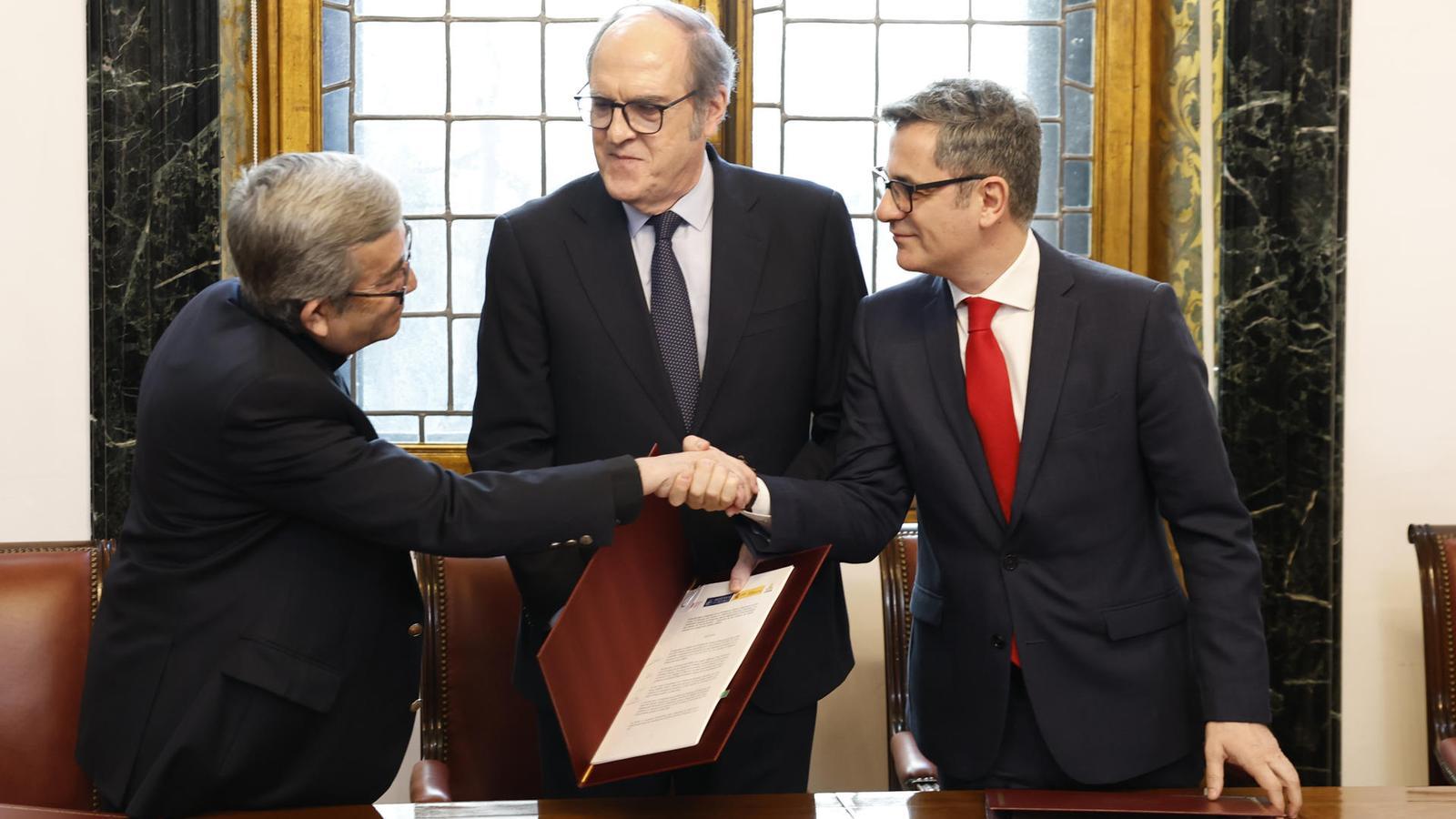
MadridThe Spanish government, the Spanish Episcopal Conference (CEE), and the Spanish Conference of Religious have signed this Monday, at the Ombudsman's office, the protocol to compensate victims of sexual abuse and pedophilia. It is the system to recognize and repair individuals for whom the judicial route is no longer possible and which had been pending detailing since early January, when a more generic pact was reached to implement it. Finally, no indicative compensation figure has been included in the text.
"We wanted to exclude the reference to scales and economic amounts. All entities agreed on this," assured Luis Argüello, president of the CEE, at a press conference after the signing, where he stressed that it is an issue that goes beyond money. According to the Minister of the Presidency and Justice, Félix Bolaños, it is positive for victims that there is no "minimum and maximum threshold" because it implies that compensation is not limited. "It is good news that it is studied on a case-by-case basis," he added.
Applications can be submitted from April 15, and the Ombudsman will have the final say on the resolution of proceedings, in case of no agreement between the parties. With the culmination of this protocol, the reparation for victims of cases that are judicially time-barred or where the abuser is deceased, ceases to be solely in the hands of the Church, as had been the case until now with the system created by the Episcopal Conference in July 2024, known as PRIVA.
“This plan had an original sin, which was that the Church had the final say, and that made many victims not trust it," remarked Bolaños, who celebrated the launch of a "mixed model" that places the final decision on what the Church should do or pay on the State. "Comprehensive reparation is guaranteed, which in most cases will certainly be economic," stated the minister. Victims who have already been recognized through the PRIVA plan will be able to reapply for compensation with the new mechanism, although the previously agreed reparation will be taken into account to avoid "duplication".
Thus, what criteria will be valued to determine the amounts of economic compensation? "The severity of the abuses suffered –taking into account their nature–, the violence exerted, the age of the victim, the duration and the relationship between victim and perpetrator", establishes the protocol, which also foresees evaluating the "damage to dignity, pain, suffering and emotional distress and the physical, psychological, social and family consequences they have produced, including the loss of educational, labor or social security opportunities". Reparation may also be "symbolic", "restorative" or "spiritual".
Phases of the procedure
Victims who wish to claim compensation have one year to do so from its launch in mid-April, although the parties have left the door open to extend the protocol for another year because they do not know if it can be fully resolved within this time. The Ombudsman, Ángel Gabilondo, has acknowledged that they do not have a forecast of how many cases they may encounter. Victims who decide to opt for the procedure must submit a form to the Ministry of the Presidency and Justice, which will forward it to the Ombudsman's victims unit.
"It is not a simple procedure [...] it is a flexible, personalized, professional and humane procedure," Gabilondo guaranteed, who assured that the team in charge will be "very careful." "We have seen the pain it causes, there is no fun in seeing sixty-year-old people turned back into children. We will not play with the idea of making them go through this again, but we must listen to them and make an assessment," he said.
The Ombudsman's unit will have three months to make a reparation proposal once the request is received. Afterwards, it will be passed to the PRIVA advisory commission of the Church, which will have a maximum of two months to evaluate it. Once this has been done, both responses will be communicated to the victim so that, within fifteen days, they can state whether they agree or, on the contrary, if they submit allegations. If there is no agreement, a new period of fifteen days will be opened for the Ombudsman to convene a joint commission – made up of nine members appointed by the ministry, the Ombudsman, the Episcopal Conference and that of Religious, as well as representatives of the victims – to try to reach a consensual agreement within one month.
In the event that an agreement is not reached, the Ombudsman will be responsible for imposing his criteria. "I will work to ensure maximum possible consensus and I hope it will not be necessary to discern in the last instance, but if it is necessary, we will exercise our responsibility with complete naturalness," Gabilondo stressed.
