Welcoming those expelled from the B9 into their homes: "If the opposite of being good is being bad, I choose the good ones."
A doctor from Badalona provides shelter to two Senegalese men, aged 24 and 30, in the face of inaction from municipal social services.

-
CAT -
CAST
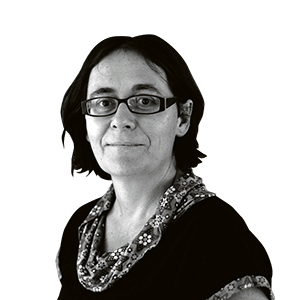
BadalonaThey got up at an unusually late hour considering they are two young sub-Saharan Africans who were surviving in the former B9 Institute in Badalona, which was evicted last Wednesday. Our bodies have rested for the first time in a long time.“Because it’s hard to relax on the street, and the cold keeps you from sleeping,” explains Abdu Ngom, a 30-year-old Senegalese man from the city of Saint Louis, sitting on a sofa in Ángela Valeiras’s house. Faced with “the inaction of the authorities,” this retired doctor has decided to take matters into her own hands and, as A humanitarian crisis of seeing 200 young people living in the open air has been brewing since last night. On Friday, Ngom and Serigne Babacar, another 24-year-old Senegalese man, said: "To those who tell me I'm being overly nice, I say that..." if the opposite is evil“You’ll always find me with the bonds,” Valeiras exclaims.
On Friday afternoon, Valeiras went with a friend to the spot where about a hundred of the 400 evicted from the B9 building had settled. They brought some industrial and waterproof plastic sheeting to distribute among the group. The evicted students called her to tell her that if she wanted to help, she had to start with Babacar, because he had been in that old school for such a short time that he didn’t know how to get around and barely had any friends. This isn’t the first time she’s offered a helping hand. A few years ago, she took in another homeless sub-Saharan boy for a few months, with whom she still keeps in touch, and who is now able to support himself.
Then she saw another young man with a hand wound he'd gotten while rummaging through scrap metal, and a fever of 38 degrees Celsius. It was Ngom, and she took him to a hospital, but they charged 120 euros for the visit, so after treating him herself, she took him to a primary care center where he got a tetanus shot. Today he's feeling better and only has a slight fever.
Step by step
It's Sunday morning and they haven't had breakfast yet because they rushed out first thing to the Cáritas center in Badalona to ask for information about their options for finding shelter, help, and food. For now, there's little more to do than wait and stay with Valeiras for a few days. Until when? "I don't know. Initially, I took them in for one night because it was raining, but today will have been three. We're just figuring it out," she says, adding that she understands gestures like hers aren't the solution and that "the responsibility for providing answers lies with the administration." However, she's determined to help them with the paperwork so they can begin the process of becoming residents. One of the young men is sleeping on the living room sofa and the other on a mat in a bedroom. "We've been very well taken care of, we're very happy and grateful," they both agree, and to show their appreciation, they've cleaned the kitchen and, "even the tiles," the doctor laughs.

Babacar listens and, from time to time, asks his friend for a translation because he barely understands either Catalan or Spanish. He nods and ventures to explain that when his mother died, he wanted to leave Senegal behind and emigrate to Europe. He was a fisherman and says he knows how to operate a bulldozer, but after almost two years in Spain—first in Almería and for the last few months in Badalona—he hasn't achieved anything. "I came here to work, work, and work, nothing more," he says while cradling the dogs in the house, who are half asleep in his warmth.
Also Ngom He left Senegal for the Canary Islands in search of better fortune, since he saw that he could not earn a living as a fisherman because they The country's fishing agreements with the European Union prioritize EU vessels. and leave the locals "without fish." On his journey to Badalona, he passed through Valladolid and for the last 14 months had occupied a space in the B9 market. He earned a living collecting scrap metal, from which he made little money, "just enough to survive and be able to eat every day." His only goal—he repeats—is "to work," and he laments that "Europe doesn't let him work, neither in Senegal nor here."
The plans for this Sunday are to have lunch with another of Valeiras's friends. He is a man who lives on the street and has polio—a disease that affects the nervous system and causes paralysis. "We'll see what we make for lunch, all as we go along," says this compassionate doctor, who says she can tell "from their faces that the two young men are good people." And before closing the door, she adds: "People shouldn't be afraid of them."
First relocations
Beyond the solidarity shown by neighbors, social organizations have also mobilized to secure a space to accommodate at least some of those evicted. Last Saturday night, a handful of people were able to sleep under cover after three nights spent outdoors in the rain and low temperatures. "I was so cold and couldn't take it anymore. I was crying and begging God to take me out of here," recounts Samba Niang, one of the ten people who will be able to stay for at least a week at the Casal Antoni Sala i Pont, provided by pro-independence organizations, reports ACN. In addition, fifteen people will ultimately be able to spend the night in a church in Badalona, provided by the Archdiocese of Barcelona. Social organizations reached an agreement yesterday for the Ministry of Social Rights to cover the living expenses of those relocated. Starting this Sunday, the Virgen de Montserrat parish in Badalona will open its doors from 8:00 PM to 9:00 AM for people selected based on their vulnerable profile. They will be provided with dinner, a bed, and breakfast for one month, as detailed jointly by the Red Cross, Cáritas, San Juan de Dios Social Services, and the Roca y Pi Legacy Foundation. The Red Cross will be in charge of managing the space.
