Oriol Nel·lo: "Unlike Barcelona, Madrid is a great vacuum cleaner of the cities in its surroundings"
Geographer and professor at the Autonomous University of Barcelona (UAB)

-
CAT -
CAST
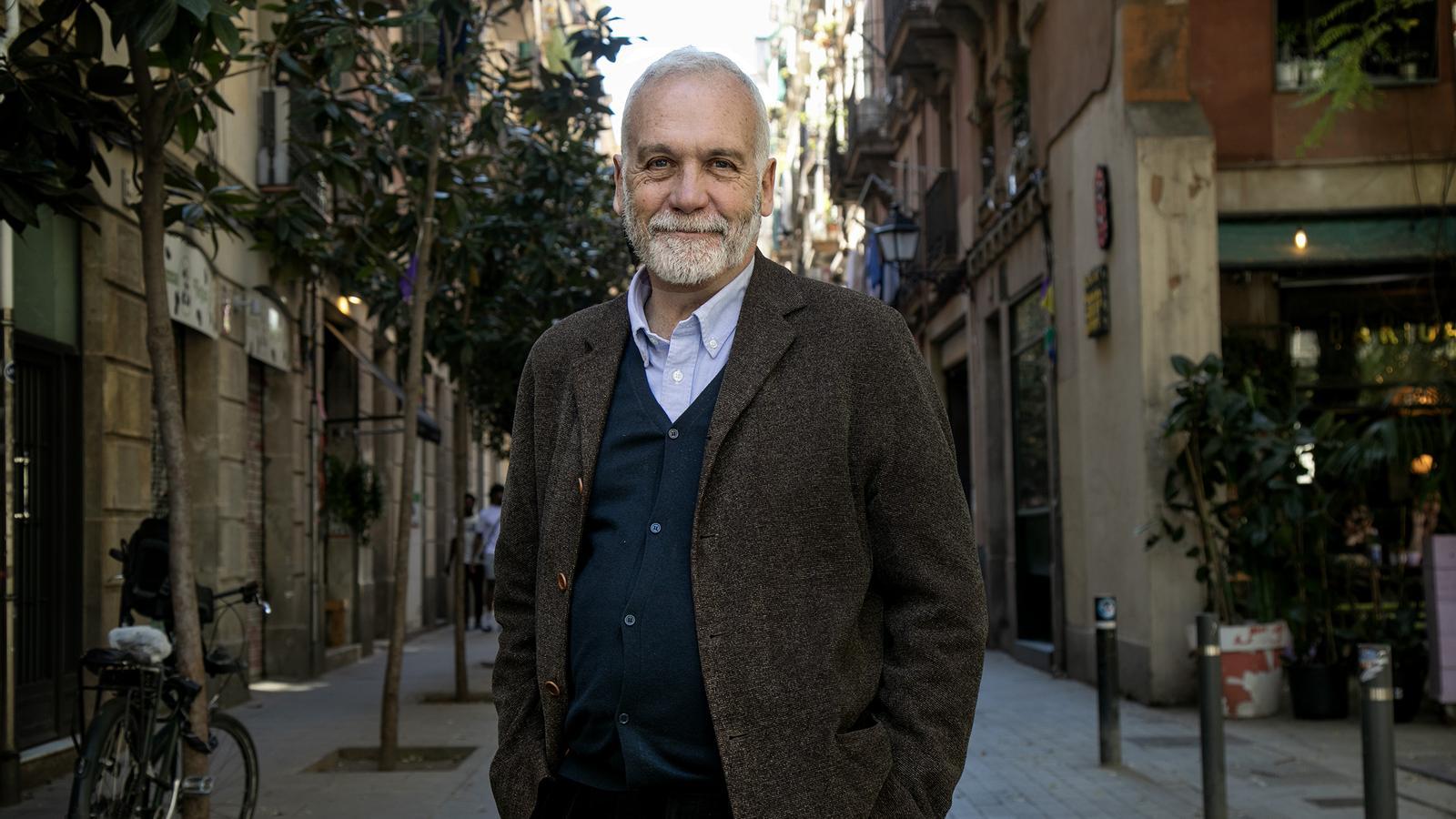
BarcelonaThe geographer Oriol Nel·lo (Barcelona, 1957) has just made, along with the Madrid architect Agustín Hernández and with essential infographics by fellow geographer Joan López, one of the most relevant contributions in recent years to the eternal debate between Madrid and Barcelona. The book Barcelona/Madrid, per un diàleg crític –which for now can only be found in Italian, but which will soon be published in Catalan by the publisher Tirant lo Blanch– was presented a few days ago at a conference of the Metropolitan Strategic Plan (PEMB) and is a commission from the Federico II University of Naples.
Is distance needed for a somewhat dispassionate view of the Barcelona-Madrid debate?
— Normally, the two cities are used as archetypes. Entrepreneurial Barcelona versus bureaucratic Madrid, social democratic Barcelona versus neoliberal Madrid, decadent Barcelona versus rising Madrid... What we have tried to do is approach a dialogue between two cities based on material realities.
And archetypes are not met?
— Like all archetypes, they always have a basis in reality. But what is interesting is to understand what the two cities have in common and what they have in difference.
What do they have in common?
— The process of metropolization, of the city's expansion over the territory. And also the increase in inequalities and the commodification of housing.
And the differences?
— One very fundamental aspect is the polycentric character of Barcelona compared to the more monocentric character of Madrid. Our metropolis rests on a multitude of centers –Mataró, Sabadell, Terrassa, Vilanova...– and in Madrid everything relies above all on the central municipality.
And what is this due to?
— It is conditioned by the physical structure of an abrupt territory that forces a certain crumbling of urban centers and leads to administrative fragmentation. In Madrid, what they did was annex the surrounding municipalities. We, in a space of 600 square kilometers, which is what corresponds to the municipality of Madrid, have the entire metropolitan area. That is why, when we make comparisons, we cannot make them municipality against municipality.
And what does being polycentric mean for Barcelona?
— It has a very evident drawback, which is that inequality in municipal resources makes redistributive policies more difficult. The budget that Barcelona can allocate per capita is not the same as, for example, L'Hospitalet.
Does a larger city inherently favor a fairer redistribution? inherently a fairer redistribution?
— It is a favorable condition, but not sufficient. There must be the possibility of redistributing, but there must also be the will to redistribute. The tradition of social democratic policies in Barcelona has had a lesser presence in Madrid.
Another key difference is being or not being a state capital.
— Yes. 30% of the State's workers are in Madrid and 5% in Catalonia. Then there is also a very notable headquarters effect. And also the issue of the investments it receives. It's not that there is such a notable difference in investment forecasts between the two cities, but there is in their fulfillment. Execution in Madrid is much more diligent and often even exceeds expectations. In Catalonia, it falls far short of what was predicted.
And how is the relationship of the two metropolises with their surroundings?
— In the last half-century, the Barcelona region has stopped growing at the expense of the rest of the territory. Madrid, on the other hand, is like a large vacuum cleaner that causes population loss even in provincial capitals in its surroundings. There is a brain drain from Madrid with respect to the cities of Castile. Young people go to study in Madrid and do not return.
One thing they both agree on is the strong arrival of immigration.
— Immigration nowadays is a structural factor in all metropolises in the world. But migratory dynamics are diverse. In the case of Madrid, there is this peculiarity of the arrival of very well-off population from America, which ends up generating overgentrification. That is to say, very well-off social groups in central neighborhoods of Madrid, such as Salamanca, are displaced by much more affluent populations from other countries, who transform the real estate market, commerce, etc.
Are there more inequalities in one city than in the other?
— What we see is that residential segregation, in general, has jumped in scale everywhere. In the case of Madrid, this translates into a very marked duality between the northwest and the southeast, and where everything to the south tends to have lower incomes. Our segregation, again, is more fragmented; spread across each urban system in the metropolitan region.
The polycentrism or monocentrism of the metropolis also impacts housing construction.
— To move forward with 200,000 homes, Madrid has enough with about twenty major urban planning initiatives, while in the Barcelona area half a thousand are needed. The physical availability of land is much higher in Madrid. Now, depending on how these developments are carried out, they will not guarantee access to housing for those who have the least.
And with this scenario, can Barcelona absorb sustained population growth?
— This polycentric structure would allow us to better absorb the population distributed across the territory. With two requirements: we need land and it is absolutely necessary that it be integrated into a network. Therefore, public transport must work.
In the end, in this Barcelona-Madrid duel, is there a winner?
— The terms "winner" and "loser" are difficult to apply because cities are not homogeneous subjects. They are territories where there are social groups with opposing and very often contradictory interests. It would be a mistake to frame progress in terms of competition between cities; rather, one must consider how policies can be applied that benefit the majority of the population in both cities.

