The darkest side of the Costa del Sol: "It's the UN of drug cartels"
The police claim that all major mafias have lieutenants in Marbella, a key point for global trafficking
-
CAT -
CAST
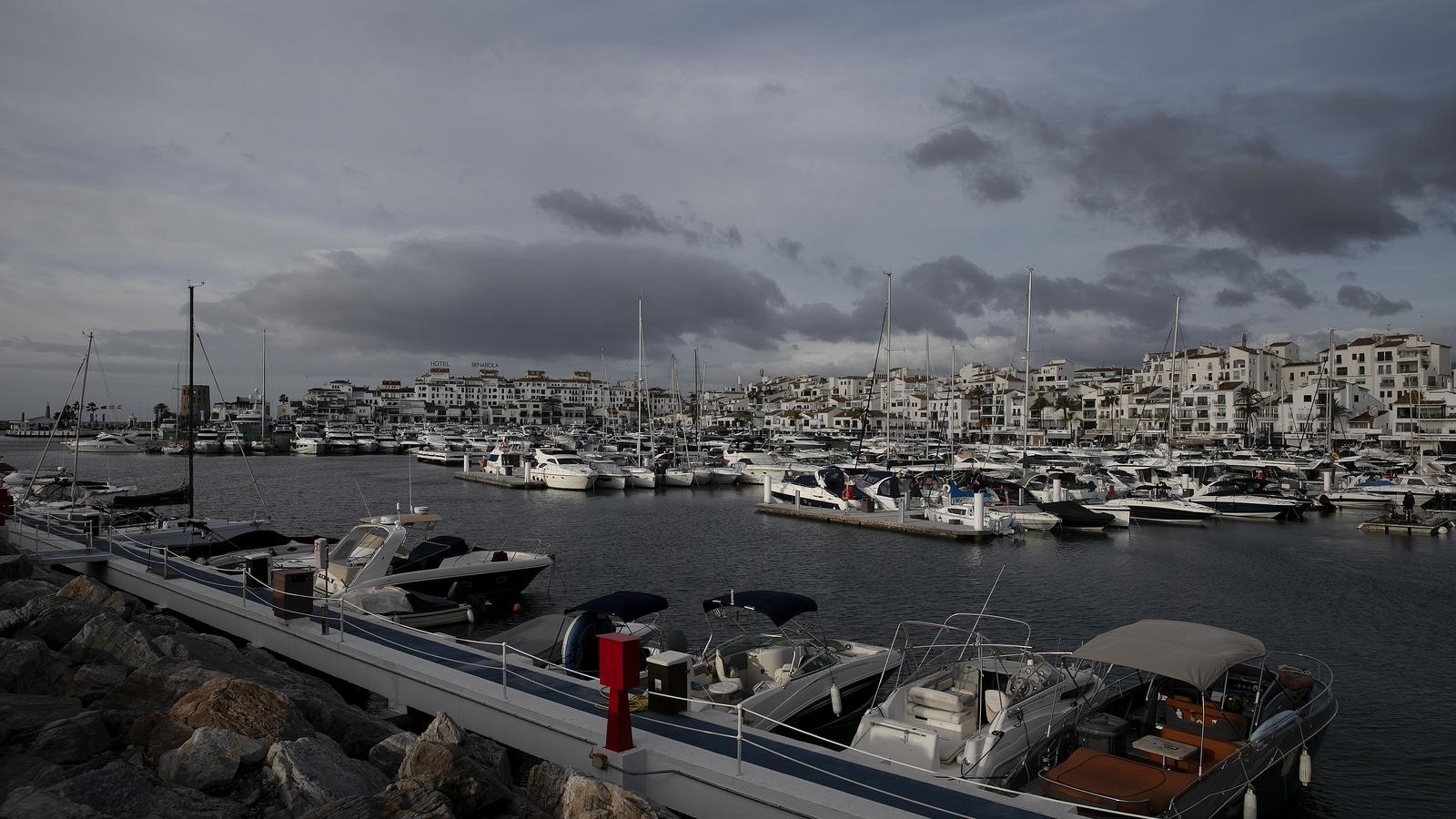
Marbella / Malaga / FuengirolaThe first scene of the movie takes place in a huge guitar-shaped pool surrounded by umbrellas, palm trees, and waiters serving tropical cocktails to bathers floating in tranquility. A song plays – an upbeat one – by Julio Iglesias, and some people are dancing. The camera slowly moves forward until it focuses on a specific table. Two men with serious expressions sit down. One of them is a well-known lawyer in the area. The other is the client, a powerful drug trafficker. They talk about drugs. Cinema has repeated this scene in dozens of gangster films, from Scarface to The Godfather. But this scene is real and was experienced by a lawyer at the Hard Rock Hotel in Puerto Banús a few months ago. Now it is an ordinary January day, and the hotel is practically empty. It is raining outside, and three foreigners walk around the hall in bathrobes. There is a reception for VIPs and another for regular guests. Michael Jackson's jackets and Jimi Hendrix's guitars are on display.
"The Costa del Sol is the Wall Street of organized crime," says Juan José Gómez Millán, a retired national police officer who has dedicated 30 years of his life to fighting drug trafficking. In Marbella, meetings are not held in offices with views of a
skyline of skyscrapers, but in hotel pools, VIP areas of restaurants or nightclubs, and shopping centers. Another lawyer explains that one day he witnessed an entire shopping center in the area being closed down just for a meeting between two drug dealers. They have even closed down brothels. In Marbella, money is counted in kilograms of cocaine, not on screens displaying charts of rising and falling values. Deep down, the only thing that unites Marbella and Wall Street is that if you want to be important, you have to be there. "If you want to be someone in the drug world, you have to be on the Costa del Sol. We are the UN of drugs," says a high-ranking official of the National Police in the area.
It talks about the United Nations because the Costa del Sol, in the same way that it receives tourists of all nationalities, also hosts cartels from all corners of the world. Englishmen, Irish, Turks, Swedes, Russians, Chinese, Moroccans. And they are not neighborhood drug dealers or small marijuana producers. "They are powerful narcos worldwide. They are in the Costa del Sol, but their scope of action is all of Europe," insists the police source. Mafias install some of their most important "lieutenants" in the Costa del Sol. They call the shots from white mansions with sea views. Driving along the road that runs along the coast and connects cities like Marbella and Fuengirola, it is difficult to see cliffs that are free of houses or developments. Normally, drug traffickers look for elevated points to hide without losing panoramic views of the Mediterranean. "They are there, but you don't see them," explains another commander of the National Police.

"It's almost impossible to face it"
In the classes at the police academy in Malaga, they always make the same comparison: there is an elephant in the room, and it is called drug trafficking. The elephant "is growing", and it is already so big that it is "almost impossible to tackle it". The drug trafficking elephant, admit police commanders, has infiltrated police structures. "Even if we tripled our forces, we couldn't fight them," they accept. Drug trafficking should not only be understood as a group of people who receive drugs and move them, but as a business. As a multinational of crime. "They are like Ibex-35 companies, money is never a problem for them," continue police sources. This money allows them to buy everything, officials and police officers, but also to resurrect after an operation that has escaped them or a war with a rival gang that has weakened them.
And even if the police multiplied their efforts tenfold, laws changed and became harsher, and many other hypotheticals, it would be very difficult to erase the footprint of drug trafficking on the Costa del Sol. It would be so because it is in a privileged location, and not only because drug dealers can sunbathe and play golf. Marbella is an hour's drive from the European port with the most cocaine interventions, that of Algeciras. It also takes an hour by boat to sail from the main hashish-producing country, Morocco, to the Costa del Sol, where the sea stretches for more than 150 kilometers of sand. And Marbella is also close to one of the main marijuana producers in the country, the Granada area – which, together with Girona and Ciudad Real, are the main producers in Spain. Andalusia has become a paradise for tourists seeking tranquility, but also an ideal refuge for drug traffickers who want to dominate the southern gateway for drugs into Europe.
The drug coast
Data shows that southern Spain is deeply marked by the footprint of drug trafficking. The province with the most arrests per 100,000 inhabitants for drug trafficking-related offenses is Ceuta. Then comes Granada, followed by Cadiz and Malaga. Andalusia is the territory in Spain with the most cocaine seized – double the records of Catalonia. It also leads, by a large margin, the ranking for hashish, and even for marijuana. "This is not the Costa del Sol, it's the drug coast," comment two National Police officers fighting drug trafficking. They explain that they constantly collaborate with the Mossos d'Esquadra, as Andalusia and Catalonia are two communicating vessels: the drugs traded in Andalusia – or entering through the Strait of Gibraltar – will eventually pass through Catalonia via the AP-7. The conversation takes place in a bar near the Fuengirola police station on a sunny January day.
The previous day, however, the streets of this city near Marbella were streams of water through which some residents who are not accustomed to intense rain walked. In another bar, also not far from the police station, sits Juan José Gómez Millán, who retired a few months ago after a lifetime fighting drug trafficking. He has the vision of an authority agent who has seen it all, but also that of a resident of the Costa del Sol who has seen his town fill up with unknown outsiders. The first question we ask him is which drug cartels are strongest in Marbella. And in his first answer, he already lets out a smile: "Phew, here you have them all." The Kinahans, the feared Irish mafia; the Italians, from the oldest mafias in Sicily and Naples; the Russians, although they are seen less and less – "But they are there". And the Balkan clans, the Moroccan hashish dealers, and the Mexicans, who, fortunately, have not yet brought fentanyl to Spain. "But it will come," says a police commander. Now, in fact, in the world of drug clans, these are changing times.
Mixture and new elements
Globalization, which has led to direct flights from one end of the planet to the other and products directly from China to your doorstep in two days, has also led to drug traffickers worldwide getting to know each other, doing business, and mixing among themselves. It is increasingly common, for example, for criminal groups to be made up of people of diverse nationalities. Or for one group to be in charge of collecting the cocaine, another of storing it, and a third of moving it. "There's enough cake for everyone," comments Gómez Millán. In fact, until now, a certain diplomacy has existed. Long gone are the days when drug traffickers would attend Jesús Gil's parties and be accepted as just another member of the upper class on the Costa del Sol. They were interested in knowing what was going on and being part of the luxury world of Marbella. Now, drug traffickers live more hidden, but until recently, certain non-aggression pacts existed. The paradigm shift has come with the emergence of new cartels, such as the Dutch and Swedish Mocro Maffia or the Turks, groups that have also left their mark in Catalonia. They are more violent, executions have increased, and they have broken a kind of tense peace that had existed for years.
The same happens with the police. Until now, this certain diplomacy also existed. "They don't attack us to maintain the climate of peace," explains a high-ranking official of the National Police. In recent years, this too has begun to change. The drug issue is a dangerous cycle. A fish that often bites its own tail when a member of a mafia goes to jail and, instead of coming out rehabilitated, comes out strengthened. "In prison, they learn even more and meet more people. They don't know how to do anything else and are afraid of nothing," comment two National Police officers from Fuengirola. The main fear is expressed by a high-ranking police official from the area, who admits that drugs, cartels, and mafias can end up "destabilizing a country".
The money laundering machinery
As the coffee finishes and he occasionally lets slip that the Costa del Sol isn't like that, that it's actually sunny most of the year, retired policeman Gómez Millán becomes nostalgic. He recalls the arrest of Alexander Ivanovitx Malixhev, one of the big names of the Russian mafia from St. Petersburg in the nineties, who ended up living on the Costa del Sol and was arrested in 2008 in a luxury villa in Frigiliana, Málaga. Or the arrest of Sergejus Beglikas, a Lithuanian who was in a wheelchair and led a drug cartel from a mansionin Marbella that earned 350 million euros a year. This is surely one of the most important elements for understanding drug cartels, which are a money-making machine.
The various police sources contacted during the trip to the Costa del Sol explain that drug traffickers are lovers of luxury. The same lawyer who initially sat at a table at the Hard Rock hotel in Puerto Banús, a few months ago received a call from a client linked to the drug world. "Come, I want to go to a car exhibition of a friend's," he told him. There were 50 luxury cars, from a McLaren to a Ferrari, closely observed by people drinking cava and wearing watches worth 400,000 euros and gold chains.
Although it is most common in the collective imagination, the times when drug traffickers had millions and millions of euros in cash, in safes or in unimaginable places, are becoming a thing of the past. "Narcos have realized that it is as important to move the money they have as it is to earn it," explains the same lawyer. That is to say, they know that money laundering is as important as trafficking. And, often, this also means paying taxes and having businesses with a totally legal appearance.
Fuengirola agents recall some traffickers they arrested who owned a car wash company. What did the company's accounts say? That they were making a lot of money. What happened when you approached their business? That they cleaned one car a month. There have been Russian narcos who have bought hotels and declared that every day of every month all the rooms were full. There have been traffickers who have bought stakes in vulture funds to sell and buy buildings, who have run laundromats and bars that, surprisingly, were closed.
In fact, the location of the Costa del Sol is also important for understanding money laundering. For example, it is adjacent to Gibraltar, which can function as a tax haven, according to police and legal sources. That narcos seek exotic tax havens to hide their fortunes is an everyday occurrence, according to the same sources. To achieve this, they have lawyers – not the case of the lawyer this newspaper has spoken to – who create complex corporate structures. And, finally, one must take into account the Chinese mafia. Often hidden, difficult to catch, but present in the money laundering of many drug clans.
The beginnings
That all this happens in Marbella, however, is neither new nor recent. Since last century, the beaches of the Costa del Sol have become a hiding place for fugitives. First, after World War II, several Nazis hid in Marbella to go unnoticed –and even more so at a time when Francisco Franco’s dictatorship was already ruling Spain–. The Costa del Sol was also discovered by some of the Glasgow train robbers, who took a loot of 2.6 million pounds from the Glasgow-London mail train in 1963. One of their members, Charlie Wilson, ended up living in a large villa in Marbella, where he was shot dead in 1990. The motive for the crime? A drug dispute.
Juan José Gómez Millán explains that the urban development boom in the area occurred between the 60s and 70s, and much of the land fell into the hands of thieves and criminals. He has experienced firsthand how in the 70s members of Cosa Nostra, the quintessential Sicilian mafia, and the Camorra, their Neapolitan counterparts, were already landing on the Costa del Sol. They came to "launder money" and control the passage of drugs from Morocco and through the port of Algeciras. It wasn't long before other mobsters from England and Holland arrived. And, a few years later, the Russians began to buy plot after plot.
Without the history of Marbella and the Costa del Sol, the total infiltration of drug trafficking into society cannot be understood. They have their lands, their developments, their bars, their hotels, their bought police officers, their associates, and their rivals. Foreign language does not only mean tourism. There has always been coexistence and a certain acceptance, but now drugs not only bring mansions, watches, and cars, but also shootings, wars, and murders.
It is common in movies that, after the scene in the pool disguised as a tropical setting, once the meeting between the drug trafficker and his trusted lawyer concludes, a conflict between rival gangs erupts, a bloodbath in which the protagonist loses friends and family, but ends up winning the upper hand and becoming the most powerful narco in the area. Again, this does not only happen in movies. Now the police are very concerned about the feeling that the new drug traffickers have lost their fear of everything.
