The 'chimney': the phenomenon that could explain the L9 collapse
The experts warn that the current section of the work is one of the most delicate

-
CAT -
CAST
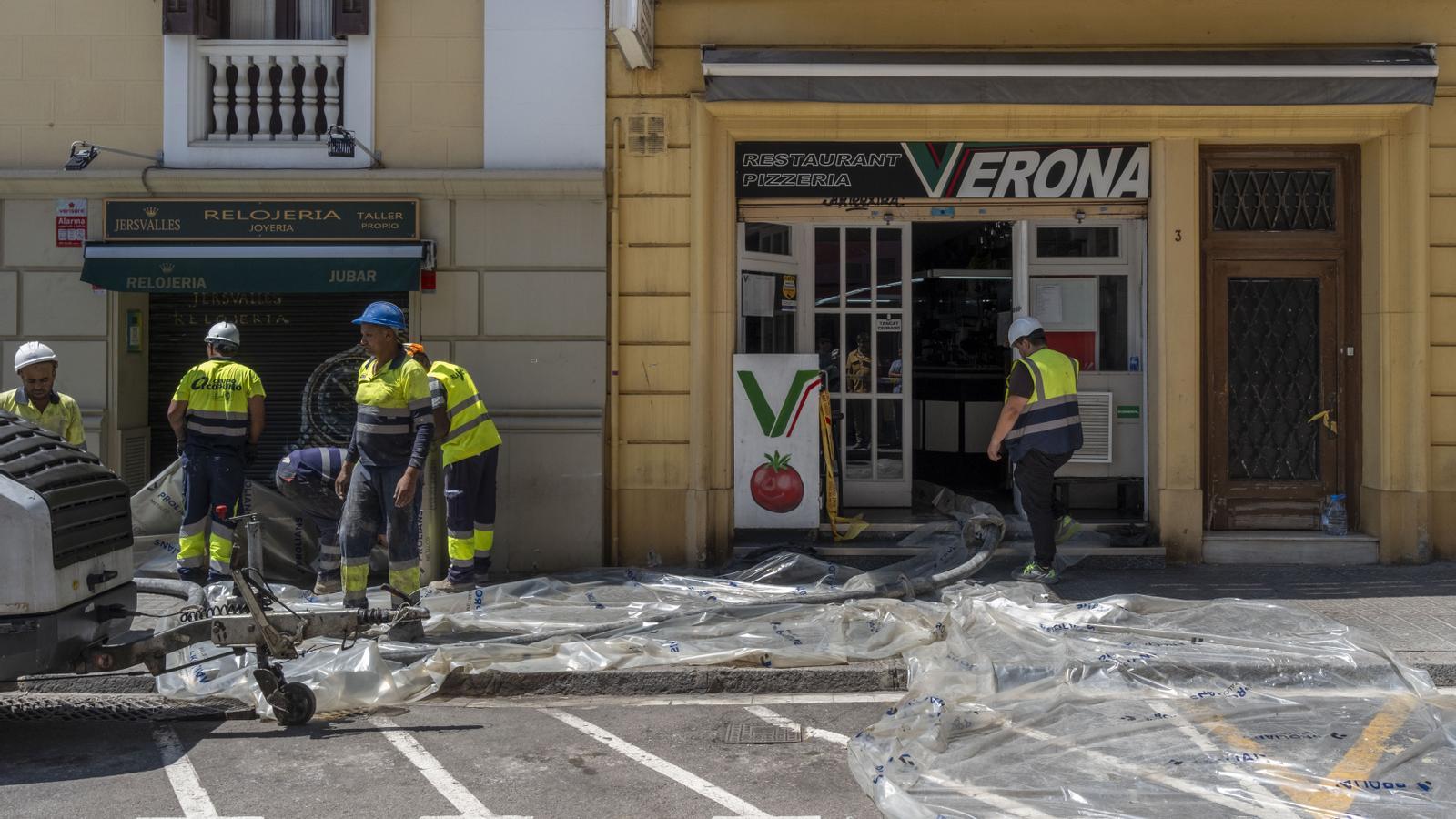
Barcelona48 hours after the sinkhole that the L9 works opened in the Sant Gervasi - la Bonanova neighborhood, it remains an unknown what exactly happened for the ground to suddenly open up. While fire department teams inspect one by one the 93 affected apartments to check for new movements, the causes of the incident that has forced at least eight blocks to be evacuated until Saturday are also being investigated. Among experts, there is also debate about how it could have happened. And they point to a main hypothesis: that, due to some incident, the tunnel boring machine has generated what is known as a chimney.
To explain what this phenomenon consists of – one of the biggest scares in this type of tunnel boring machine work – it is necessary to consider some peculiarities of Barcelona's subsoil – very heterogeneous compared to other cities – and more specifically of the area where the sinkhole occurred. This is discussed by Josep Anton Muñoz, professor of structural geology at the Faculty of Earth Sciences of the UB, and Albert Ventayol, a member of the Georisk Observatory of the College of Geology of Catalonia. Furthermore, both participated in the soundings and geological interpretation of the reports that were made on the L9 route twenty years ago.
Both Muñoz and Ventayol emphasize that the change in rock typology in the subsoil that occurs in this area of the city is key. "The tunnel boring machine had been crossing hard or very hard granite rocks from Mandri. And instead, here, through a fault, it has penetrated black slates, which form a much softer rock," explains Ventayol. The change of material also implies making adjustments to the tunnel boring machine's operating system. "If you are in hard rock and suddenly enter a very weak area, it can flow and produce this earth movement," points out Muñoz.
It is here where the two geologists point to the chimney as the most probable hypothesis behind the sinkhole. It is a phenomenon that occurs when, for some reason, the tunnel boring machine begins to swallow more earth than necessary, creating a void above the machine. "A cavity forms just above where the tunnel boring machine passes, and it grows vertically upwards – hence the name "}chimney–. If it reaches the surface, that's when the sinkhole occurs," recounts Muñoz.
In this case, they both point out that the earth movement reaching the surface may have to do with the fact that the Torrent de Cal Almirall used to pass through the area. "This can cause part of the upper land to be sediments – softer – and, therefore, it is easier for movements to occur, which can contribute to the sinkhole if there is a problem in the lower area," remarks Muñoz.
Uncertainty about the land situation
Beyond the exact origin of the sinkhole, Muñoz and Ventayol highlight another of the unknowns they consider relevant. In what situation has the ground been left between the hole that swallowed the toilet of the Verona pizzeria and its origin. They point out that, although the sinkhole is only 4 meters deep, its origin is 36 meters further down, as the tunnel is built at a depth of 40 meters. "The basic issue is what happens between the sinkhole on the surface and the 40 meters of depth," argues Muñoz.
Although both geologists understand that from the engineers' point of view, the priority was to immediately stabilize the ground so that the buildings would not suffer structural damage, and that for this reason it was refilled with concrete, they regret that there has not been the possibility of thoroughly analyzing the hole before covering it up. "Acting by putting in cement is probably the best solution, but it doesn't allow you to understand the phenomenon," emphasizes Muñoz.
Regarding the doubts that this week's incident may generate about the safety of the work, Ventayol underlines that "the construction method with a tunnel boring machine is the safest tunnel construction method there is". He recalls that whenever a tunnel of these characteristics is excavated, it is done with intensive monitoring of buildings and streets, and he also opines that the scare of these days will make the Generalitat even "more careful".
The geologist explains that, on the way to Lesseps station – about 500 meters to definitively connect the L9 – the tunnel boring machine will continue to cross slates and perhaps some harder limestone "a little before reaching Lesseps". He underlines that, as the reports made twenty years ago said, the tunnel boring machine has been entering for weeks the "most delicate" area of the route due to the transition between rock types. "So far it has been easy," concludes Muñoz, who explains that when entering a fault zone – the tunnel boring machine's most immediate challenge will be the Putxet fault – and with more heterogeneous and soft materials, there is "a greater propensity to collapse".
The Department of Territory, Housing and Ecological Transition has commissioned the company responsible for the L9 works to begin the ground consolidation phase in the area affected by the sinkhole. This action follows up on the immediate work carried out, which has made it possible to stabilize the situation by concreting the cavity.The technical managers of the work informed the affected residents this Thursday morning about the status of the work and the planned actions for the coming days. The objective is to guarantee the stability of the subsoil, verify the state of the surrounding properties, and move towards the progressive normalization of the area with the maximum safety guarantees. A first round of inspections has already been carried out in the properties that could be accessed, and so far, no pathology has been detected that compromises the structural integrity of the buildings or represents a risk to their stability.
