Joan Carles Salmerón: "The bus is covering all the commuter rail problems with a very good grade"
Director of the Terminus Transport Studies Center

-
CAT -
CAST
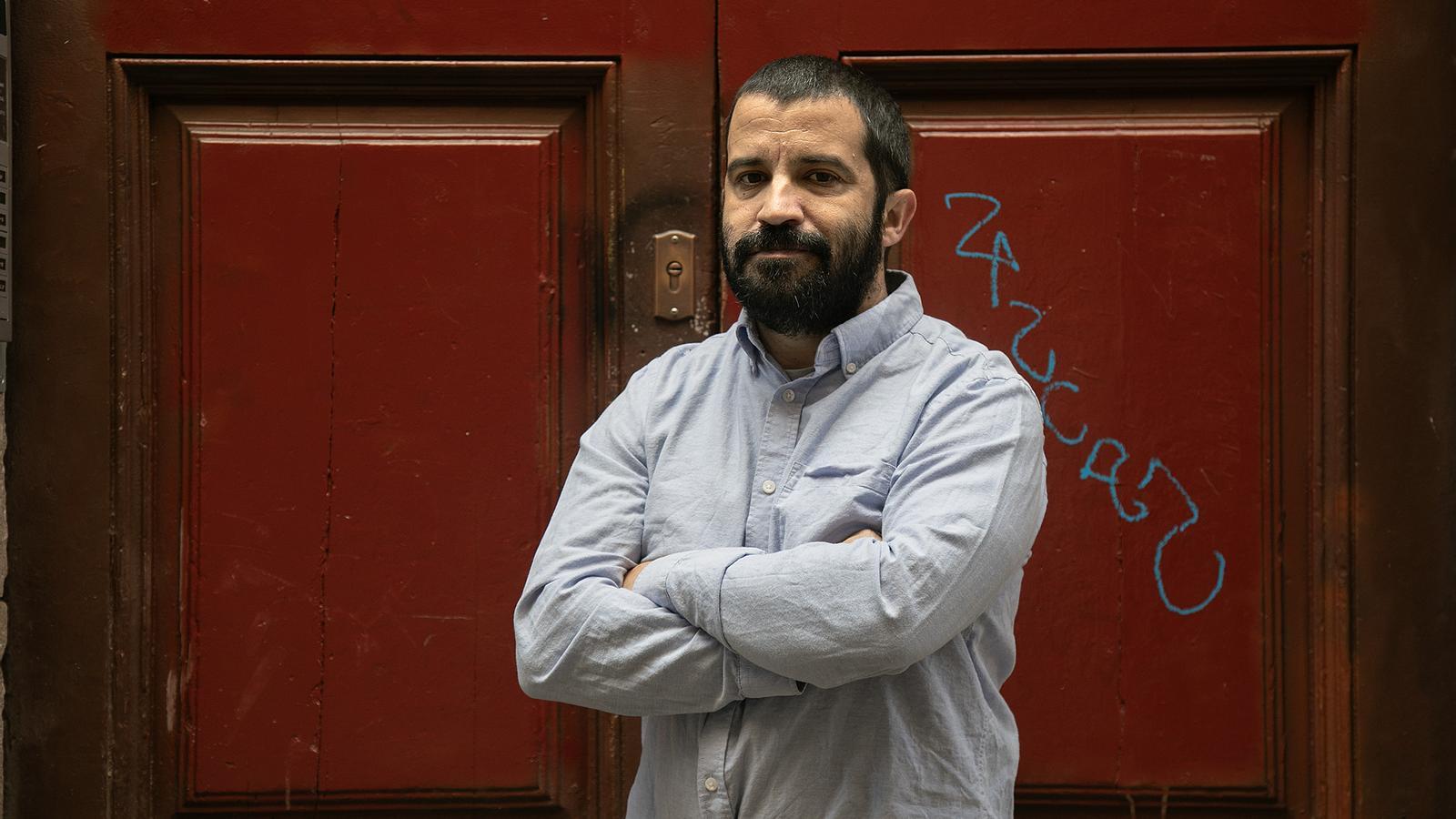
Barcelona"Public transport should be considered an essential service, just like education or healthcare." This is one of the maxims of Joan Carles Salmerón, the director of the Centre d'Estudis del Transport Tèrminus and one of the experts in mobility in Catalonia. This week he has presented the book The bus and coach in Catalonia, the first publication that collects the entire history of the sector. All of this, at a time when buses have taken over from Rodalies, which is still struggling to recover from the crisis opened in January, after the fatal accident in Gelida.
¿Is there any other moment in history when the bus has had to come to the rescue of the railway?
— No, what is happening is unprecedented. And we hope it is a temporary situation: Rodalies has to recover, but for the moment the bus sector has taken a step forward and is demonstrating great adaptability. They have gone to look for vehicles in Mallorca, Murcia, Galicia, also drivers... and they have managed to maintain the service. Today, the bus is covering with a very good grade all the problems that Rodalies has brought.
And what if Rodalies does not recover in the short term? Will buses be able to withstand this pressure?
— It would be a bad scenario, but for society as a whole, because the mobility system is one; we should not separate the bus network from the rail network. We cannot afford to propose, as a society, that in two or three years, all of this, including some major works, will not be resolved. It would not be sustainable economically, socially, or environmentally. The current situation is exceptional.
In his book, he reviews, region by region, how the sector has evolved. What are the key historical moments?
— Everything appears with the turn of the century, at the beginning of the 20th century. There is a double phenomenon: throughout Europe the first buses begin to appear, which are an evolution of carriages; and in Catalonia, moreover, the road network begins to grow. The most paradigmatic case is that public transport manages to reach the Pyrenees. Between 1924 and 1926 the first concessions are created. It is legislated that there can be no competition on a specific line, a company is chosen, timetables are created... Because until then it was a disaster; businessmen argued, they would rush ahead to pick up travelers from the stop before others, there were no defined prices, nor timetables.
It is when you really start to understand it as a public service...
— Clear rules began to emerge, yes. And we have documented in the book that there was almost a bus company in every important town. The 50s and 60s saw a great boom in tourism and the roads were flooded with the famous Pegaso, with more modern buses. And from the 80s and 90s, and especially from the 2000s, with the turn of the century, the large business groups that we recognize now began to be created: Moventis, Sagalés, Plana, Hife, Avanza, Alsa, and Monbús. And there are also a hundred companies that do discretionary transport: school, medical... The main one is Avangrup. There is also tourism transport.
Precisely at the turn of the century, in 2003, is when the first major extension of these concessions is made, which is still in effect.
— Yes, they are the same ones from the 20s and 50s that have been renovated and modernized. In fact, at that time, a total change of services was demanded, the image was unified... It meant a big change because the administration forced the renewal of all fleets and the adaptation of vehicles for wheelchairs, for example, and to improve information.
And beyond the story of 47 Barcelona, which we all know now, what other historical anecdote would you highlight?
— I would choose three. I was very surprised to discover that around 1920 there were already electric buses covering the Girona-Banyoles route. They were charged at night, at the flour mill in Banyoles, but they didn't last long. Also that the current prefix hispano, which some companies still maintain, is because the first vehicle they had was a Hispano Suiza and the company gave them very favorable conditions if they used the name. And I was also surprised to learn that in the 60s there was already a woman at the head of one of the large companies in the sector, La Plana, in such a masculinized world. She led even before the first female drivers entered the sector. And one more anecdote: we have managed to collect many images of towns that held a great celebration, with welcome signs and all the neighbors in the street, when the first bus line finally arrived. They really welcomed progress.
And the future of the sector, where is it going?
— The administration has to face that the bus network will play a very important role in the coming years. Even if we take for granted that the Cercanías chaos has to be solved, a metropolis of 5 million inhabitants is being created and we are heading towards Catalonia of 10 million inhabitants. A rapid public transport system will be needed... We have just inaugurated the second bus-HOV lane, 15 years after the first one. Hybrid buses will be needed everywhere, better applications to offer unified information, comfortable, sustainable buses... Furthermore, new technologies will help us in the fourth great change for buses, with more efficient and safer driving systems or with vehicles with better traction.
One of the things that remains pending to be fixed are all the scattered stops used by intercity buses in Barcelona, for example, and the lack of stations, the model in short.
— Extend to Barcelona and the rest of the regions as well. There are several important things here. The first is that buses must arrive at places in good condition: a place where a driver can make a change, where they can go to the bathroom, where they can rest or unload if they are carrying luggage. It is unacceptable that to this day there are routes that end on a damn sidewalk in Barcelona. We need proper stations at least on Diagonal, Gran Vía, and Meridiana. In this regard, Madrid is a good example, with a bus station at each access to the city. Furthermore, there are still many stops lost in the middle of nowhere, at which the teams themselves have been saying for years that they don't pick anyone up. Please, let's eliminate them! These are things that don't require waiting until 2028; they should have already been done.
