The Adamuz track broke 22 hours before the accident, but no Adif system alerted to it
The Civil Guard rules out that the origin of the accident was sabotage, a terrorist attack, or recklessness by the drivers

-
CAT -
CAST
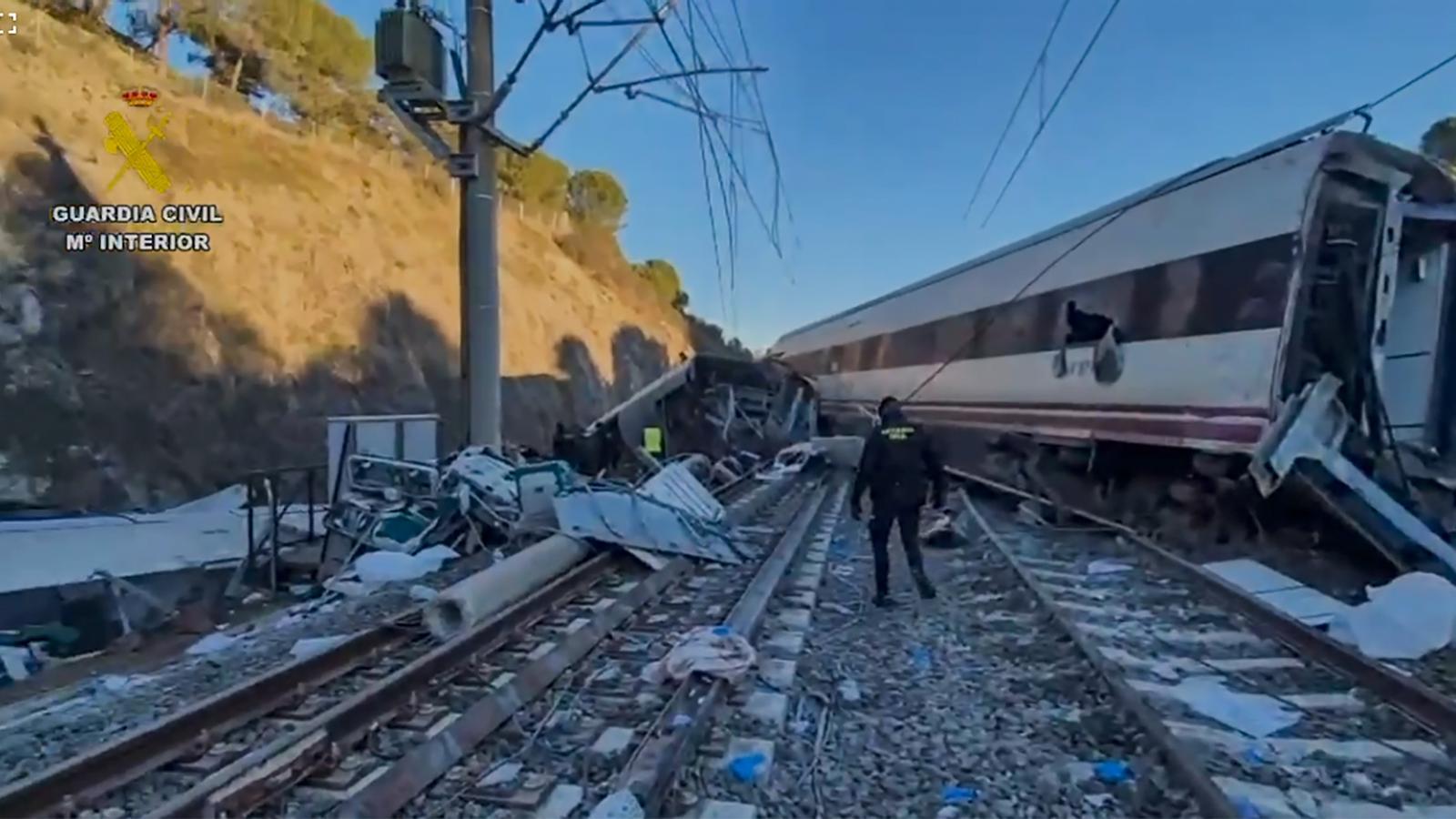
BarcelonaThe Civil Guard has fewer and fewer hypotheses on the table to try to find out why two trains collided in Adamuz, in the province of Córdoba, on January 18, an event that caused 46 fatalities. In fact, the Spanish police are now practically only investigating one of the hypotheses: a track breakage would have caused a derailment of an Iryo train traveling towards Madrid, which collided with an Alvia train that was moving in the opposite direction at that time.
The armed institute, in charge of the investigation of the accident, states in a new report sent to the courts of Montoro that it cannot yet definitively conclude what the causes of the accident were, as some procedures and inspections still need to be carried out. In fact, the Civil Guard has thoroughly analyzed the tracks at the kilometer where the accident occurred, and the diagrams indicating track tension have revealed an important detail.
The railway accident occurred at 7:43 p.m. on January 18, but 22 hours earlier, at 9:46 p.m. on January 17, there was already a drop in electrical tension on the tracks. It went from 2 V to 1.5 V. This means, and the Spanish police indicate this, that the track breakage occurred almost a day before the accident, as the drop in tension would be an indicator of this breakage. However, it is still not clear whether the rail or the weld broke first.
The big unknown after this statement from the Civil Guard is why Adif – the manager of the railway infrastructure in Spain – did not detect the breakage or the drop in tension during these hours that passed until the accident. The summary, according to the report from the Spanish police, is that Adif's system was not prepared to detect this type of electrical alteration.
"The SAM system (maintenance support system) did passively register an electrical alteration compatible with a breakage hours before the accident, but the signaling system was not configured to alert automatically due to lack of reliability," concludes the Civil Guard. And it adds that, while Adif requires in its specifications that the system must be designed to detect the fracture, in this installation "it did not require it."
Other detection methods
The signaling system is designed to warn of voltage drops, but it alerts from 0.78 V. In the case of Adamuz, the voltage dropped to 1.5 V. "However, it will be necessary to clarify whether there was a technical possibility of receiving any type of alert for these voltage drops, especially considering the time it remained at these unusual levels and the severity of the consequences," states the Civil Guard in the report.
Following the publication of this report, Adif sources defend that the 0.7 V variation detected in the electrical voltage "may coincide with different incidents, which do not necessarily indicate a track break." In this regard, the same sources point out that the threshold for determining "track circuit occupancy" – whether a section of track is free or occupied by a train – due to voltage drop is set at 1 V, "that is, less than what was measured." "The system did not detect track circuit occupancy in any case," they affirm. Furthermore, Adif adds, the system that detects if the track is occupied "is not a system to determine a rail break, but an exclusive system to determine the positioning of a train."
The Civil Guard has analyzed how the rail that appeared broken was welded and installed, as well as which review processes have been followed, without any irregular aspect being detected. In this regard, and despite the voltage drop occurring 22 hours before the accident, the drivers who passed through that section – a total of 19 – did not detect any strange movements or sensations while driving. Only one of them perceived a jolt on the right side. On the other hand, during the investigation, the trains that passed through there were inspected, and in several of them, signals compatible with a rail break have been observed. This break can occur due to various technical, operational, and metallurgical causes, ranging from the manufacturing process to wear and tear from continuous use. The Civil Guard is now analyzing all these possibilities.
Hypotheses entirely ruled out
However, what the police do is rule out hypotheses they have investigated, such as it being sabotage, a terrorist attack, or that everything was caused by recklessness or poor driving by the drivers, one of whom died. All these hypotheses are ruled out and the police are focusing on the breakage of the tracks. For the moment, and without confirmation from the analysis of the removed materials, the armed institute does not conclude in what order the damage to the track occurred; that is, whether the breakage of the rail caused a breakage of the weld or vice versa.
