Why does the CAP Passeig de Maragall still appear in the name of a Francoist union?
Many large hospitals and CAP are owned by the State, but the Generalitat assumes their maintenance and investment expenses
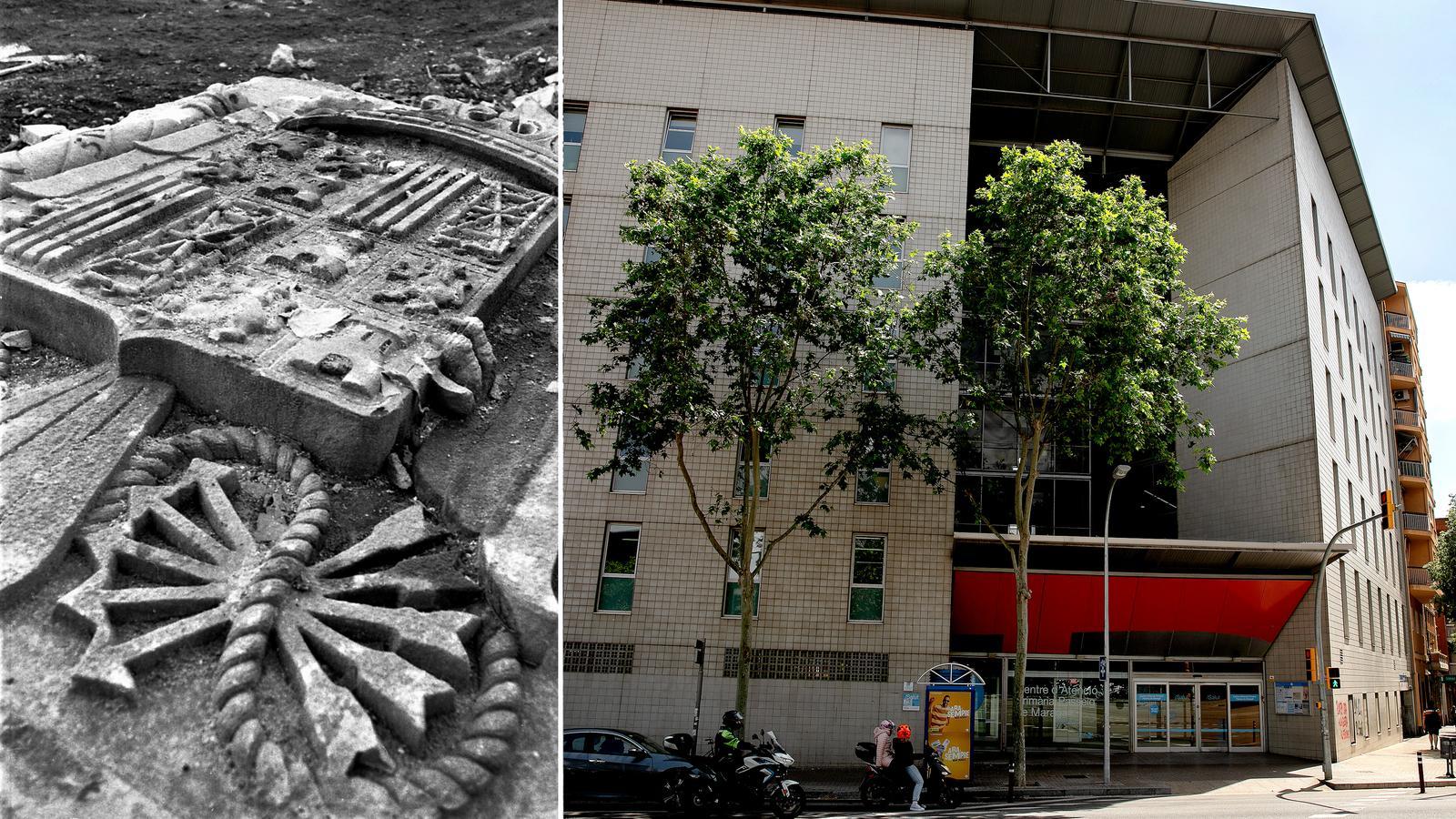
BarcelonaThe current CAP Passeig de Maragall, in the Sant Martí district of Barcelona, still figures today – half a century after Franco's death – in the name of the Falange Española (FET y de las JONS). Although the Generalitat manages the center and assumes all maintenance costs, the registered ownership remains in the hands of the dictatorship's political apparatus. This is the most disconcerting finding of the investigation by historian Neus Moran, who documents how the State protected healthcare assets originating from Francoist spoliation before the transfer of powers.
Practically all the large public hospitals of the Catalan Health Institute and the historic primary care centers (CAP) are affiliated with the Generalitat. However, a paradox exists: in many cases, ownership does not belong to the Catalan government, but to the General Treasury of Social Security (TGSS). This situation forces the Generalitat to assume the maintenance, renovation, and investment costs of facilities it does not own. In other words, it has management but not ownership. There are other consequences. The transfer of buildings is strictly conditioned to healthcare use. If a center becomes disused, as has happened with the old CAP Sant Elies (Barcelona), or as will happen when the Trueta in Girona moves to its new location, the Generalitat cannot decide its future. The TGSS has the final say and can block any alternative use for the neighborhood.
It's not that the TGSS has been investing and acquiring assets over 50 years of democracy. Created in September 1978, it was established as the body responsible for administering the assets of the Social Security system. Upon its creation, it inherited a large and diverse legacy from the defunct National Institute of Providence (INP) and the Obra Sindical 18 de Julio, the healthcare branch of the Francoist regime's vertical union. During the dictatorship, the INP was the one pulling the strings of social security and the one that built some of the major hospitals (such as the current Hospital Vall d'Hebron, which was originally called Residencia Sanitaria Francisco Franco).
A substantial part of this heritage originates from the dictatorship's confiscations, which affected the labor and associative movement as well as institutions and individuals. The CAP Passeig de Maragall had been, before the dictatorship, the Ginecós clinic, but with the Francoist victory it passed into the hands of the fascist vertical union. "It is a shocking case," states Moran, winner of the Ciutat de Barcelona Prize 2025 for the research General Spoils (L’Avenç). Surprisingly, according to the registry data, and as ARA has been able to verify at the Property Registry, the property is still registered in the name of the "Delegación Nacional de Sindicatos de la F.E.T. y de las J.O.N.S." The big question is: how is it possible that, in the 21st century, a fascist party that was suppressed in 1977 appears as the owner of a CAP?
How did it pass into the hands of the Falange?
The Institut Ginecós was born in 1923 as a public limited company driven by a group of doctors –Climent Selvas, Enric Baldocchi, Emili Ardèvol, Joan Riera and Salvador Casanovas– and the industrialist Josep Lafitte. The center, specialized in gynecology and obstetrics, was located on Garrotxa street (currently, Maragall promenade) with a stable medical team and cutting-edge facilities for the time: about sixty rooms, state-of-the-art operating rooms and central heating. In 1925, a second pavilion was built and shares were issued.
and this is listed in the register of political parties of the Ministry of the Interior)

"The building of the old Ginecós hospital was integrated into the Obra Sindical 18 de Julio as Clínica Victoria. The operation, formalized in November 1942, included the donation of surgical material and 10,000 pesetas to the new institution, a truly disconcerting fact," explains Moran. The center became part of the Compulsory Health Insurance (SEO), had a capacity of 140 beds and treated surgical specialties, chronic patients, and retirees. "In a 1963 hospital catalog, only two hospitals in Barcelona appear as property of the Obra Sindical 18 de Julio: Clínica Victoria, classified as a provincial surgical center under the patrimonial dependency of the General Secretariat of the Movement, and the Hogar Enfermería Oftálmico Santa Lucía, on Anglí street," details Zarzoso. The lack of investment during Francoism degraded its appearance. After a period of disuse, the building was demolished in February 1989. On the same plot, the new CAP Passeig de Maragall was built, which was inaugurated on November 8, 1997.
How can it be that in 2026 it is still in the name of Falange Española Tradicionalista y de las Juntas de Ofensiva Nacional Sindicalista (FET y de las JONS)? "In principle, it cannot be because the historical Falange disappeared in April 1977 and, therefore, it is an administrative negligence. It is a case of neglect. Today there are other falanges (and this is stated in the list of political formations of the Ministry of the Interior) that are fascist groups, but I would not want to think that they are the owners," states Thomàs.

The Ginecós clinic is just one of 110 properties studied by Moran to document the origin of the health heritage that the Generalitat has occupied since the transfer of powers agreed in 1981, but which remains under state ownership. Moran's research, which the ARA was able to consult after requesting it through Transparency, has encountered persistent administrative opacity, and following the documentary trail is still a complex task today. "I have not been able to access property registry records –explains Moran–. The lack of documentation makes it difficult to reconstruct this map. Furthermore, no complete inventory of the Generalitat's heritage during the Second Republic is preserved, even though there is evidence of it in the years 1932 and 1937".
Moran has been able to trace the ownership of 97 of these properties. "A key detail reveals the State's strategy: 50% of the buildings registered in the name of Francoist organizations were formally registered between 1975 and 1978. This massive registration, just before the transfers of powers, served to safeguard ownership in favor of the State (through the TGSS) and to prevent the assets from returning directly to the Generalitat or their original owners," says the historian.
It was no secret: the 1995 letter
The anomaly of the CAP Passeig de Maragall has not gone unnoticed by the administration, but no government has taken the definitive step to correct it. In 1995, during the processing of the new CAP Passeig de Maragall, an urban planning report already warned that the plot was still in the name of the Delegación Nacional de Sindicatos. This newspaper has been able to verify this at the Sant Martí Archive. The document specifies that the situation is being regularized within the process of transfer from the State to the Generalitat and clarifies that the transfer of the road corresponding to the Passeig de Maragall "cannot be ceded until the property is legally in the name of the Institut Català de la Salut". Nevertheless, in 1997 the new building was inaugurated on a property that, officially, holds a great mystery. According to the Property Registry, it still belongs to the political apparatus of Francoism, and according to the inventory of heritage that the Generalitat has open, it is the property of the TGSS.It is not the only singular case. "Between 1958 and 1961, Barcelona City Council also completed the transfer by exchange to the National Social Security Institute of the property where the Sant Andreu CAP currently operates. The building and land had been acquired in 1952 by Edificadora Barcelonesa S.A., a trusted developer of the municipal government, without clear information about the first owners," details Moran. The historian has traced other buildings: the Sant Martí de Provençals CAP, on Fluvià street, is located on land acquired by the Urban Planning Commission in 1958 and later registered, in 1967, in the name of the National Social Security Institute. The Gavà CAP was also donated by the municipality's city council to the INP in 1975 on the condition of building an outpatient clinic there; in 1983, two years after the transfer of powers to the Generalitat, the TGSS registered the ownership in its favor. The Doctor Robert CAP in Badalona, formerly the Provincial Trade Union House, and the Montcada i Reixac CAP, formerly the Local Trade Union House, were donated to the INP by the local delegations of the Brotherhood of Farmers and Ranchers, an organization within the Vertical Syndicate, in the years 1957 and 1971.
Some of the major projects that the dictatorship did realize, such as the Vall d’Hebron Hospital, had already been part of the political plan of the Second Republic. Three prominent members of the Group of Catalan Architects and Technicians for the Progress of Contemporary Architecture (Gatcpac), Josep-Lluís Sert (future dean of architecture at Harvard), Josep Torres-Clavé and Joan B. Subirana, the authors of the Central Anti-tuberculosis Dispensary (1934) in Barcelona's Raval, designed in 1936 the large Anti-tuberculosis Hospital of Vall d'Hebron: a new healthcare facility with 9 floors and 400 beds, in the same place where the current hospital center was eventually built. "A similar situation occurred with the heritage of the Mancomunitat (Commonwealth) abolished during the Primo de Rivera dictatorship. At that time, many properties passed to the State, but with the Republic they were returned to the Generalitat. At that moment, there was political will to do so," says Moran.

And what about the headquarters of the Catalan Health Institute?
There are more unusual cases that Moran has found throughout his investigation. On Gran Via de les Corts Catalanes in Barcelona, where the headquarters of the Catalan Health Institute is now located, there were several privately owned buildings – such as Casa Bonet or Casa Viuda Baixeras – that were affected by the bombings of March 1938.
After the war, the Reconstruction Committee of the Barcelona City Council, chaired by Ignasi Ventosa Despujol, took over the management of urban reconstruction, including the granting of building permits, the recovery of assets, and the planning of new actions. In some cases, owners were forced to demolish the buildings and bear the costs, a situation that led to complaints and litigation. There is evidence of several reconstruction requests that remained paralyzed for years, while the administration advanced its own projects.
On January 8, 1940, for example, Dolors Batlló Bofill, then wife of the pharmacist Josep Andreu Miralles, submitted a request to rebuild the building at number 589. The request included the technical project, the corresponding plans, and a request for exemption from payment of building fees, given that it was a property listed as affected by war damage. Despite complying with the administrative requirements, file number 2553 remained paralyzed for years, probably because the plot had already been designated for the construction of the future headquarters of the National Provident Institute.
In February 1945, the municipal architect sent a letter to the Urban Planning Commission indicating that no documentation presented by the Batlló family was on record. The report stated: "No application or documentation has been submitted, nor is there any trace of works initiated on the plot, which, along with the adjacent properties demolished up to the Gran Via line, belongs to the National Provident Institute for the construction of a social building, according to the notice posted on the same site." Currently, the building is also owned by the General Treasury and is the headquarters of the Catalan Health Institute.
