The Barcelona City Council has activated four new walk-in services to assist applicants for extraordinary regularization and to issue residency registration and vulnerability reports, if necessary. Starting this Tuesday, the SAIER on Tarragona street is operational; on Wednesday, the OACs in Plaça Sant Miquel and Monumental will be added, and next week a space will open on Miquel Bleach street, in Hostafrancs. The Deputy Mayor for Social Rights, Raquel Gil, explained that regular services will also be reinforced with 60 new workers, but that queues will be unavoidable because "people have a lot at stake".
"No one has to pay a single euro for regularization": the State asks consuls to watch out for possible scams
The presentation of documents to process the residence and work permit brings "relief" to the applicants
21/04/2026 - 15:36 h
-
CAT -
CAST
Barcelona"Submitting the documents for regularization is the first step to being able to continue growing here with stability and calm." This is how Xavier, from Venezuela, explains the opportunity that regularization as an asylum seeker would mean for him. In front of the Post Office in Plaça del Doctor Letamendi in Barcelona – enabled for in-person processing since this Monday – the 31-year-old explains that he has already managed to submit all the documentation. Xavier arrived in Spain almost a year ago and, once settled in the Catalan capital, sees the approval of extraordinary regularization as another step to continue working without having to worry about his papers. A process he undertook alone. "You have to read everything very well and bring the necessary documents, but in my case it has been quite easy and quick," says Xavier.
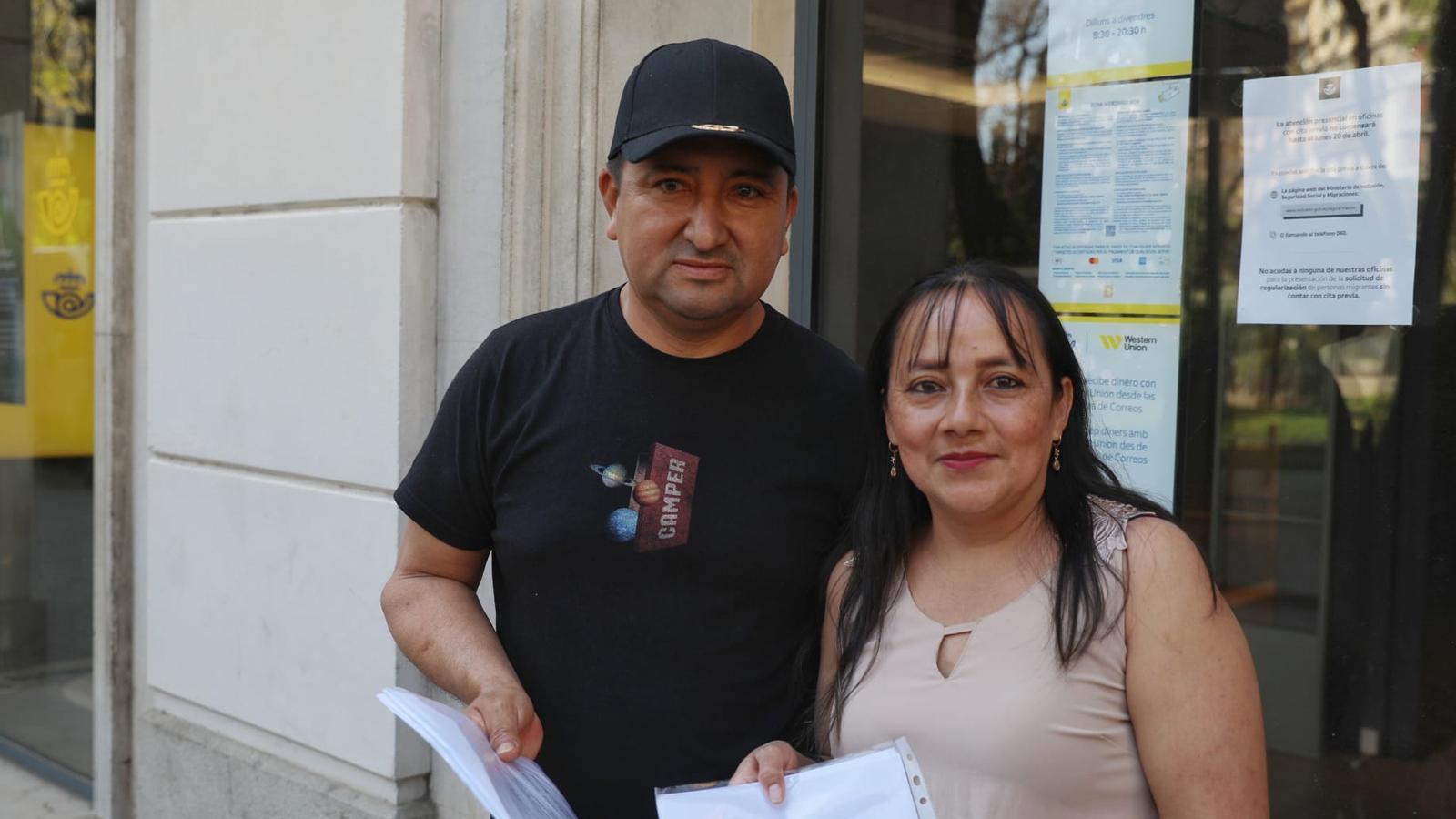
A situation also shared by Francisco and Nellie, an Ecuadorian couple, who have gone to submit their documents at the same office to process regularization. "It's a process that, when you have people nearby who know a bit, isn't that complicated," they admit. In their case, they came to complete the process accompanied by their two minor children, with whom they came to live in Barcelona about two years ago. "The opportunity came up and we all did it as a family, except for my eldest daughter, who is already of age and lives there," he says. It was with the help of his eldest daughter that they obtained all the documents to make the application. If all goes well, they believe that regularization will bring them more peace of mind: "It's a help to continue living here with the children and, furthermore, with a little more confidence."
None of these three people have asked for help to process the application, but many others have asked for advice or to get an in-person appointment to submit their papers. As the ARA explained, there are users who have paid between 100 and up to 500 euros for the procedures, which include the administrative fees charged by consulates and the State. In view of this, the Spanish government delegate, Carlos Prieto, asked consuls this Tuesday to inform citizens "that no one should pay a single euro" to get an appointment to process extraordinary regularization, unless citizens themselves decide to go to a manager or lawyer to handle the procedures for them.
In a meeting with the consuls of Albania, Argentina, Belarus, Brazil, Burkina Faso, China, Ecuador, El Salvador, Ethiopia, Mexico, Peru, Senegal, Morocco and Pakistan, Prieto regretted that there are people who want to "take advantage of vulnerability" and the language barrier and are "scamming" people. "There is no need to buy any appointment," he insisted, and explained that he has already spoken with the head of the National Police in Catalonia and it has been noted that there are difficulties in proving that some of the actions fall under the Penal Code or are considered administrative offenses.
With conviction and hope
The criminal record certificate, a document proving residency in Catalonia, or the asylum justification are some of the papers that both the Ecuadorian family and the Venezuelan young man have had to submit. "In my case, it hasn't been difficult to gather everything. I've been able to do it independently, without having to pay anyone," Xavier specifies. The young man is fully convinced that he will be regularized and, therefore, assures he is calm: "I meet the necessary requirements to obtain it." Accompanied by their children, Francisco and Nellie also trust they will receive a 'yes': "After having submitted it, we don't lose hope. Being able to submit everything is already a relief."
Despite everything, both are also aware of the difficulty faced by a large part of the 150,000 people who are estimated to benefit from the process in Catalonia to collect all the documentation on time. In fact, also with an appointment at the Correos offices, Maribel, also from Venezuela, explains that she could not submit the paperwork this Tuesday because one of the documents was incorrect. "It's a complicated process, especially for people who have to request the vulnerability certificate, but we need it to achieve peace and tranquility," she assures. A series of procedures that, moreover, she details that most try to resolve throughout the first few days. "It's better this way in case we run into problems," she concludes.
Four more walk-in points
