Landslide on the R2: the Rodalies closure will be extended at least until next week while they cover the hole
The workers have begun to fill the hole with concrete and with the crashed crane inside

-
CAT -
CAST
BarcelonaThe day after the collapse of the R2 works between Barcelona and Montcada, which caused a great scare and swallowed a large crane, the Secretary of State for Transport, José Antonio Santano, admitted that it would take "days" to fill the gap with concrete, but that, "if all goes well," train traffic could be restored next week. However, the secretary has asked for caution and acknowledged that a more concrete date for the resumption of service could be given from Saturday.
This morning, the councilor for the Nou Barris district of Barcelona, Xavier Marcé, explained that the collapse could have been caused by the presence of groundwater in the area. Santano, however, assured that it is too early to have any hypothesis. "The causes of the sinkhole are being analyzed, therefore, it would be imprudent and premature to advance any hypothesis. It is evident that the ground has not behaved as we expected, but nothing can be advanced. None of the speculations that have been made have any basis," insisted the Secretary of Transport.
Slate, sand, gravel and water
At this time, geologists also prefer to be cautious, but they are advancing some of the characteristics of the terrain and possible causes. "We are talking about a somewhat complex area, where there are slates, which is a material that is not of great geotechnical quality, with planes that can slip, subject to small faults and less resistant," explains Joan Martínez, doctor in land engineering and vice-president of the College of Geologists of Catalonia. "Above this slate is the Besòs riverbed, which is basically sand and gravel saturated with water," he continues.
This geologist confirms, then, that there is a lot of water in the subsoil of Vallbona and this makes it difficult to predict how the terrain will react: "We would have to take a sounding every meter and that is not viable, neither technically nor economically," he assures. For his part, Josep Anton Muñoz, professor of structural geology at the University of Barcelona (UB), explains that when sinkholes of this type occur, it is usually due to "either the rock is very weak and moves with the drilling; or some problem with groundwater." Martínez, however, adds another factor, the human one: "Before acting, on paper, many calculations are made, but then it has to be executed, and the construction companies and contractors arrive. If the problem is that a well wall has collapsed, it cannot be ruled out that there has been an error in construction," he assesses.
According to Adif, the tasks now focus on stabilizing the hole by filling it with concrete, a common practice in this type of incident. This time, however, it will be done without removing the crane that fell inside. The Secretary of State said that the machine will remain buried because moving it "would generate new unnecessary risks." In fact, the hole is already being filled with mortar with the crane inside.
Santano has also made an effort to emphasize that there are no homes where damage has been detected and that they are carrying out all necessary monitoring to detect any possible movement. They have also started an information campaign to keep residents updated on the progress of the work.
Changes in rail traffic
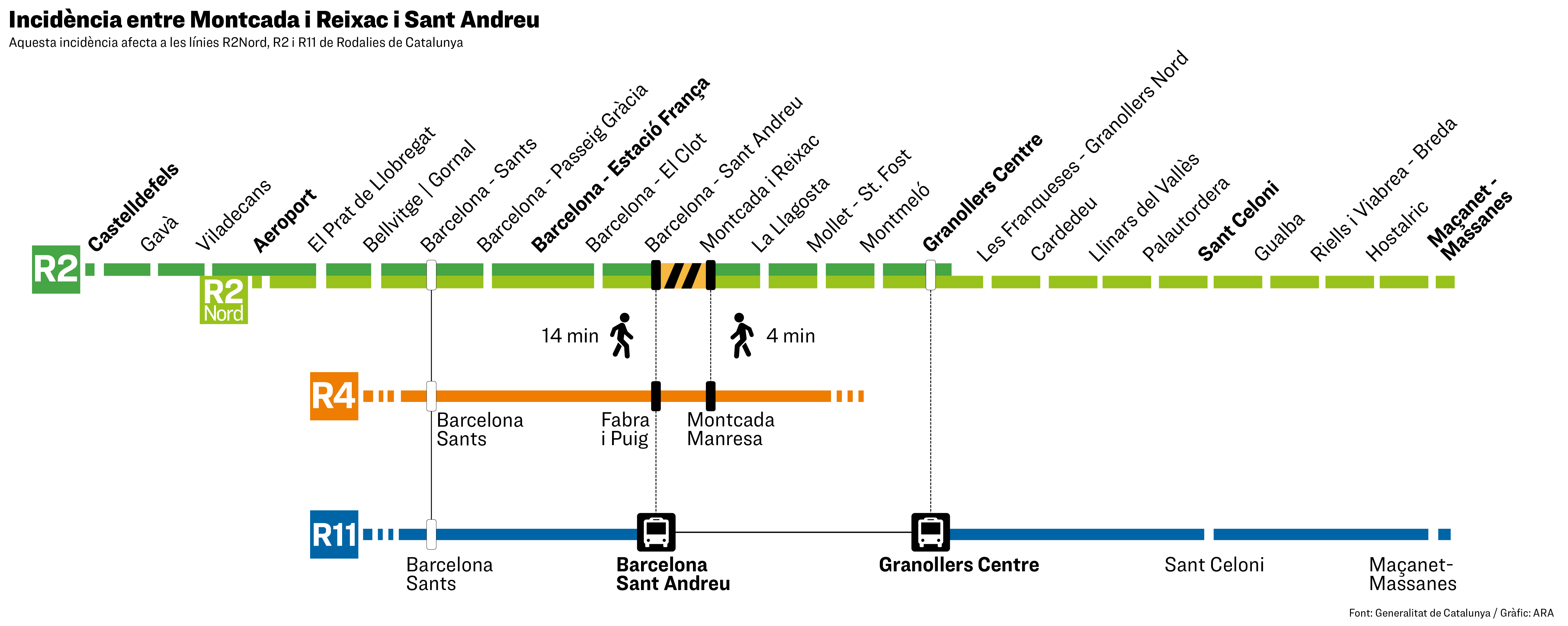
Although the collapse did not cause injuries, the sinkhole has had a direct impact on traffic. Railway traffic between Montcada i Reixac and Sant Andreu has been preventatively cut off and for the momentsine die railway traffic between Montcada i Reixac and Sant Andreu. This affects three lines: the R2, R2 Nord, and R11, for which Renfe has organized an alternative operation to ensure mobility.

- If you want to investigate the graph in more detail, open the high-resolution version in another tab.
Thus, starting this Thursday, R2 Nord and R2 will only offer service between Maçanet-Massanes and Montcada i Reixac. At this point, passengers can make a transfer, about five minutes on foot, to go towards R4 in the direction of Martorell-Vilafranca-Sant Vicenç de Calders. This line, R4, will offer service between Montcada i Reixac, Manresa, and Barcelona Sants. On the other hand, R2 Nord and R2 destined for the airport and Castelldefels will start their journey at Sant Andreu station.
In turn, R11 will offer the usual rail service between Cervera de la Marenda/Portbou and Granollers Centre. From here there will be an alternative road service, which will be direct between Granollers Centre and Sant Andreu Comtal, with schedules coordinated with train departures and arrivals. In addition, these passengers can also opt for the R2 Nord and R2 trains between Sant Andreu and Montcada.
Finally, travelers from Girona and Figueres will be directed to the Avant services at Barcelona Sants. Renfe has explained that it is reinforcing this service, with more seats between Figueres-Vilafant, Girona, and Barcelona Sants. More information staff will also be deployed.
Despite the alternative plans, the impact on passengers has been evident this Thursday and the complaints about the incidents among users of R2, R2 Nord, and R11 have not been long in coming. In fact, at Granollers station, travelers were not very surprised by the incidents. “It’s the daily bread,” complained a passenger. “You never know with Renfe,” added another user, who calculated arriving two hours late for work.