Mallorca intones 'La Balanguera' in unison for the first time in history
The unitary act with administrations, citizens and cultural entities does not cover up the decisions of the PP and Vox regarding Catalan
-
CAT -
CAST
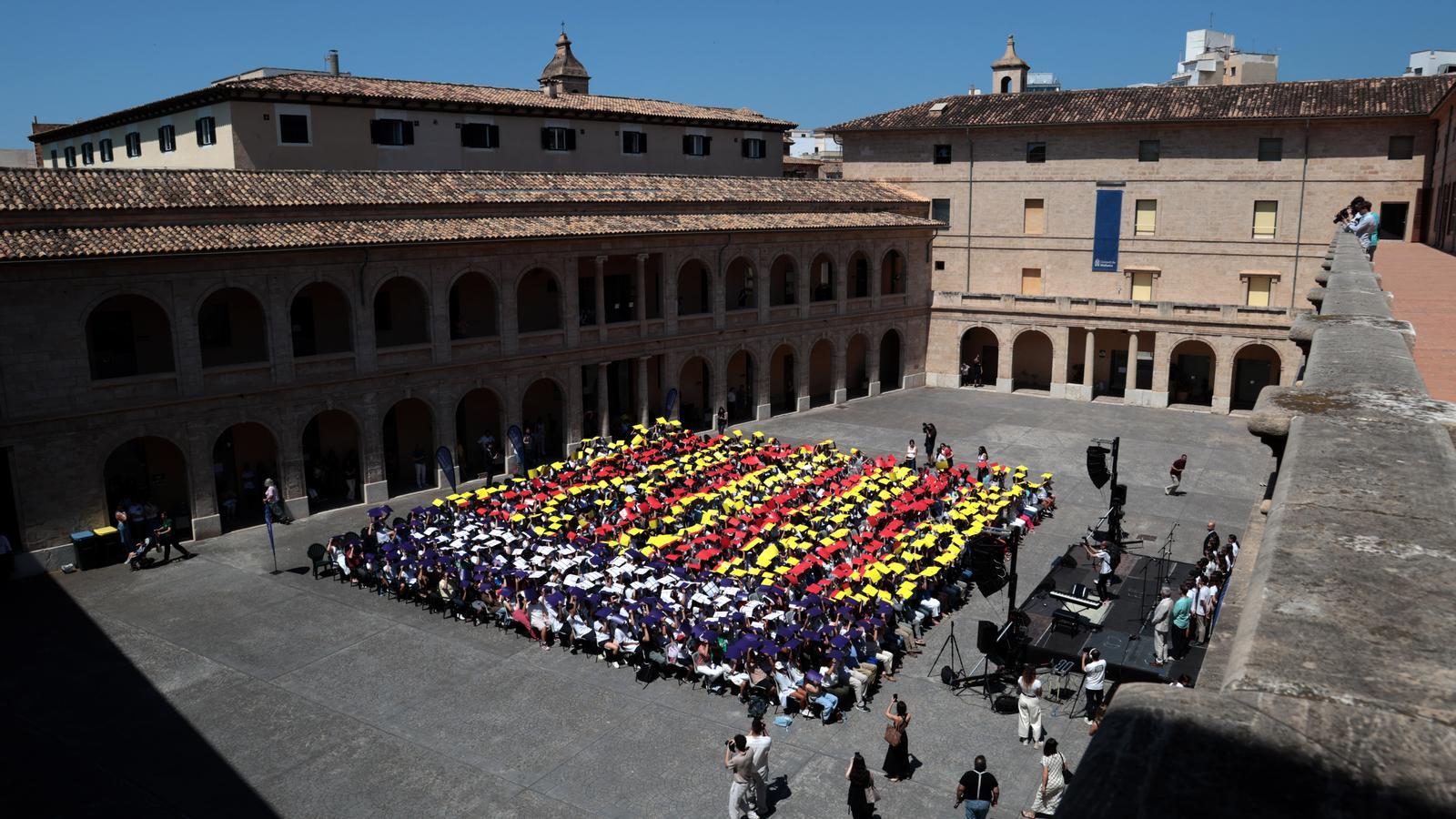
PalmaOne hundred years after the death of Joan Alcover, Mallorca has once again sung in unison La Balanguera, the island's official anthem. Thousands of people gathered in Plaça Major in Palma, while dozens of municipalities simultaneously replicated the same scene in a mobilization promoted by Obra Cultural Balear (OCB), a historic entity in defense of the Catalan language and culture. It was also heard in educational centers and Eroski supermarkets.
The commemoration was supported by the main Balearic institutions, even though Marga Prohens' government has been harshly criticized by educational and cultural sectors for its policies. For example, the linguistic segregation plan in schools – which, in practice, reduces the weight of Catalan within classrooms –, the elimination of the Catalan requirement for teachers in positions of very difficult coverage or for doctors and nurses, and the withdrawal of subsidies to the OCB, which, despite this, has maintained institutional collaboration in the centenary events.
Educational centers and the University of the Balearic Islands (UIB) have been heavily involved in the commemoration. More than 250 schools and institutes performed La Balanguera after weeks of rehearsals with students and teachers. Public schools, traditionally linked to the defense of education in Catalan, have been the majority in participation in the events. At the event, at the Centre Cultural de la Misericòrdia (Palma), five public centers and four subsidized centers participated. One, Santa Mònica, is part of the linguistic segregation plan agreed between the PP and Vox. The choir of Madre Alberta, the other major Catholic subsidized center, performed the piece on stage and with microphones.
The expression of Mallorcan identity
The OCB and institutions governed by the PP – and, in some cases, with the support of Vox – have shared symbolic spaces and moments such as the mass singing of La Balanguera, turned into an expression of defense of Mallorcan identity and its own language and culture. But this image of consensus coexists with a climate of strong political and social confrontation around the language. Since the PP came to power with the support of Vox, the Balearic institutions have promoted several measures that entities, unions, and the opposition interpret as a setback for Catalan.
The Prohens Government eliminated the Catalan language requirement in public healthcare, turning it into a mere merit for doctors and nurses, with the argument of facilitating the coverage of vacant positions. This provoked protests from unions, cultural entities, and opposition parties. In fact, the OCB took it to the Constitutional Court. In the educational sphere, the executive has also promoted the linguistic segregation plan, which introduces separate groups by language and reduces the weight of Catalan as the vehicular language in classrooms. Only nineteen centers have joined the initiative, all of them Catholic subsidized schools.
The measure has been widely contested by a significant part of the educational community and by entities defending the language, who denounce that the model breaks the linguistic consensus built over decades. The OCB also took it to court. In parallel, linguistic requirements for some teachers in very hard-to-fill positions have been relaxed, allowing some professionals to access public service without proving Catalan language proficiency.
At all political levels
The Palma City Council, also governed by the PP, has been accused of sidelining Catalan in various areas. Public companies like the EMT have announced job openings without requiring knowledge of Catalan, despite them being public services. The OCB claims this violates citizens' right to be served in Catalan and represents a setback in linguistic normalization policies.
Regarding the Consell de Mallorca, various entities and unions have criticized the reduction of institutional support for Catalan promotion policies and, in particular, the economic cutbacks to historical cultural organizations. In 2024, the Consell reduced subsidies to the OCB by 25% – from 50,000 to 35,000 euros – and to Joves de Mallorca per la Llengua – from 60,000 to 45,000 euros.
The decision generated strong controversy because Vox had publicly called for the complete elimination of aid to entities promoting Catalan. Tensions escalated further with the 2026 budgets, when the Consell, with the votes of the PP and Vox, approved the suppression of subsidies to both entities, which denounced that the withdrawal sought to economically weaken the main collectives defending the Catalan language in Mallorca. Both have been particularly active against the linguistic segregation plan and against the linguistic policies promoted by the Government.
