Interest in studying a double university degree is growing: "The effort was worth it"
The La Caixa Foundation awards scholarships to a hundred university students to continue their studies outside of the State
-
CAT -
CAST
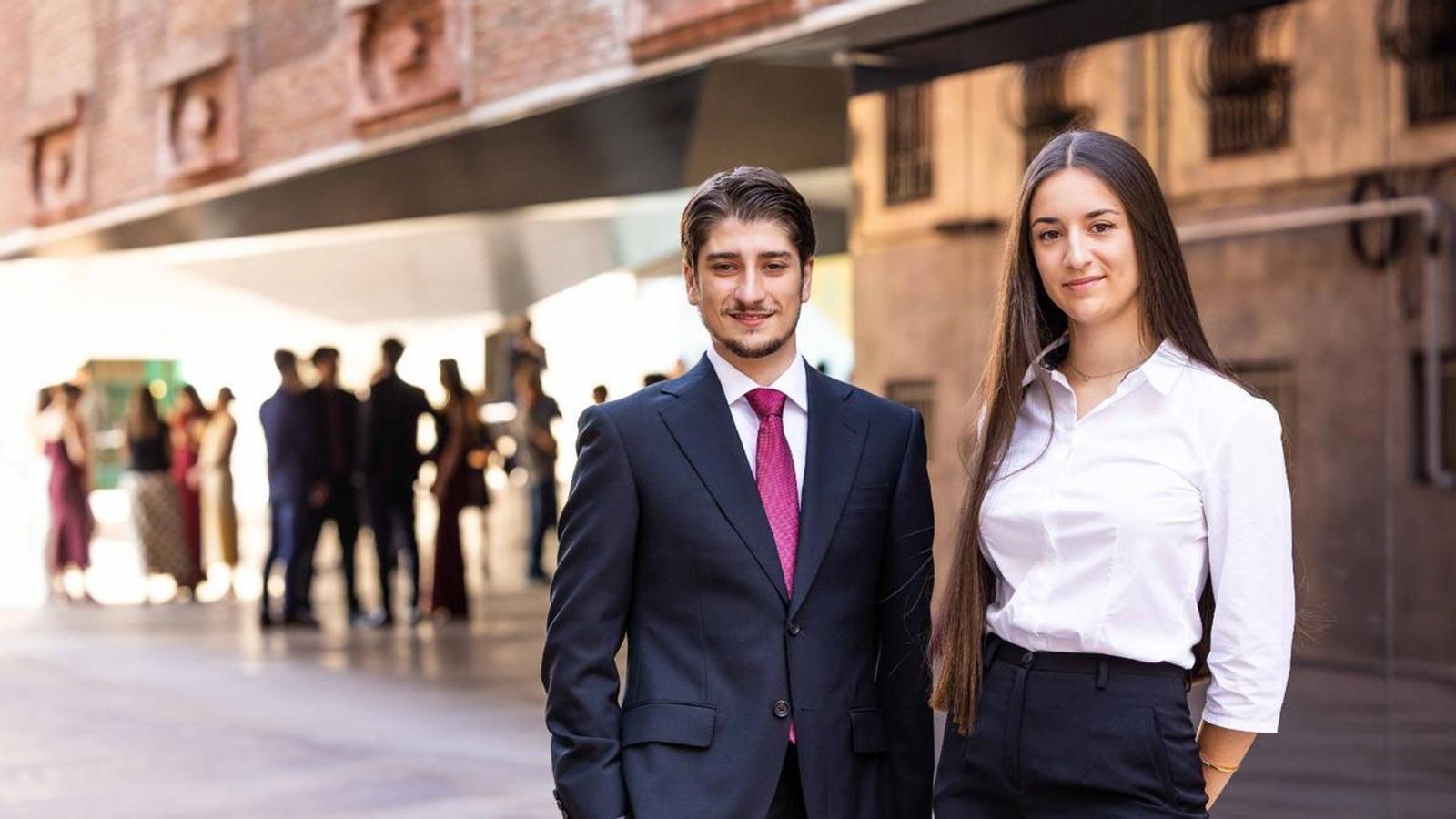
BarcelonaNeither medicine nor mathematics. In recent years there has been a paradigm shift in Catalan universities, which are seeing their students show increasing interest in studying a double degree. This 2026, for example, the highest cut-off grade in Catalonia is for the first time the degree in Law and International Relations at the Autonomous University of Barcelona (UAB), surpassing the degree in Physics and Mathematics, also from the UAB, which has topped the Catalan cut-off grade rankings for the last three academic years. Paula Ramió is one of the graduates from the latest cohort of this double degree and explains that, although it was very demanding, it was also very rewarding.
"The demanding nature and the culture of effort are something I've had since I was little; my parents and my teachers instilled it in me. It hasn't been an easy path, but this effort has been worth it because now I'm able to enjoy the studies I've wanted to do for so long," Ramió explains in an interview with ARA. She is one of the 100 scholarship recipients of the 44th edition of postgraduate scholarships abroad from the La Caixa Foundation and is about to begin the master's in quantitative finance at the Swiss Federal Institute of Technology Zurich (ETH) and the University of Zurich. She assures that having studied the double degree was key to obtaining this scholarship, as it helped her "to put commitment into every detail".
When she was little, she was passionate about astronomy, recalling how she was given a lot of books about outer space and she devoured them. "It was like discovering a world of science fiction, but at the same time it wasn't an imaginary world, it was real," she describes. As she grew up, she began to be interested in outreach in other fields and understood that the linchpin of it all was physics, which is why she knew she wanted to continue studying it. Applying for the double degree in Mathematics and Physics was thinking about the future: "I had the idea that mathematics offers a lot of versatility when looking for a job in the labour market, or for applying physics in a research field. If you know mathematics, you have it easy," she admits. She is now preparing to delve deeper into the field of financial mathematics, and will do so in "one of the most important financial cities in Europe".
Rethinking international relations
Another of the scholarship holders is Pol Colomé, who has also studied a double degree. In his case, he is a graduate in Law and Economics at the Pompeu Fabra University (UPF), about which he only has good words despite the effort his university stage has entailed. "A double degree involves a lot of work, both inside and outside the classroom. The level of intensity is exactly what is expected from UPF, which is very rigorous," assures Colomé. He explains that he has had to work hard to keep up with the syllabus, but that it has helped him to face the new stage in the best possible way. He has decided on a master's degree in Foreign Service Sciences at Georgetown University, in the United States, as he believes it is an "excellent synthesis" of the double degree he has completed in Barcelona.
For all those who are interested in these fields, Colomé has his recommendation clear: "The return on a double degree is very positive. If you make good use of the program, it's worth it". He has decided on Georgetown because he considers it to be the best university in the world in international relations. "It is an institution that is in an excellent location, very close to think tanks, embassies and organizations that work in this field," he argues.
"We are at a historic moment when we need to rethink how we approach international relations, what is the approach to diplomacy, to conflict resolution, or to the dilemma between autocracy and democracy," reflects Colomé, who says that this is why he has chosen this master's degree. During his degree, he already did a year-long exchange at the University of Oxford to study Anglo-Saxon law, and an Erasmus at Maastricht University in Economics, which is why he believes that Georgetown is another step in his career.
