"Going to summer camp makes you feel like the rest of the children"
The Pere Tarrés Foundation plans to award scholarships to more than 7,000 minors so they can access leisure activities in the summer
-
CAT -
CAST
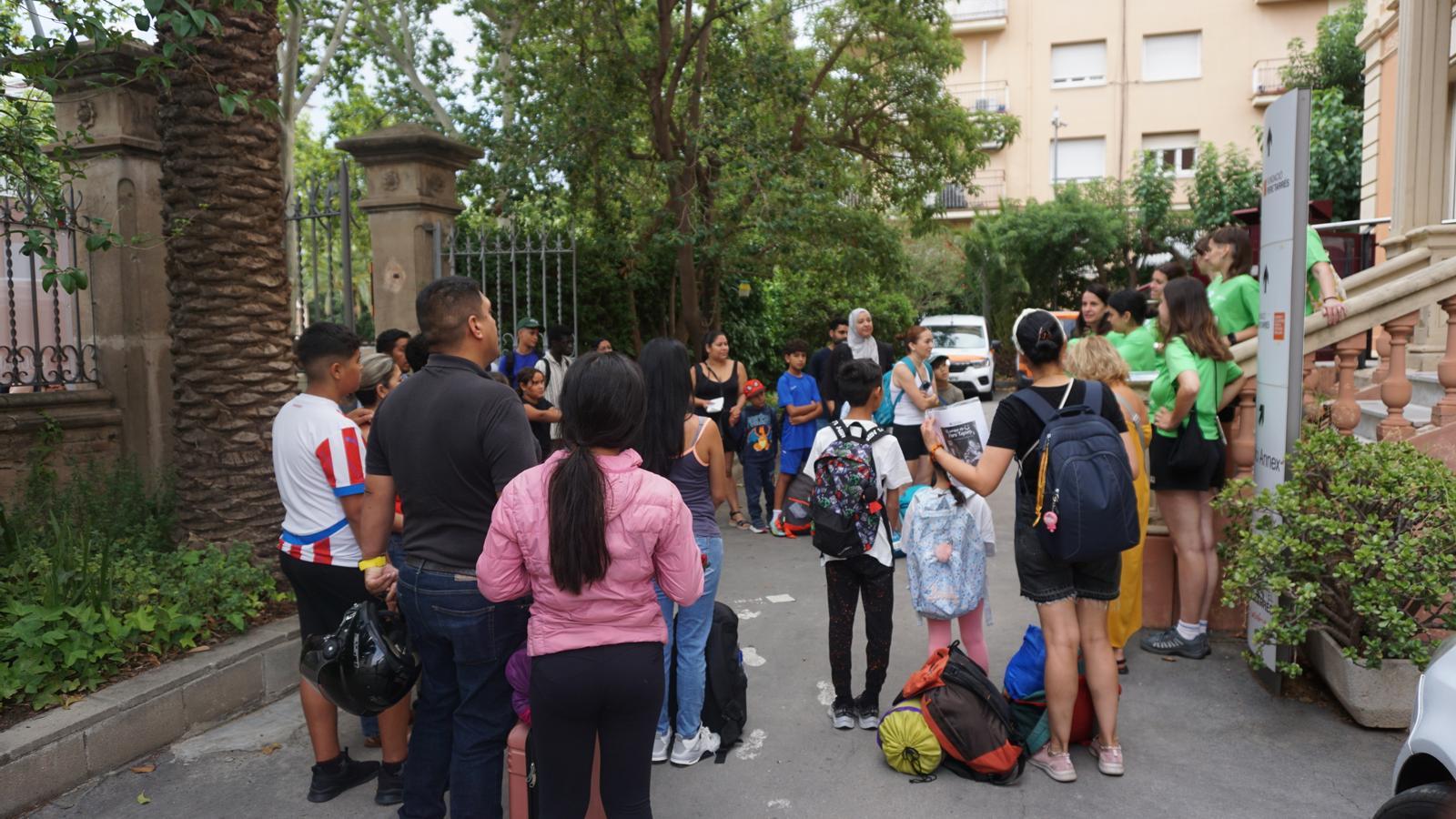
BarcelonaGoing to the pool, going on a mountain excursion, spending a day at the beach or playing football are simple activities that not all children can take for granted during the summer, either due to family financial difficulties or personal interaction. Bhermar arrived in Barcelona from Colombia a couple of years ago with Khamila, her 7-year-old granddaughter, and turned to the Raval socio-educational center to help the child bond and strengthen her emotional well-being. "When she leaves the summer camp, my granddaughter comes home and tells me everything she's done throughout the day. I'm clear that this has helped her grow a lot emotionally," she explains.
She is one of the families participating in the program Transform your summer, scholarships promoted by the Pere Tarrés Foundation to guarantee children's leisure in the summer, and which for this year plans to help nearly 7,500 boys and girls. "When you arrive here you have many expectations and fears, but since Khamila started the camp, it's easier for her to read, she expresses herself better, and she almost arrives home with more energy than when she leaves," points out her grandmother.
An experience that David Gambau, now 36 years old, lived similarly when he was a child. He was one of the children who received a scholarship for the summer program from the Sant Adrià socio-educational center. "The fact of being able to access a summer camp makes you feel like the rest of the children, because we all have the need to do these leisure activities," explains David, who says he remembers the center "in a very special way". In fact, the influence of those who accompanied him at that stage of his life led him to want to train as an educator, and now he helps children in Sant Adrià. "They were people who believed in me a lot when I was little, and now it's me who helps children take off that backpack and live as children," he says.
Referral from social services
With the aim of valuing leisure and demanding that these activities can reach all children, the Pere Tarrés Foundation annually analyzes in a report the economic conditions of families receiving summer scholarships, which in 2025 helped 7,146 children and young people in vulnerable situations to access summer camps and colonies. Based on 334 cases, the entity concludes that eight out of ten families analyzed are below the poverty line and six out of ten are in situations of extreme poverty. A fact that highlights this context is the way these children have arrived. "Between 80% and 90% of families have been referred or attended by social services, which is equivalent to approximately 6,000 of the 7,146 scholarship children," says the report's coordinator, David Lozano.
Cases like Khamila's or David's show that leisure is a fundamental point in learning. This is supported by the Deputy Director of the Foundation, Rafael Ruiz de Gauna, who points out that children who participate in summer activities away from their homes return more active to school in September and have more ease in relating to others. "As a society, we increasingly understand that leisure is not just a form of entertainment, but also an essential element of social cohesion."
Furthermore, the study also highlights that 36.8% of cases occur in single-parent households, which, on the other hand, can be households with three or more children (24.3%). Bhermar, for example, shares the issue of single parenthood. "When you are a single mother-grandmother, as is my case, you can feel helpless, and this also helps you psychologically," she explains. One of the activities that has helped her the most in this regard is literacy, a practice she does with her granddaughter and in which they both learn to write and read, one with the other.
Special educational needs
The entity also emphasizes that only one in five children with educational needs regularly participates in leisure or sports activities. "This must be reversed so that these children do not feel like rara avis", points out Ruiz de Gauna, who adds that in 2025, almost 500 children with special educational needs were part of the Foundation's leisure activities with the help of nearly 300 caregivers. Even so, the director of the entity's network of socio-educational centers also points out that this year they have an additional demand of 26%. "That is why we call on public administrations to provide more resources, so that the right to leisure is a policy that leaves no child behind," concludes Ruiz de Gauna.
