Constant surveillance and isolation cells: this is what the Center for the Internment of Foreigners in Barcelona is like inside
We reconstruct from testimonies and social entities like the CIE of Barcelona, a space through which hundreds of people pass each year before being expelled
-
CAT -
CAST
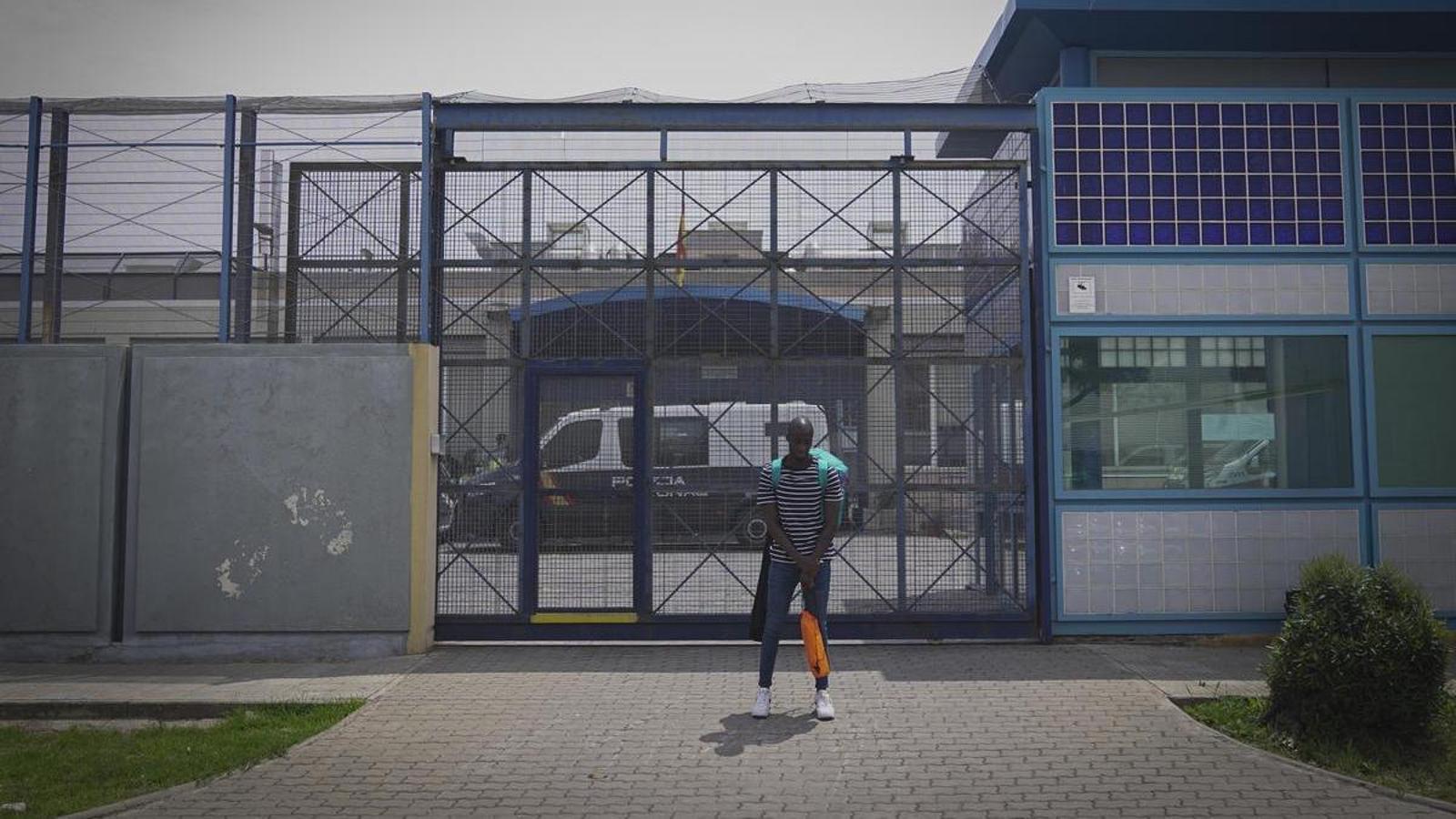
BarcelonaHidden in the Zona Franca, between factories and warehouses, far from tourist Barcelona, lies the Barcelona Centre for the Internment of Foreigners (CIE). Hundreds of people are held locked up in the facilities for a maximum of 60 days. “They spend weeks deprived of their freedom in very harsh conditions just for not having papers,” explains Cel Far, a social educator who has visited the detainees with the Migra Studium organization. The reality is that most of those who end up in the CIE have not committed any crime: last year, only 7% of detainees had been convicted.
Despite this, the confinement regime is strict for all of them without distinction, and very little is known about what happens behind these walls. The center is off-limits to journalists. Unlike prisons, where information professionals can access, the Ministry of the Interior systematically denies access to CIEs. I was able to develop this report in detail because I was able to enter for five years as a friend of several detainees whom I could visit.
Their stories are examples of lives that have been marked by the CIE. In 2024, 401 people passed through the Zona Franca center; in 2023, 592; and in 2022, 482. In the era of mass deportations driven by Donald Trump, in Barcelona the machinery has never stopped: every year, hundreds of people are interned and expelled. The question is what will happen with the announced regularization of half a million immigrants: “There will be many people who will benefit, but in the CIE everything will remain the same,” assures Far.

When you arrive at the gates of the Zona Franca center, the first thing that catches your eye is a low tower, painted with blue and white stripes. Inside, relatives await, mostly women and children of the detainees. They are people like Luisa, who last March had just found out she was pregnant and was going to see the father of her first child: “I feel deceived, I never imagined they could expel him from one day to the next.
This reality is repeated throughout Spain. In 2024, more than a thousand people were expelled from different CIEs. Besides the one in Barcelona, there are six more: Madrid, Valencia, Murcia, Santa Cruz de Tenerife, Las Palmas de Gran Canaria, and Algeciras. The last one to become operational is the latter, located in Botafuegos: a macro-complex that has cost 21.5 million euros, financed by 90% with European Union funds.
The complex's waiting room leads to the visiting room, a small space with a table and three chairs. In one of the booths, on the wall, a child has made a drawing with a pen. The ceiling of the booths is open, and goodbyes from families can be heard. In December 2024, the control judges of the CIE, Zita Hernández and Alejandra Gil, asked the center's director to guarantee “the respect for privacy and confidentiality”. For the moment, there have been no relevant changes.
Next to the visitors' room, there is a security door that closes behind you like in a prison. From here on, only detainees and the National Police can pass. The regulations define CIEs as "public establishments of a non-penitentiary nature," but once inside, life is organized with strict schedules, locked dormitories, restricted freedom, and constant surveillance.
On the ground floor, behind the metal door, there is a corridor that distributes the different spaces. One is the library, about 100 square meters. Here, detainees watch movies projected by the Red Cross, such as Torrente, or read books like The Lord of the Rings. In case of mass expulsion operations, the space has also been used to isolate detainees from the rest of the CIE for hours.
Continuing down the corridor, you reach the dining room. The CIE assures that the menu changes every two weeks and is adapted to different religions. Men have breakfast at 8:30 AM, lunch at 12:30 PM, and dinner at 7:30 PM; women, about fifteen minutes later. “One of the most recurring complaints over the years is the scarcity and poor quality of the meals,” explains Marta Vallverdú, from the Irídia collective.
*Some names have been modified at the request of the protagonists to protect their privacyAfter years of litigation, the Jesuit Migrant Service (SJM) managed to get the justice system to oblige the Ministry of the Interior to make public the data on complaints filed by relatives, entities, and also detainees through the director's mailbox. Until then, these figures had been kept secret. Thus, in 2024, 358 complaints were filed throughout the State, 78 in Barcelona. Criminal lawyer and CIE expert Josetxo Ordóñez assures that directors “have real headaches controlling the agents: they pull strings to remove the most violent ones.” “They have admitted it to me themselves; there are people who go too far,” adds Ordóñez.
CIEs depend on the Ministry of the Interior and are managed by the National Police with the collaboration of the Red Cross. Most experts agree that it is not the most suitable body. Law professor and CIE researcher Markus González Beilfuss points out that “police officers should guard the premises and ensure security, not hand out razors”.
At the end of the ground floor hallway is one of the two courtyards where they can play football and basketball, and they are also equipped with exercise machines. All these spaces are testaments to the daily conflict that takes place in the center.
At the end of the hallway, on March 22, 2025, Jorge Leonardo got into a fight with another detainee and a police officer hit him on the head with his baton. Blood began to gush out, according to his testimony and that of two other detainees, in a phone conversation from the center. The CIE allows the use of mobile phones, but without internet access and without a camera.
Outraged, Jorge Leonardo went on a hunger strike. On the eighth day, the doctor warned that he had lost six kilos and he was transferred to the Hospital Clínic. "He told me that my organs could fail at any moment," he recalls. That same day he broke the strike. Two weeks later, he was expelled without prior notice. He had filed a complaint, but the judge did not take his statement.
Precarious hot water
The CIE has 46 rooms distributed in three pavilions, two for men (A and B) and one for women (F). At the beginning of the floor there is a space where soaps are kept and a room with seven showers. During the winter of 2025, different witnesses claim that only one shower had hot water. “We take turns; while one is putting on soap naked, the other is showering,” details an inmate. Hot water in the showers has been a recurring complaint for years.
The cells have two or three bunk beds, meaning they can accommodate between four and six people. The room has a window overlooking the inner courtyard, and in one of the corners there is a tap for washing clothes. All cells have a closed toilet, but some inmates claim they smell bad. The rooms are always locked with barred doors.
In 2012, one of the founders of the brand Top Manta, Aziz Faye, was at the CIE in Barcelona, when there was still no toilet in the rooms. When someone needed to go to the bathroom, they had to bang on the bars. “Often, the police reacted with annoyance and insults, and many times, they simply didn't respond,” recalls Aziz.
Isolation cell
Isolation cells are small spaces of only five square meters, with a concrete bed and a thin mattress, without furniture or a sink. Inmates are locked up without judicial decision, in conditions that can pose significant risks to physical and mental health.
“The cell does not meet international human rights standards. We have explained it to the director, and he says there is a suicide protocol, but basically it is a camera that watches you 24 hours: maybe you won't commit suicide, but you can go crazy”, explains Marta Vallverdú of Irídia. During the pandemic, the cells were used to isolate covid-positive inmates for weeks.
The testimonies
*Some names have been changed at the request of the protagonists to protect their privacy

When Abraham Calderón entered the CIE, his name changed. The police began to call him by a number, 145, and his companions by an alias, Doc. The number the police baptized him with meant that Abraham was the 145th inmate to enter the center that year, 2023. Of Peruvian origin, Calderón was returning to Italy by bus when the police made him get off. In Figueres, he went before the judge, who ordered his detention in the CIE and his expulsion. “I had never been imprisoned, the worst thing is that they looked at you like a criminal, but I hadn't done anything,” he says, perfectly remembering that fateful day.The 145
he read to escape, he devoured the books of Gabriel García Márquez, but also the immigration law. “When you are in the CIE, your whole life starts to arrive in the form of papers: notifications, fines, files. The other inmates would ask me what each document meant. “Doc, doc, doc!” they would shout at me. “They needed answers and someone to listen to them, and that's why they called me Doc, the doctor,” he explains.Inmates can only spend 60 days in the CIE. If the police have not managed to carry out the expulsion before this date, they are obliged to let them go. The day he completed 59 days of confinement, Calderón submitted an asylum application, and the police released him. Processing an asylum application can take a couple of days. In 2024, 180 asylum applications were submitted in the CIE, and in 40% of cases, people were released.An hour later, Calderón crossed the CIE gate towards the outside. He was in the Zona Franca and there were only a few hours left until nightfall. He remembered a park in Sant Boi de Llobregat, where he spent the first night. He lived there for two months. The annual survey by the Arrels organization, conducted among people living on the street, reveals that 74% are immigrants like Calderón.
Every day he went to the first reception center for homeless people in the Zona Franca, very close to the CIE. Over time, he managed to get a place to sleep there. Calderón stopped being 145 and became 972. “The CIE is a prison, not a center; they deprive you of your freedom, here I can leave whenever I want.”
One day he went to the lawyer at SAIER, the municipal service, who gave him a number. “He told me that when I had papers, that would be my identity document. They really like that number thing... I just want papers and to be allowed to work,” he thought. Finally, this year Abraham Calderón, number 145 or El Doc, has obtained legal residency.
Every week, Eli and Bea went to the CIE in Barcelona to accompany an detainee. As volunteers for the Migra Studium organization, they were part of the group of people who visit detainees. That day, in the visiting room, Abdou Aziz Sow sat down. Eli started with the usual questions: "How are you? How are you feeling?". But very soon, the conversation delved into the anguish the young man was suffering.
Abdou sold his fishing boat and left Senegal due to problems with his partner's family, with whom he had just had a daughter. With tears in his eyes, he recalled his story: he just wanted to start a family, not to migrate. After a year-long journey through several countries, risking his life at sea, he was detained at the CIE with the aim of returning him to Senegal. Desperate, he even considered suicide by drinking bleach, but a Red Cross worker at the CIE gave him "encouragement to live," he explains.
After much thought, Eli made a decision: she would invite him to live at her house for a few months. They would draw up a contract, a volunteer would be a witness: she would let him use her sofa bed from 11:30 PM to 7:30 AM. Additionally, she would help him with the paperwork; in return, he would sign up for Spanish classes and look for work.
After 59 days at the CIE, Abdou regained his freedom, still not knowing why, and went to live on a sofa bed in a 60-square-meter apartment in the Sant Andreu neighborhood of Barcelona. Freedom, although unexpected, is the most common way out of the CIE. In 2024, only 148 expulsions were carried out, 37% of the total detainees who passed through there, practically the same proportion as in 2023. The remaining 63% of detained individuals were released. Without papers or the right to work, Abdou became withdrawn.
He spent long hours contemplating photographs of his daughter and the life he had left behind. Six months later, Abdou went to inform Eli that he had been offered a job in the south to pick olives. Since then, he has passed through several towns in the provinces of Jaén and Almería, the last of which has been Adra, a municipality surrounded by thousands of greenhouses, in the so-called sea of plastic in the Spanish southeast. Abdou continues to think about his daughter, who will turn five on November 26th. He left when she was only three months old.
L’Aziz has been locked up five times in a CIE (Immigration Detention Center), twice in the Barcelona facilities, and has been deported to Senegal on three occasions, but he has always managed to return, risking his life at sea in a cayuco (small boat). One of the founders of the Barcelona Street Vendors’ Union has, by obligation, become very knowledgeable about the Immigration Detention Centers and an expert at enduring the burden of spending 60 days locked up awaiting deportation.
In 2012, after more than three years in Barcelona, he went with his friend, Lamine Sarr, to complete the paperwork to regularize his situation. But the police stopped them and sent them to the CIE. It was December and there was no hot water. “Showering with cold water was a real sacrifice,” recalls the promoter of Top Manta.
The street vendors who visited him brought him a book to learn English. In the midst of that oppressive environment, Aziz found refuge in studying. Every day he learned a lesson: one day verbs in the simple past or continuous, the next day the conditional... An episode that marked him from those days was Lamine’s punishment. His companion was praying when they were called for dinner, but he could not interrupt his prayer. The police locked him in an isolation cell for a whole day as punishment.
A few days later they were deported to Senegal. Aziz quickly prepared his return and became a captain to be able to afford the trip. When he arrived in the Canary Islands, the police transferred him to Lanzarote. Aziz describes that center as “a dark space, a basement, with many people together.” From there, he was sent to Barcelona.
His freedom was short-lived. One day, the police carried out a large raid at Maremàgnum and arrested him with other street vendors. When Aziz entered the CIE for the second time, his brother brought him another English book. Aziz continued with his routine: “I had my little world to disconnect from the center.”
After spending forty days locked up, he regained his freedom, he still doesn’t know why. “When they called me, I started crying with joy.” These days, Aziz is preparing the new collection for the clothing brand Top Manta. Beside him, he has the same English book. Aziz likes learning languages; in fact, he speaks Wolof, French, Spanish, and Catalan clearly and fluently. English has always been a bit harder for him, he takes it calmly, little by little, he is in no hurry.
It was two in the afternoon on Tuesday, April 8. Marta was lying in bed, as were her two cellmates, in the women's wing. After Madrid, Barcelona's is the only CIE in the State with a specific space for women. The wing was inaugurated in 2023, the year in which 62 women were interned. In 2024, the figure dropped to 29. Marta wasn't feeling very well: she had menstrual cramps and thought she'd ask for a painkiller. She also wanted to call her 18-year-old son to find out how his doctor's visit had gone that morning. She sat up slowly to pick up the phone. At that moment, the National Police burst into the cell in a hurry and with bad manners.
The officers snatched the device from her hands, handed out trash bags where they were supposed to put their belongings, and didn't let them communicate with their families; they could only make one international call. "I wanted to talk to my three children and my mother who live here, not in Colombia," she recalls with helplessness. Along with about fifteen more people, they sent her to Madrid. When they arrived at the airport, her hands were swollen: she had been wearing handcuffs for over ten hours and the belt was pressing on her chest. She was able to go to the bathroom a couple of times, always with handcuffs on and a police officer by her side. She couldn't change her clothes: she was stained with blood due to her period.
The plane was full to the brim, people from all over Spain being expelled to Colombia and Peru. Sitting on the plane, Marta only thought about what she would do when she arrived in Colombia. With no money and no battery on her phone, it took her two days to manage to speak to her brother: “When he heard me, he started crying; my family is devastated.” A few months earlier, the CIE's control judge had formally requested the center's director to have the police give at least 24 hours' notice before carrying out an expulsion. The warning came after another woman had been expelled without any prior notification.
“For some things there are laws, for others there are not”, denounces Marta. “All the weight of the law falls on me; on them, it does not”, she laments. She had arrived in Spain twenty-three years ago, had worked in precarious jobs, combining periods of employment with others of caregiving, while trying to grow the family. This instability had also affected her administrative situation. The last expulsion order arrived after an eviction. “I tried to annul the expulsion with a lawyer, but while we were doing the paperwork, they sent me to the CIE”.
The family, desperate, began to gather all the papers to file an appeal. But the public defender did not make a move. With days numbered, they looked for a private lawyer. When he managed to file the appeal, it was already too late: the fateful Tuesday had arrived. The day Marta was expelled, thousands of kilometers away from her home, from her family.
Mohamed Zaidan avoids eye contact, but his face lights up when he speaks. His story is clear, full of details, you can tell he's told it hundreds of times: to police officers, psychologists, judges, to his mother... But, above all, he tells it to himself, every night, just as he closes his eyes. His case will be told once more, but for the first time it will be heard by the European Court of Human Rights (ECtHR), which had never had to judge a case of mistreatment in detention centers. Ton Mansilla, a lawyer for the Irídia collective, filed the complaint a few months ago: "There is a structural pattern of impunity in the CIE: erased camera footage, incomplete medical report, expulsion without taking a statement... we have hope."
Over the last decade, Irídia has filed fifteen legal proceedings for alleged mistreatment in the Barcelona CIE, but none have gone to trial. One of the main problems is that complainants and witnesses are expelled before giving a statement. In December 2019, after dinner, a good portion of the CIE's inmates were queuing to collect their medication. Among them was Mohamed Zaidan, 21 years old. A police officer, with a list in hand, decided who could enter the infirmary. That night, Zaidan was entitled to ask for an anxiolytic, but the officer blocked his way.
Zaidan, indignant, marched towards his room. As he was climbing the stairs, he saw out of the corner of his eye how the officer was approaching him and, suddenly, he punched him so hard that he fell down the stairs, according to his recollection. When he opened his eyes, he was on the floor. A group of police officers dragged him to the infirmary. "I explained to the nurse that the police had hit me, but she told me I had fallen due to nerves. I was furious. It was a lie. Several police officers immobilized me and injected me with a sedative," recalls Zaidan. When he had been locked up in the CIE for almost two months, he was deported without any prior notice. He was transferred by plane from Barcelona to Melilla. Luckily, his phone still had reception at the border, and he was able to call his family, who live on the border with Ceuta, hundreds of kilometers away.
The case of Zaidan helps to understand the legal chaos experienced by many mistreated people in the CIE of Barcelona. After suffering the aggression, she filed a complaint in the duty court, which forwarded it to the investigating court. This court opened the investigation, but did not stop the deportation or request the security camera images; most of them were deleted.
“Four of us left swimming, but three arrived”
Mohamed Zaidan wanted to try again. With the arrival of the coronavirus, he thought he might have a chance. With three more companions, they devised a plan: they would swim to Ceuta and, from there, try to reach the mainland by boat. Every year, hundreds of young people try to migrate in the most reckless way, swimming, from places like Tarajal, Benzú, or the beaches of Castillejos. Zaidan proposed the trip to a childhood friend, with whom he had shared school until he was fourteen. On the appointed day, they plunged into the sea. The tide was favorable. They calculated it would take them about two hours, but they ended up swimming for almost seven. Of the four who had set out, only three arrived. The childhood friend did not make it. "Perhaps he stopped to rest, but the tide changed and pushed him further out to sea."
Mohamed Zaidan arrived in Spain when he was still a child. At fourteen, he entered the child protection system in Ceuta. When he turned eighteen, they kicked him out. He had papers, but he couldn't work. He ended up on the street. A study by the Arrels Foundation, with data from 2023, reveals that at least 34% of young people between 18 and 29 years old who live on the street have previously been in a supervised care center.
He spent three years sleeping on the street. During that time, he was in prison in Belgium, and even reached Norway. "I went from one place to another. I wanted to travel. I was high all day, without work. I was lost. Hanging. Cocaine... everything," he recalls. Addiction led him to his first petty thefts, robberies. Now, years later, he is still paying the price. The situation of former foster care youth has changed a lot over the years, as laws have made their integration easier. The latest survey published by the Network of Entities for Youth Emancipation (FEPA) shows that 90.1% of former foster care youth in Catalonia are studying or working, and that 23.1% are doing both activities.
