Collserola Park will remain closed until the more than 500 wild boars that live there are killed.
The government is restricting access again after confirming another positive case of African swine fever in the Barcelona area.
3 min
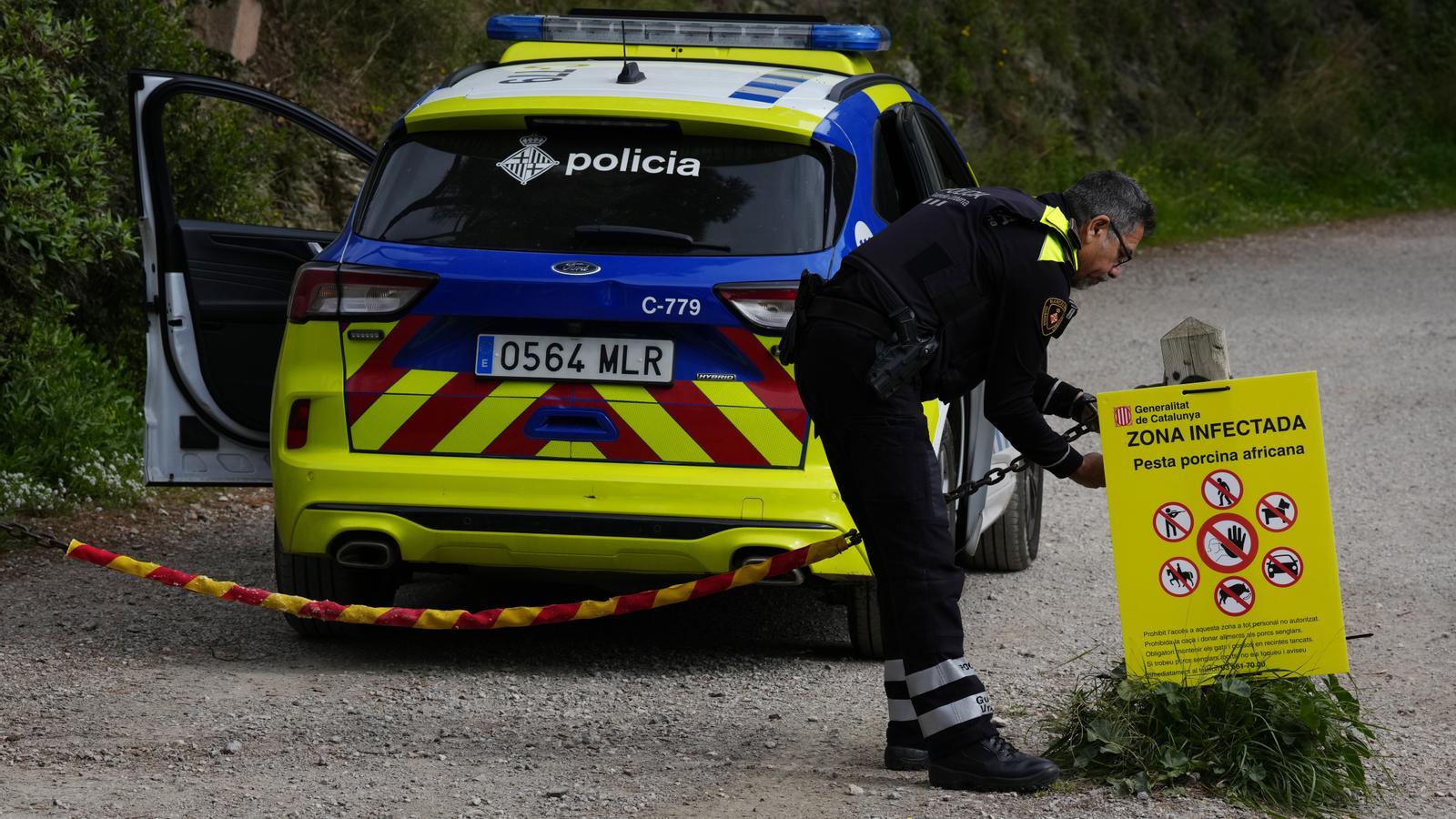
Agents of the Guardia Urbana put up signs informing of the closure of access to the Collserola Park, which will be prohibited to the public, with some exceptions, from this Thursday and indefinitely, until the population of wild boars that inhabit the area is reduced to the minimum possible.Alejandro García/ EFE
BarcelonaCollserola Park will be completely closed to the public until the more than 500 wild boars living there are killed. This is the objective set by the Department of Agriculture, which has already entrusted the Rural Agents Corps with the task of controlling and capturing the animals. The department, headed by Òscar Ordeig, has confirmed that the official resolution will be published this afternoon, but the Catalan government has already begun implementing the "immediate" and "total" closure of the park. Access to the Collserola mountain range was already restricted in many areas, and now the fences and controls will also be extended to the entrances from Barcelona. This comes after the minister himself admitted yesterday that a new case of African swine fever (ASF) had been detected in a wild boar in this area, within the city limits of Barcelona.
The closure affects the more than 5,000 people who visited the park daily on weekdays and the nearly 15,000 who gathered there on weekends. Half of these visitors enter through the Barcelona entrances. The Secretary General of Agriculture, Cristina Massot, explained that the measure now "prohibits" all sports and leisure activities. "We are doing this for three reasons: firstly, to prevent people from accessing the natural environment and causing the animals to disperse; secondly, to prevent traces of the disease from spreading via bicycle wheels or shoe soles; and thirdly, so that the Rural Agents can work safely and without posing a risk. However, the 15,000 residents who live in neighborhoods located within the forested areas will be able to continue accessing their homes normally. Educational centers and businesses (or their customers) in the area are also unaffected by the measure. However, the Government asks that this group exercise extreme caution: they are reminded to travel primarily on paved areas and to follow a "disinfection routine," such as washing the soles of their shoes with water and bleach, to prevent the spread of the African swine fever virus. "We are in the best possible scenario."
Although the virus is far from being eradicated—227 cases have already been detected in Catalonia after 11 new positive cases were confirmed in recent days—and the danger zones have increased in the last seven days, the Department of Agriculture believes that the situation is "the best possible scenario." "The measures are working, they are effective," assured Massot, who recalled that so far the virus "has only spread south" (where it borders the sea) and has not spread to the north or center of Catalonia, which would have made its control much more difficult. Currently, there are 18 municipalities located in the highest danger zone (see map), and as of today, the Collserola area is also completely closed again.
Chart of swine fever risk zonesARA
It is estimated that within the high-risk area (red on the map) there are currently around a thousand wild boars, more than half of which (between 500 and 600) are in Collserola Park. These are the ones they intend to capture and kill. In the lower-risk area (orange on the map), the Rural Agents estimate that there are between 8,000 and 12,000 more. In this case, the goal is to reduce their population by 80%, leaving, at most, one boar per square kilometer.
The head of the Rural Agents, Antoni Mur, explained that so far around 1,100 captures have been made throughout the area, half of them within Collserola Natural Park. Mur says that they practically never use firearms; instead, the most common techniques are nighttime patrols with thermal imaging cameras and drones to locate animals, or the use of canine units. Traps that allow for multiple captures at once are also used. "We currently have around forty installed, 18 of them in Collserola. We are installing more and plan to acquire even more, until we have over 100 throughout the area," Mur explained.
Possible sanctions
Both the Secretary General for Agriculture, Cristina Massot, and the Third Deputy Mayor of Barcelona, Albert Batlle, assure that patrols of Rural Agents, the Guardia Urbana (Barcelona's municipal police), the Mossos d'Esquadra (Catalan police), and civic agents and volunteers will be monitoring all access points. These agents' objective is to inform citizens, not to issue fines, but Massot and Batlle warn that, "with the regulations in hand, they can do so," and that if necessary, they will.
Batlle explained that "Barcelona has experience in closing spaces," especially in the wake of the pandemic, and expressed confidence that both residents and tourists visiting the city "will react in a very civic-minded manner." Massot, in turn, said that the Catalan government "understands" that "with the arrival of warmer weather and after so many weeks of restrictions, particularly in the Vallès region, people may be growing weary" and that some measures may be relaxed. In this regard, he assured that the government will intensify its campaigns to remind people of the rules.