Barbate, a "diamond in the rough" with military and without fishermen
The sunset of the fishing sector, the occupation of 40% of the municipal term by the Ministry of Defense and the difficulties in boosting tourism place this Cadiz municipality in a critical situation
-
CAT -
CAST
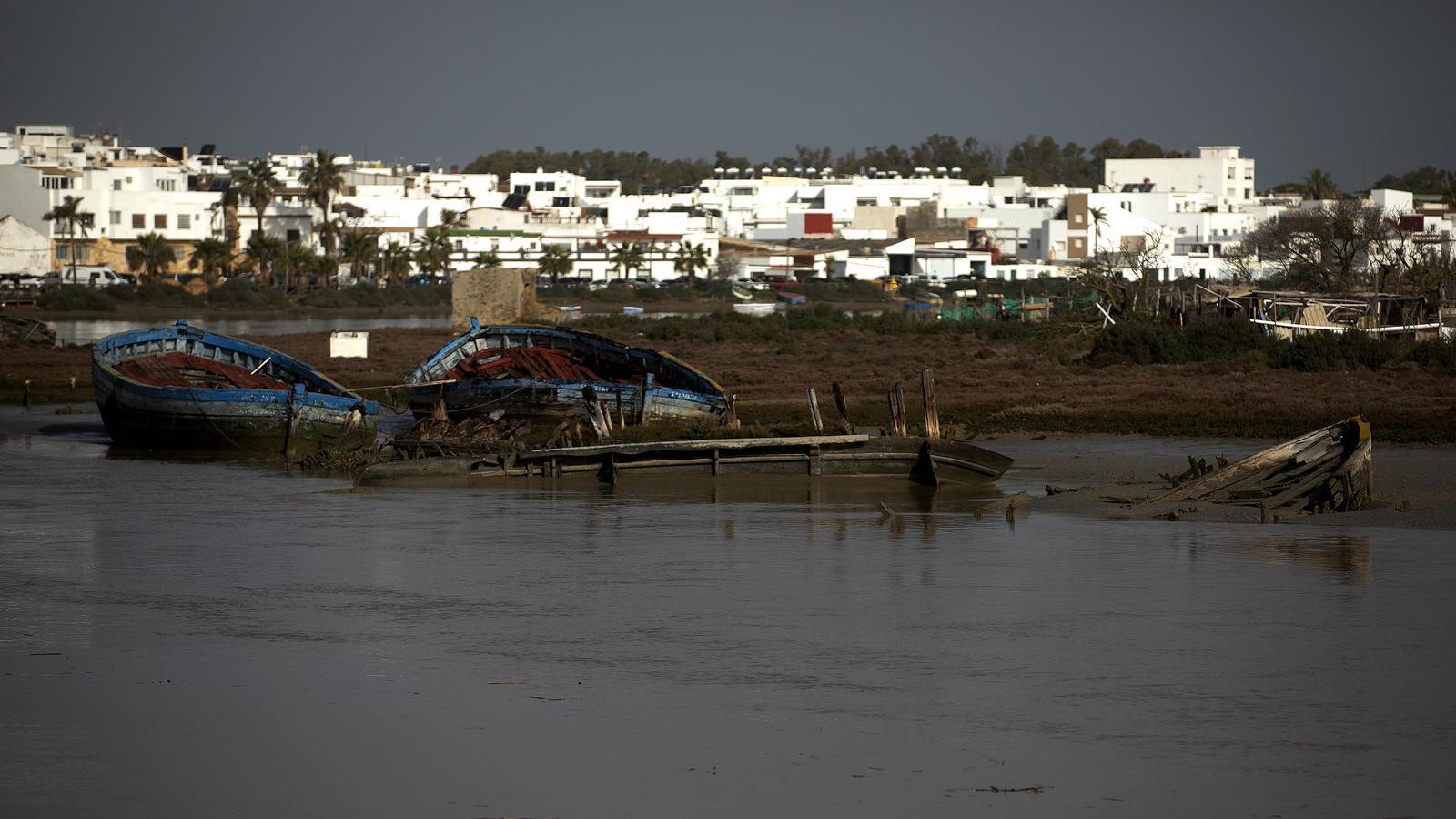
Barbate (Cádiz)The old pier on the Barbate River is a graveyard of timbers weathered by time. The barges sunk beneath the greenish water contrast with the white facades of the houses, demanding a coat of paint. The asphalt is full of ruts and cracks. In Barbate, there is no public transport. The theatre is in ruins. The parks, abandoned. The sports facilities flood when it rains. "We have an endemic lag of 15 or 20 years," admits the mayor of the municipality, Miguel Molina.
The photographs hanging on the walls of Bar del Chechu, at the entrance to the port, show that it wasn't always like this. Barbate was a prosperous town. There was wealth. The black and white images display the large fishing fleet that plied the entire Gulf of Cadiz and Moroccan fishing grounds. There used to be more than 200 boats. Now there are about twenty. The decline of the fishing sector had a strong impact because unemployment fully affected the municipality. And this opened the doors to drug trafficking, which knocked on the doors of the most needy, and to the exodus of the youngest, who left to seek a better future. The other great burden of Barbate is the Sierra del Retín military camp, owned by the Ministry of Defence, and which the socialist government expropriated for nothing in 1982. These are the two great "acres" of this town of almost 23,000 inhabitants, Molina simplifies. There are more.

The richness of Morocco
Despite the rain and the bothersome wind, the port bar is full. There are always people. It is the meeting point for those who resist within the sector, but also for young people, retirees, and unemployed neighbors who go there in case they get "some little job". Conversations overlap. There is a lot of nostalgia. Tomás recalls his time as a fisherman, when he signed up for a ship that went to Melilla and spent three weeks at sea fishing. "Twenty days without showering, but it allowed you to live well," he explains, annoyed with the shipowners, who are to blame, in his opinion, for "destroying" the sector and the town. "Why should a young person want to go to sea for 150 euros a week?", he asks. Fran, a fish businessman, expresses himself along the same lines: "How much does a sailor earn? They are not paid very well".
Shipowner Tomás Pacheco admits that there is no "generational change" because young people leave. This has led him to seek labor from outside: he has brought 10 Peruvian workers to Barbate so that his ship, the Nuxemar, which he acquired in 1999 for one million euros, can continue to anchor. "What change are we supposed to have selling fish at 30 cents per kilogram?", he asks indignantly. He has experienced it firsthand. His son also works at sea, but in the merchant navy. "I don't want my son to continue here. We are looked down upon. The administration treats us like criminals," he criticizes. Unlike the sailor, the businessman points to politicians as the culprits.
The decline of Barbate's fishing sector began in the 80s, but accelerated in 1995, when Morocco announced that from 1999 onwards it would not renew the agreement with the European Union that allowed Spanish ships to fish in the rich Moroccan fishing grounds. There was a domino effect throughout the local fishing fleet. "It was the death of the town," summarizes Pacheco, who recalls that more than 3,000 people had come to be part of the sector. 40% of the town lived directly or indirectly from fishing, as there had been, in addition to the 200 fishing boats, about a dozen canning companies and others manufacturing packaging for goods. In a short time, the sector was reduced by 90% and unemployment became structural.
Barbate now has 22% unemployment, but in 2020, before the pandemic, it was 48%, and as much as 55% had been registered in 2012. Furthermore, it is seasonal: every summer it decreases, due to the tourist season, and it skyrockets in the winter months – 70% of the active population is in the service sector. School dropout is also very high: about 18%. Pacheco regrets that the administration encouraged this decline by offering monthly aid of 151,500 pesetas from that era – 910 euros – for two years to sailors who wanted to stop working at sea. Many emigrated along the entire Spanish Levante coast and looked for a living far away, others spent everything without looking for a job alternative.
José Antonio attests to the decline of the sector. He has worked in port security for 38 years and has seen the change up close. "Before, I used to start work at 7 in the morning and couldn't leave until night, because there was a lot of work. Now...", he says, pointing to the calm water of a practically deserted port.

The arrival of the military
Even before the sea crisis affected Barbate's economy, the municipality was already affected by a major controversy. In 1982, the socialists governed the Junta de Andalucía, La Moncloa, the Diputación de Cádiz, and Barbate itself. The central government expropriated nearly 40% of the municipal area to establish the Sierra del Retín military camp. "There are 15 soldiers and it has no impact on the municipality, they don't even come to buy bread," laments the mayor. It is more than 5,300 hectares of land where the Spanish marine infantry conducts maneuvers and where other armies also come, under the umbrella of NATO. "They never consume in the town, they cause disturbances, they block the road, and at night sometimes you wake up to the sound of cannons," laments one of the businessmen in the fish sector.
The expropriation of the land by the PSOE government led the socialist mayor at the time to decide that the City Council would stop paying Social Security and the Treasury as a sign of rejection and discontent. As a result of this decision, the council now has an accumulated debt of over 80 million euros that is suffocating it: "Here, workers' salaries were not paid, we had five months of delays. Neither electricity nor suppliers were paid. We were about to be embargoed," recounts Molina about his first months as mayor, a decade ago. A critical situation that led the City Council to request the declaration of special singularity for Barbate and claim 410 million euros from the central government. According to the document they submitted in 2024 to La Moncloa, all municipalities that have part of their municipal area occupied by Defense receive economic compensation. All except Barbate. For example, Rota, which has a quarter occupied by the naval base, received one million euros in 2022. However, every time the Barbate City Council tries to go to Madrid for their demands to be heard, they receive no response.
There is another factor that limits the development of the town: more than 5,000 hectares of land are occupied by a protected natural park. Thus, the surface area available to the municipality is very limited, just 17% of the total. And they have also encountered bureaucracy, ecologists' demands, and technical problems. "We have two very important tourism projects, with more than a thousand hotel places. One is to be developed since 2002 and the other since 2012," says Molina, who regrets that the municipality gives "83% of the territory to the State" and everything is "problems." The same applies to an urbanization to move forward with 304 apartments and try to alleviate the housing deficit that Barbate has. There is a lack of hotels, a lack of houses, a lack of investment. Barbate has seen how all the surrounding towns –like Conil de la Frontera and Tarifa– have made the most of summer tourism, while they, despite filling the municipality for a few months, have a meager offering. Maria, a Brazilian woman who arrived on the Cadiz coast six years ago, corroborates this: "It is a town where one lives well, but there are no opportunities. It is an abandoned town, we have no hotels or shops and in winter there is nothing."
However, the inhabitants of Barbate do not give up. "Nobody will know this town in 8 or 10 years," predicts Fran. He clings to tourism as a source of income. Or to opportunities like those sought by the City Council, which is striving to obtain a maritime line to connect Barbate with Tangier, a city with more than a million inhabitants, which could bring wealth and more than 200 jobs. "We are a rough diamond. We are not the periphery of Europe, we are the center of two continents," says Molina to convince himself of the bright future Barbate will have.
