An unsigned text from an insurance company, the center of a Catalan exam of the PAU without authors
In the three days of selectivity no electronic device has been found with the new detectors
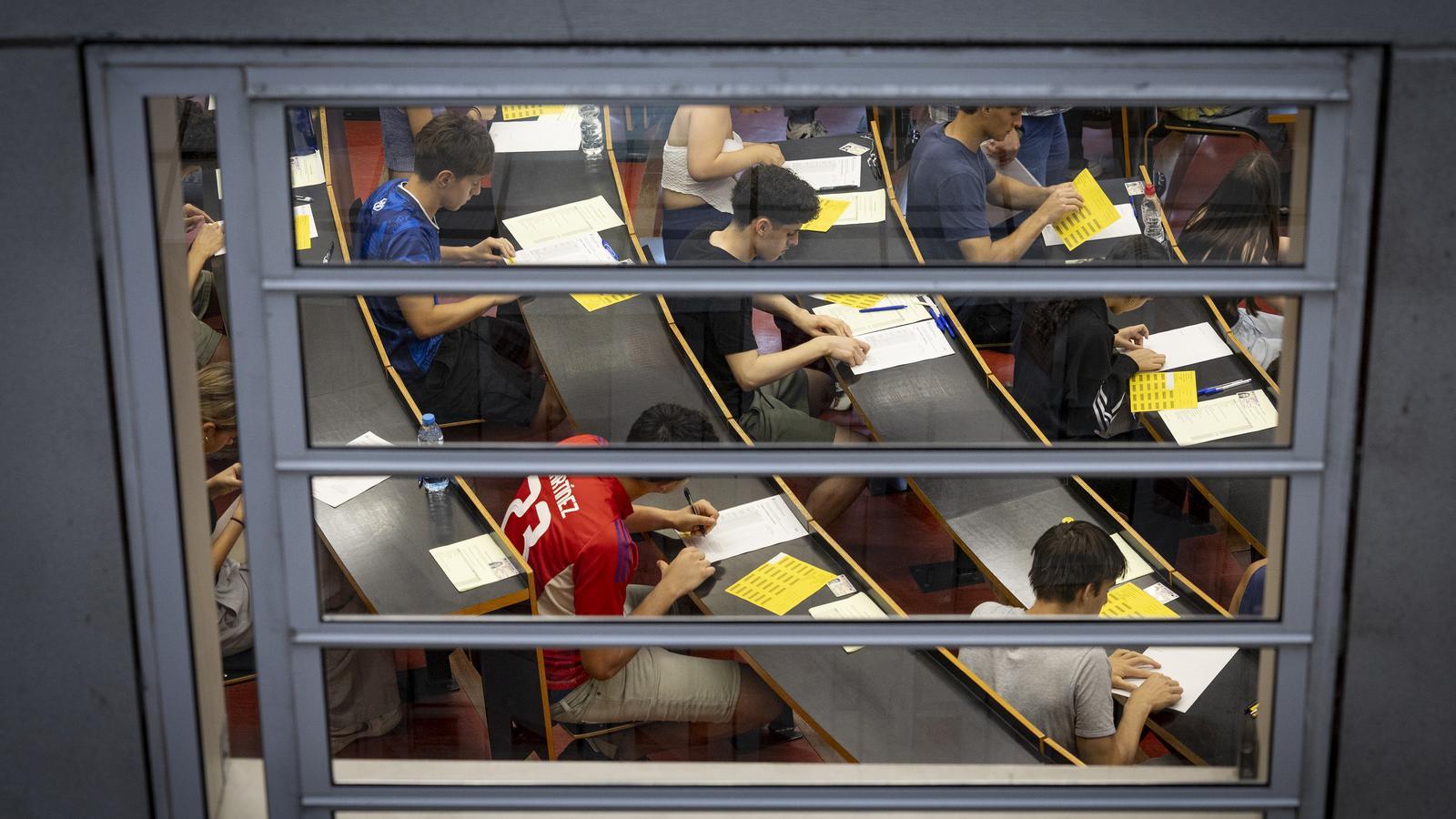

BarcelonaEnd of the 2026 PAU exams, marked by the coincidence with the Pope's visit to Barcelona and the premiere of new detectors for electronic devices —mobile phones, watches, and smart glasses, etc—. Despite this novelty, the Minister of Research and Universities, Núria Montserrat, assured this Thursday that no electronic "device" has been detected in the random checks carried out throughout the tests.
The last day of the selectivity began with the Catalan language and literature exam, which generated joy, relief, and, for some, a certain euphoria. "It was the easiest of all," assured Bruna from the Moisès Broggi institute in Barcelona as she left the exam. An exam that, after the mandatory readings were eliminated last year, featured an unsigned text from the website of a real health insurance company. In fact, the reading comprehension exercise in the Catalan test that all PAU students must take is an adaptation from the text Microplastics: how they affect health from Atlàntida Assegurances.
On the other hand, in the literary study section, students had to answer questions about The Domestic Tree from Chronicles of Hidden Truth by Pere Calders, and in the closed questions, The Count of Arnau and The Ballad of Mr. Esteve appeared. All in all, an exam in which no female author of Catalan literature appears or is mentioned.
As for the true or false section, aspects such as whether the terms "hyperbole" and "hyperbaton" are synonyms, whether a soliloquy is a play performed by more than one character, or whether onomatopoeia is a syntactic rhetorical figure were asked.

Nothing/anything, so/as much
In the linguistic reflection section there was a section where it was necessary to analyze pronouns, sentences and phrases and five questions where it was necessary to complete sentences choosing between res/gens, tant/tan, perquè/per què, que/què and si no/sinó. In addition, it was also asked to complete sentences with the appropriate verb form of concebre, interrompre, cabre, néixer and saber.
On the other hand, in one of the exercises, adolescents had to identify and correct five errors in the sentence: «Ves-t'en ara mateix per tal de que puguis agafar el primer tren. Quant surtis, tanca bé la porta. Ja saps que els lladres no tenen escrupols alhora d'entrar a robar.» Here, the statement already warned that if the student pointed out more errors than necessary, the question would be directly scored with a zero.
Finally, there was a short text in which it had to be identified to which dialectal variety of Catalan it belonged (rossellonès, central, nord-occidental, valencià, balear or alguerès), and in the written expression section, it was asked to rewrite a text by changing the present verb tenses to imperfect forms.
A controversial video of a doctor, in social mathematics
After the drama of the scientist's mathematics this Wednesday, one of the fears of this Thursday's session was the applied mathematics for social sciences test. However, the feelings upon leaving had nothing to do with Wednesday's. "The best exam of my life," celebrated one of the students from Institut Mireia, while a classmate of hers cried and assured that it was "too" difficult. However, the teacher accompanying them defended that the exam "was indeed manageable".
The test included a series of exercises where students had to calculate the evolution of followers of a doctor who published a controversial video on social media, which harmed him, and then made a new one that was very successful. There were also problems where students had to calculate the price of boxes of various fruits from a farmer or analyze how the loading time of a web page varied.
In the afternoon, it was time for the last exams of this year's university entrance exams, all in elective subjects: chemistry, technical drawing, art history, history of music and dance, Castilian literature, and graphic-plastic expression techniques.
