The storm punishes Barcelona puts five more regions on alert
The downpours force the cutting of the Ronda de Dalt and the B-20 and the cancellation of about twenty flights
BarcelonaThe storm has caused a very complicated night in Catalonia, especially in the Barcelona area. At 9:30, the Government sent an Es-Alert to phones in the Barcelonès and Maresme regions warning of the risk of flash floods. A torrential rain that has caused mobility problems in the Catalan capital, where it was necessary to cut off the Ronda de Dalt in both directions and the B-20. Also in Santa Coloma de Gramenet in the direction of Mataró, where cars have been seen trapped by the floods. All this has generated a very difficult situation on the roads. At eleven, the Government sent an Es-Alert message to five more counties—Baix Llobregat, Alt Penedès, Baix Penedès, Garraf, and Vallès Occidental—warning of the risk of heavy downpours. At 11:30, the firefighters had accumulated almost 200 alerts due to the storm.
Apart from the roads, the rainfall is also hindering rail traffic. Renfe has reported that lines R2, R3, and R4 may accumulate delays of up to twenty minutes because weather conditions force trains to travel at a slower speed. On the R4, circulation has been interrupted between Fabra i Puig and Montcada Bifurcació. It has also been necessary to temporarily close some metro stations due to water accumulation, such as Sant Andreu, Fabra i Puig, and Trinitat Vella on Line 1. Regarding El Prat airport, up to 23 flights have been cancelled due to the rains. Furthermore, the company's website shows dozens of delayed flights at the same Catalan infrastructure.
Flooding at Vall d'Hebron Hospital
The downpour has also caused flooding in the basements of the three buildings of the Vall d'Hebron Hospital, which also saw how the rain caused part of a false ceiling to fall in the pediatric nephrology ward, without any patient impact reported so far. As a precaution, there have been some transfers to other areas.
The storm—which was accompanied by lightning and thunder—has also left 570 subscribers without electricity in the Catalan capital. Sources from the electric company Endesa have explained to the ACN that company workers are working to resolve the situation as soon as possible. Civil Protection indicated on the X network that at the moment of maximum intensity, the rain caused six incidents in the electricity supply that affected 7,696 users. Once this moment passed, which lasted a short time, service was restored for the majority of those affected.
The changing scenario has meant that throughout the evening, warnings from the Meteorological Service of Catalonia have been issued one after another. At 8:30 p.m., the Meteorological Service of Catalonia issued a warning for violent weather with the possibility of hail larger than two centimeters, wind gusts of more than 25 meters per second, and the possibility of downbursts, tornadoes, or waterspouts in the Baix Llobregat and Garraf regions. Fifty minutes later, the warning was for the Barcelonès and Maresme, where according to Meteocat there may be torrential rains that could leave more than 40 millimeters in 30 minutes. The storm is now moving towards the Alt Penedès and the Anoia, where Civil Protection has also warned of the risk of hail, wind gusts exceeding 90 km/h, downbursts, and tornadoes.
Before, the storm had made itself felt strongly in the Gironès region, where the rains have left more than 40 litres per square metre in half an hour, according to Meteocat. The agency has issued a warning for the observation of intense rainfall exceeding this threshold in the area and has alerted that the downpours are very static. In some cases they have been accompanied by hail. The Fire Department has recorded about fifty services between three and eight in the afternoon, mostly in Girona, due to leaks and water accumulations. In Fornells de la Selva, 48.6 litres were recorded in 30 minutes.
At five-thirty in the afternoon, rain gauges showed readings such as the 48.6 litres mentioned in Fornells de la Selva, 27.4 in la Bisbal d'Empordà, 26.1 in Banyoles or 21.2 in Cassà de la Selva. In the northwest of the country there have also been some notable figures, such as the 22.9 litres in Vielha.
Where the storm has also hit hard is in Valencia, which has once again experienced images of flooded streets and cars trapped on the road and which even had to momentarily close the airport due to flooding.
Civil Protection Tips
Civil Protection reminds us of the basic self-protection advice in case of torrential rains, such as reducing travel as much as possible and trying to avoid flood-prone areas and crossing rivers and streams. In fact, at 6:15 p.m., the emergency management agency reported that due to persistent rains in the Girona regions, the Catalan Water Agency has issued a hydrological risk warning for the Ter basin. The Alert threshold of the Terri River in Cornellà de Terri has been exceeded with a maximum flow of 17 cubic meters per second, although subsequently the volume of water has decreased to 5.22.
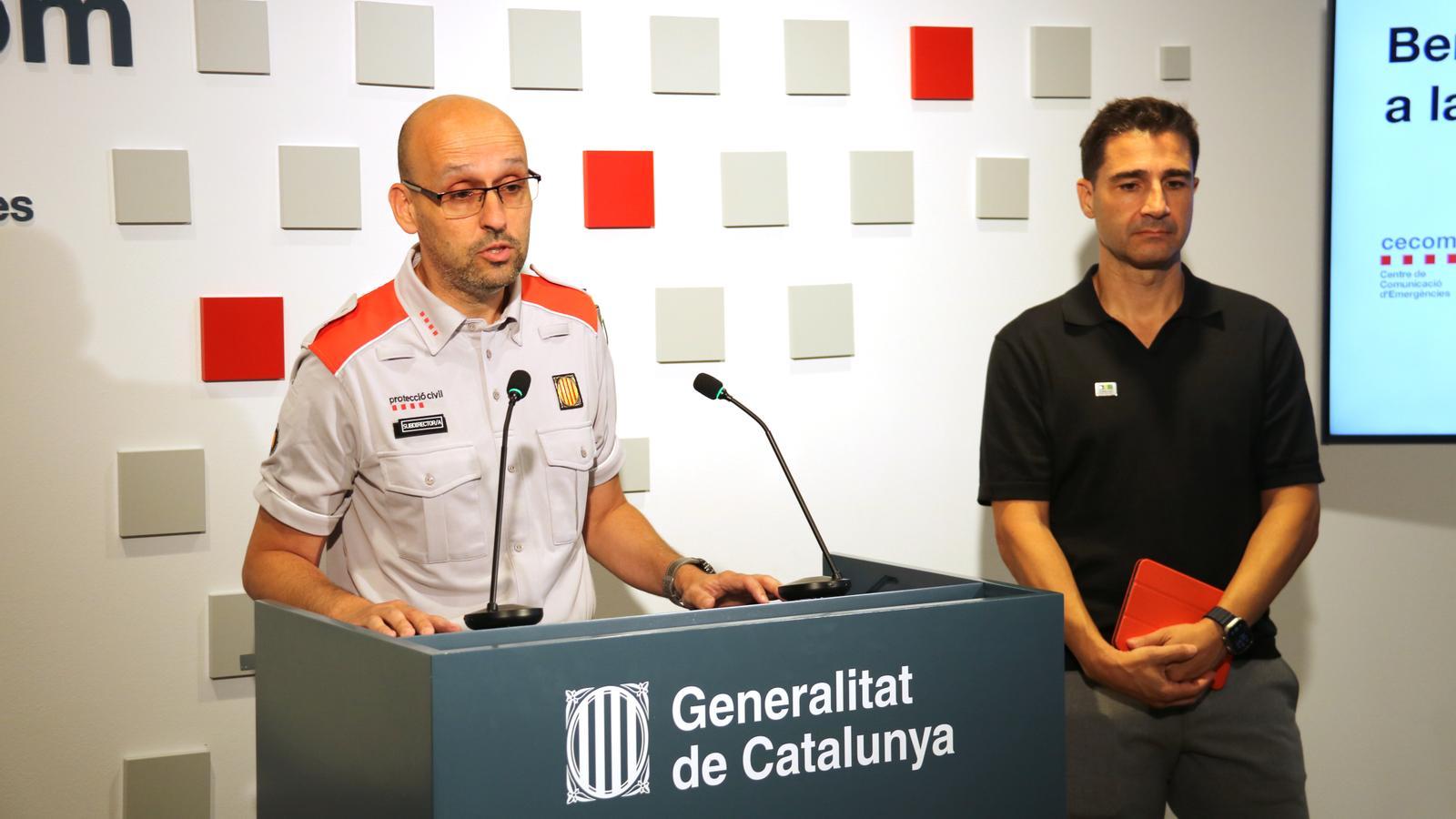
The deputy director of Prevention for Civil Protection, Joan Ramon Cabello, explained that the Inuncat plan is activated in the alert phase and recommended that, if travel is necessary, it should preferably be done via main roads and that low-lying areas, fords, and crossings with rivers and streams should be avoided. The head of the Meteocat Prediction Area, Santi Segalà, remarked that it is a situation "limited in time," with special attention during the afternoon, evening, and the first hours of the night, and has asked to consult the radars and warnings from Meteocat. "It is a day to stay alert" to the precipitation, he noted. Segalà also appealed to civic responsibility and recommended following official channels to track the rain episode.
