Will artificial intelligence be able to create life?
Synthetic biology begins to use AI to define possible new organisms

-
CAT -
CAST
Lately, artificial intelligence has become the protagonist of our lives, to the point that it seems we are constantly talking about it. It's impossible to find someone who, at one point or another during the day, doesn't use it: from the most innocent Google search to the report we're too lazy to write, soon we won't know how to live without the help of one of the most revolutionary tools ever invented.
In science, AI has been omnipresent for a few years. Two Nobel Prizes in 2024 were precisely for innovative applications in this field: chemistry for a program that predicts protein structure and the physics for the foundations of machine learning, the protocols that allow AI to learn on its own. And this is just the tip of an ever-growing iceberg that spans all disciplines. It was only a matter of time before AI reached synthetic biology.
This discipline studies the creation of life in the laboratory. It began in the early 20th century, but its main successes began to arrive from 2010 onwards, when the company of the recently deceased J. Craig Venter created the original version of Synthia, which would come to be considered the first artificial organism. It is a bacterium with a genome designed from scratch and generated by a machine; it was then inserted into a cell without DNA, which began to function like any other microbe. The key to this experiment was to determine the minimum set of genes that were necessary for life.
From bacteria to complex organisms
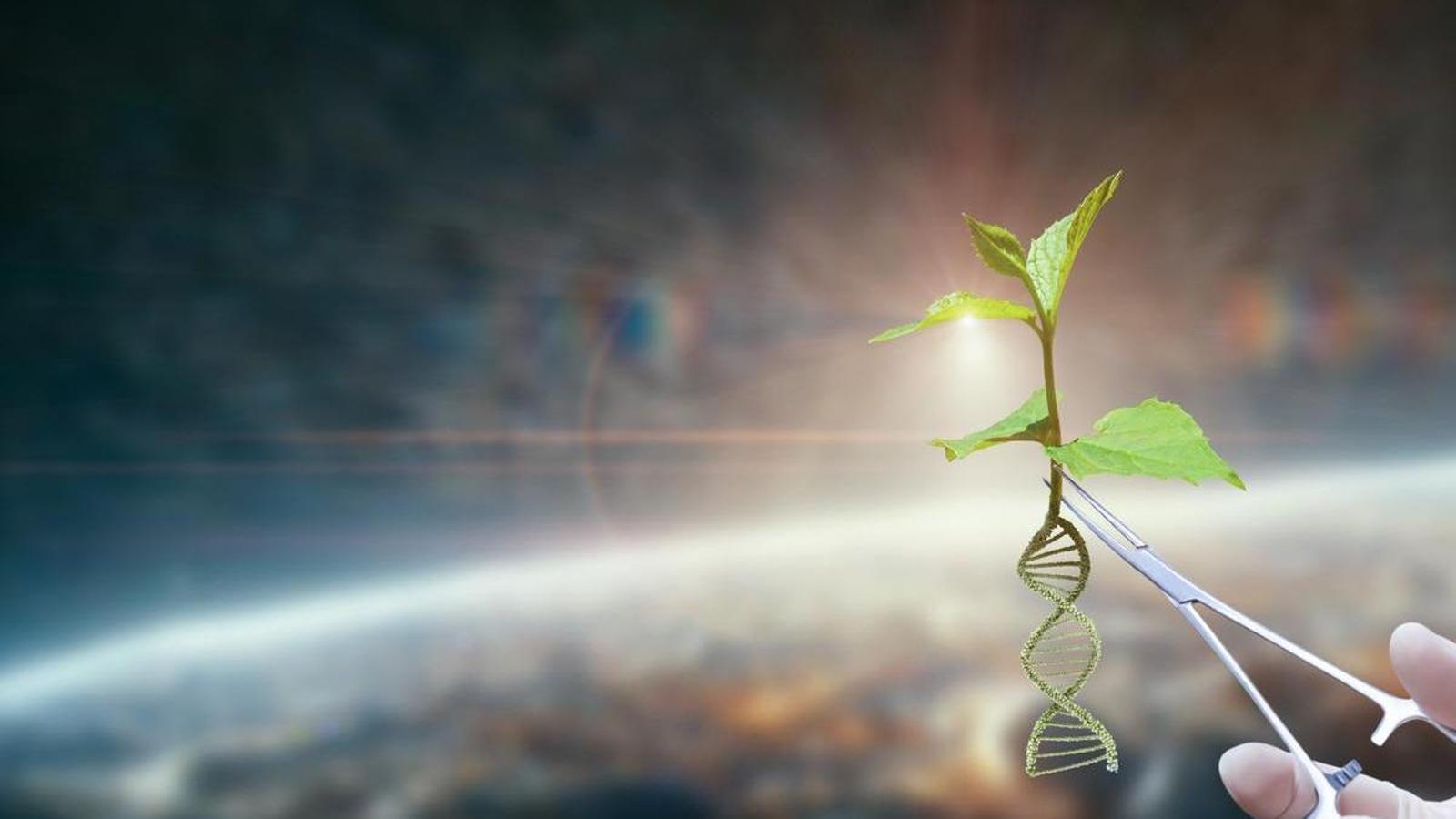
But a bacterium is a relatively simple organism, with a normally small genome. Could the same principle be used to create more complex living beings? This is where the power of AI seems to be especially useful, because its great ability to recognize patterns allows it to virtually build genomes and predict how they would work if they were inside a cell; what proteins they could make, and what functions, existing or new, they could perform. The simplest application of this idea could be to create plants like those that already exist, but resistant to all pests, for example: a kind of improved version of current transgenic plants. But if we are more ambitious, we could also think about designing organisms that do not exist, such as microbes capable of cleaning plastic from the oceans.

An important step towards this scenario was taken a few weeks ago, when the Arc Institute, Stanford University, and Nvidia published Evo-2, a free AI model that allows scientists to write entire chromosomes and even small, entirely invented genomes. Evo-2 has been trained on 128,000 genomes of all kinds of organisms, including our own, and is considered the largest AI-based biological model in existence. The main innovation is that it can generate both the parts of the genome that contain information for making proteins and the so-called dark DNA, whose functions we don't yet fully understand but which is certainly more important for life than we thought a few years ago.
They have already used it to design possible new microbes, but the idea is that it can end up proposing genomes as complex as ours. For the moment, last year a project was launched in the United Kingdom to build the first synthetic human chromosome, with a budget of ten million pounds. In principle, Evo-2 could go further and design an entire human genome, changing, for example, weak points that make us not well protected against diseases or infections. Perhaps it could create a genome resistant to the harshness of outer space to give life to a race of stellar explorers.
All this is still science fiction, because AI does not know enough to predict the behavior of interconnected genes in a regulatory network as intricate as that of our species, nor how it will evolve depending on the impact of the many environmental factors that can influence it. But seeing the speed of the progress it is making, it is not unreasonable to predict that one day we will reach this point. And then we will have to decide whether we want to continue down this path or not.
If synthetic biology is already a field that normally arouses a lot of ethical doubts, from the protests of religious people who see it as an attempt to play God to those who fear it will be misused to create terrible biological weapons, the irruption of AI threatens to multiply the problems exponentially. A technology that is capable of accelerating and magnifying practically any advance can also bring us more quickly towards the abyss if we are not clear about where we want to go. But a rational use of these tools applied to disciplines that are already groundbreaking in themselves, such as synthetic biology, can also lead us to a future in which many of the health and even social problems we currently suffer can be improved. Time will tell if redesigning microbes, animals, or perhaps humans themselves from scratch is the way to do it.
