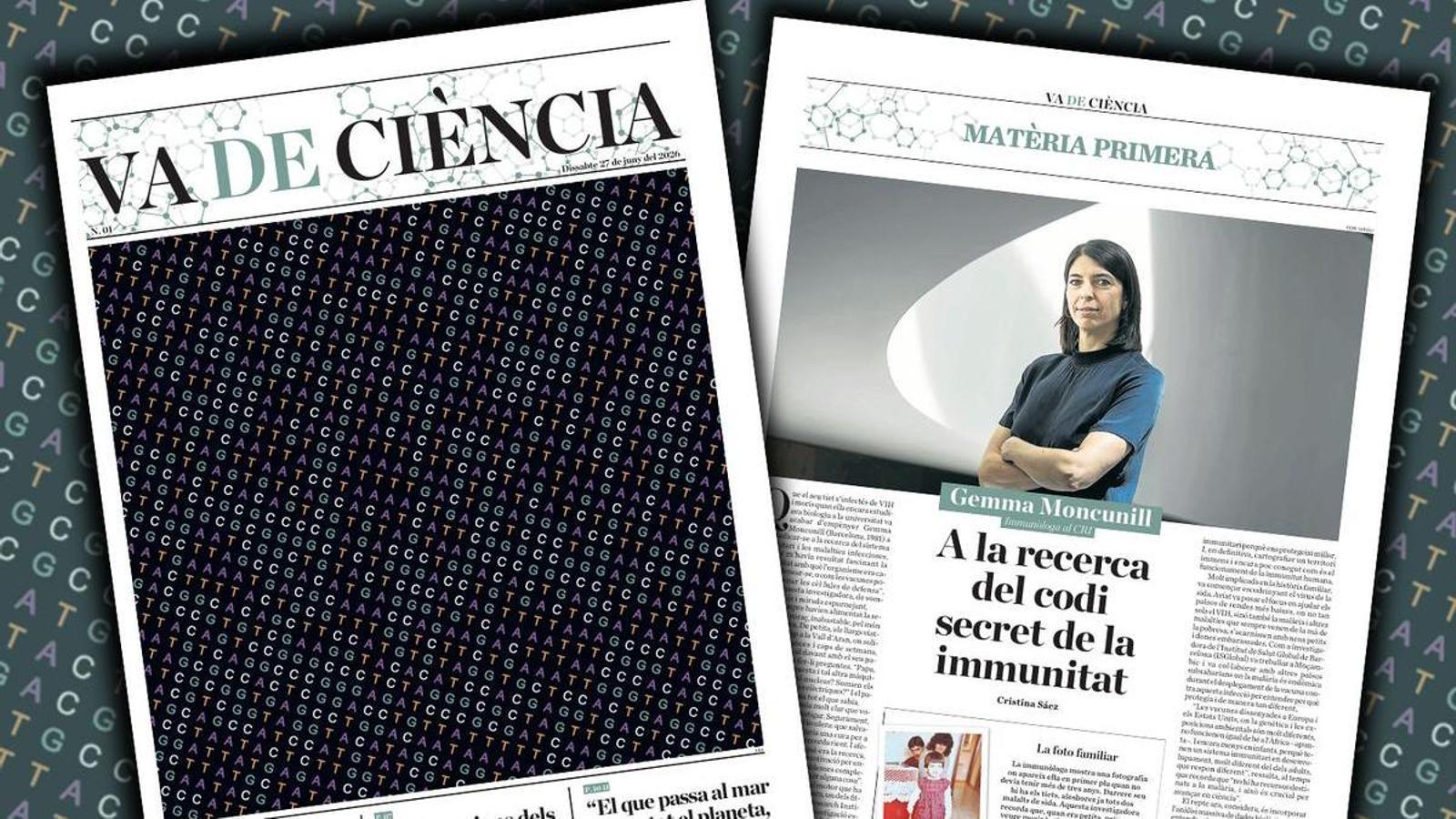
'Va de Ciència', the new supplement of ARA dedicated to research
It will be published the last Saturday of each month
-
CAT -
CAST
"We are living in a time when science is more necessary than ever," explains Cristina Sáez, the science specialist at ARA and now also director of the monthly supplement Va de Ciència, which publishes its first issue this Saturday.
"In an environment saturated with misinformation, fake news, and simplistic discourse, scientific knowledge is an essential tool for understanding the world and making informed decisions. But science is not just an antidote to misinformation: it is also a source of progress, hope, and collective debate," adds Sáez, who has designed a supplement that focuses on disseminating research, especially that carried out in Catalonia, but also from elsewhere, emphasizing major debates and the work of researchers.
"We are in an extraordinary phase, marked by advances that only a few years ago seemed like science fiction: gene editing, artificial intelligence, new personalized therapies, or the fight against climate change," says Sáez. These advances open up immense opportunities, but also raise ethical, social, and political questions that concern us all. As a society, we cannot leave these debates exclusively in the hands of scientists, technologists, or companies. We need informed citizens, with a critical spirit and the capacity to participate in the decisions that will shape our future. This is precisely the objective of Va de Ciència: to bring scientific knowledge closer to everyone, explain it with rigor and context, and contribute to building a freer, more critical citizenry, better prepared to face the great challenges of the 21st century.
The twelve-page supplement will be published on the last Saturday of each month and will be an expanded and more complete version of the weekly supplement that has been published every Saturday for over a decade. "In fact, the supplement was born out of the frustration of seeing how every week there were very powerful and interesting science topics and we didn't have space in either the newspaper or the supplement to cover them," recalls Sáez. "With the complicity of the newspaper's deputy editors, I sought external funding to make this dream possible."
The supplement maintains the format of major reports – the first will be dedicated to analyzing whether the expectations of the human genome have been met in the last quarter of a century –, in-depth interviews and current news, and also incorporates various monographic sections. It begins with the section En òrbita, which will collect the opinions of two scientific voices each month. It continues with Coordenades, a selection of events, acts, films, books, and exhibitions related to science, coordinated by La Mandarina de Newton, and concludes with a section called Matèria primera, with which it is intended to give a somewhat special touch to the way science and research carried out by researchers in Catalonia is presented.To create the supplement, in addition to the contributors to the science section –Salvador Macip, David Bueno, and Gemma Marfany–, other researchers have been incorporated, such as Gemma Parramon, Ricard Solé, or Ignasi Ribas. Also scientific journalists, who will vary depending on the issue: Raquel Villanueva, Xavi Duran, David Segarra, Hèctor Garcia, Núria Jar, Júlia Bestard, Irene Lapuente, or Toni Pou. The aim is to gather many voices to ensure a diversity of contributions that showcase the richness of the Catalan scientific ecosystem.
