The trial begins for four officers for emptying an eye of Roger Español, the only police officers tried for the 1-O
The accused will testify on the day of the ninth anniversary of the charges and face 13 years in prison
BarcelonaNine years after the 1-O, four national police officers sit this Wednesday in the dock for the rubber bullet that blinded Roger Español in one eye. They are the only officers who will be tried for the charges of a day with a thousand injured. The Prosecutor's Office has requested their acquittal because it believes they were doing their job and the State Attorney's Office is defending them. Even so, Español's complaint and the popular accusations of Irídia, the ANC and Òmnium have caused the case to reach the trial that begins this Wednesday, in which the officers face sentences of up to 13 years in prison and disqualification for the crimes of torture and injuries with the loss of an organ.
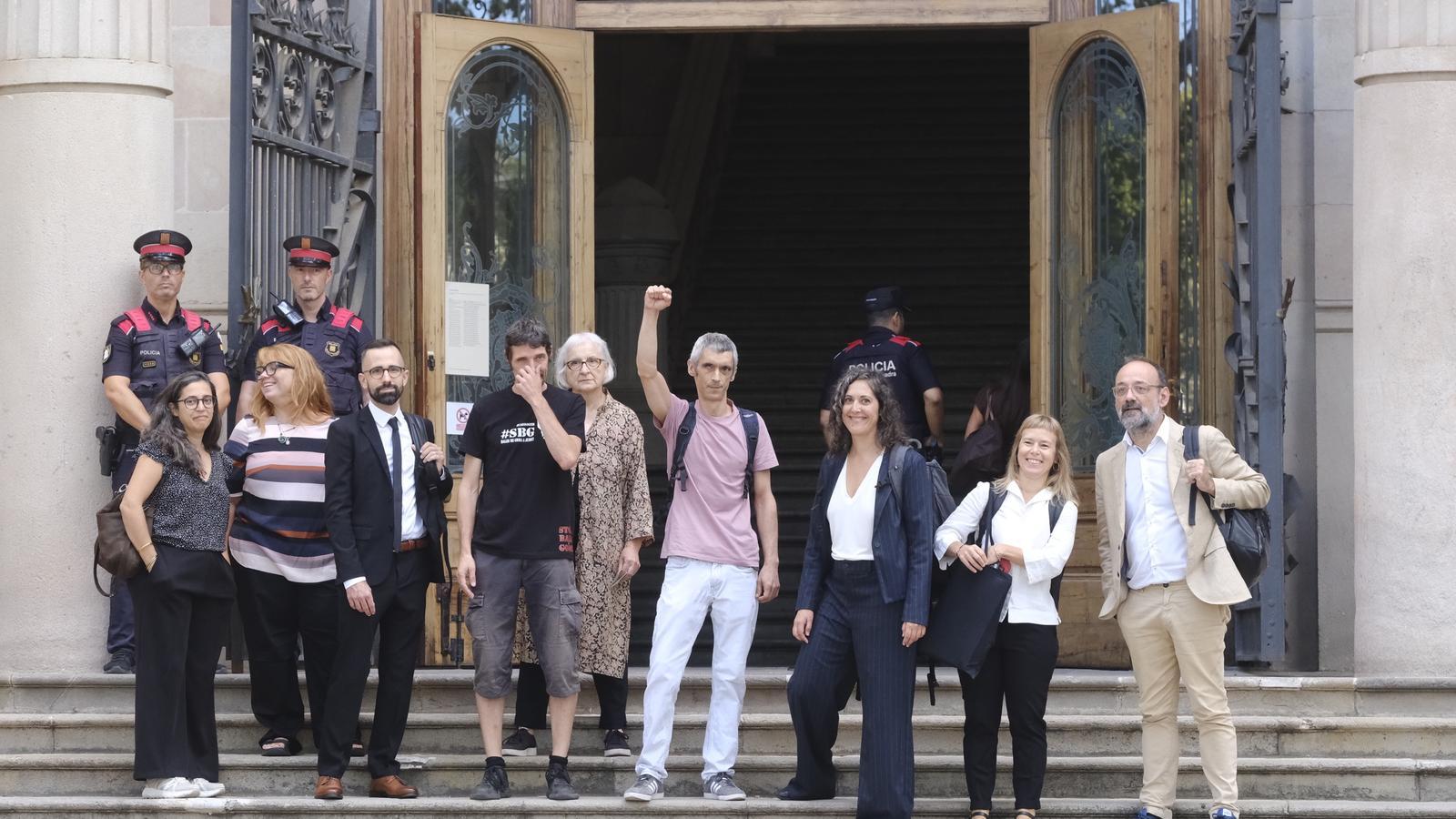
Español arrived at the Barcelona Court accompanied by his lawyer, Benet Salellas, and dozens of people who came to support him at the start of the trial. "We have all the evidence that proves us right, we would not understand any resolution other than one of guilt," he said before entering the trial. "I hope that this resolution of guilt serves for all those people who could not have recognition, justice, or reparation for October 1st and so that a step forward is taken in the prohibition once and for all of those cursed rubber bullets," he added.
The accused are the shotgunner who fired the rubber bullet, the inspector who led the operational group, and two sub-inspectors who acted as deputy heads of the riot police group. The three commanders ordered and authorized the use of rubber bullets. The officer who fired and the three superiors were among the 10,000 police and civil guards that the State sent to Catalonia for the referendum. Unlike the 46 officers investigated in another case for the charges of 1-O, these four police officers have not benefited from the amnesty law, because it does not cover injuries of this severity.
Español will testify at the beginning of the trial and the case witnesses –among whom are about fifty officers– will do so between this Wednesday and Thursday. Afterwards, the trial will not resume until two weeks from now, on Wednesday, September 30. This will cause the last day of the trial, when the defendants will testify, to coincide exactly with the ninth anniversary of October 1, 2017, the day that the impact of a rubber bullet mutilated Roger Español's eye at the Ramon Llull School in Barcelona. For that day, a mobilization is planned at the Arc de Triomf, in front of the Barcelona Court, where the case will be judged.
Throughout the entire investigation of the case, Español was also pointed out in this same cause. The Prosecutor's Office wanted him to be tried for assault against the officers for having thrown a fence, but the Barcelona Court ruled it out. During the trial, the role of the prosecutor –who usually represents the public prosecution– will not be against him nor against the police, because he asks for them to be acquitted. Español also requests 320,632 euros in compensation from the police and the Spanish government.
The intention and role of the superiors
A central element of the trial will be the intention with which the shotgunner acted. Specifically, whether he shot with the intention of harming and "punishing" Español, as the accusations state, despite being aware of the risk involved. The shotgunner fired three times towards the place where Español was, at a distance of 14 meters, and the third rubber bullet was the one that hit him in the eye. The scene was recorded in the footage by the journalist from La Directa David Bou. The fact that he fired three times has also led the judges who have intervened so far to think that the action could have been intentional.
The role of the three superiors will also be key. The accusations consider them co-authors because the shotgunner fired "by mutual agreement" with the three superiors, who had given the orders to use rubber bullets at a time when, according to the judges who sent them to trial, "it was not appropriate, nor necessary, nor relevant at a clearly dangerous distance".
Representatives from six international human rights organizations will follow the trial to assess whether it is given the guarantees of a "fair and impartial" trial. There will be members from Amnesty International, the World Organisation Against Torture, the International Network of Civil Liberties Organizations, Redress, the International Coalition for Human Rights and Defender a quien Defiende.
